height build
Height
Likely slightly above average height for his time
Roman male averages were modest; literary sources and his role as a leading general suggest a presence and posture that conveyed tallness relative to peers.
Portrait reconstruction
100 BCE–44 BCE · Roman Republic (Italy) · Late Roman Republic
Julius Caesar likely looked like a lean, middle‑aged Mediterranean man with thinning forward‑combed hair, a prominent aquiline nose, and sharp, angular features.
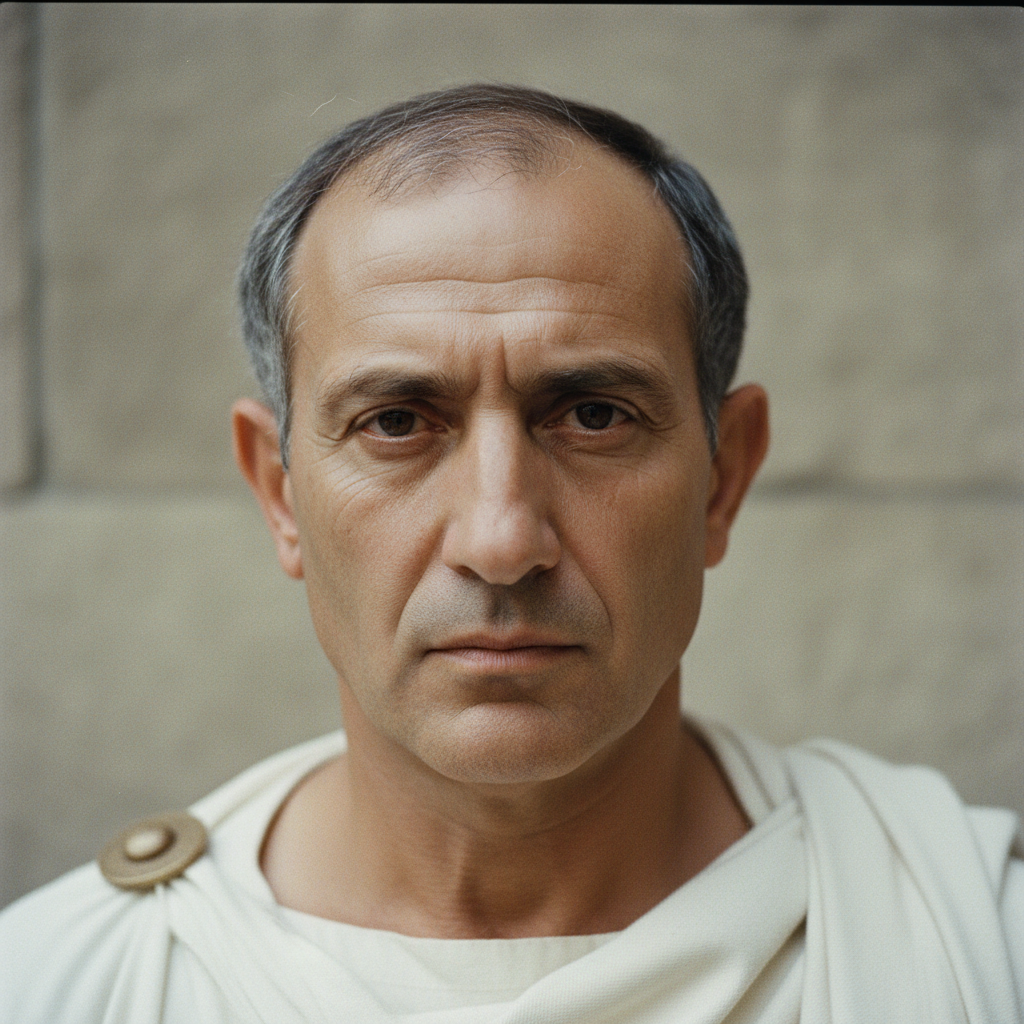
His face was angular and taut: high cheekbones, a prominent, slightly hooked (aquiline) nose, and a firm, narrow jaw. Portraits emphasize a tight, serious expression—lines of determination rather than softness. Hair was a notable feature: a receding hairline with short, forward‑combed strands across the forehead—often rendered as thinning or balding at the crown; he was probably clean‑shaven, as Roman elite men of his era usually were. Modern reconstructions of his portraits suggest likely dark hair kept short and neat. Complexion and build fit a Mediterranean Roman of his class—olive to medium skin, a lean, fit body rather than bulky, and an upright, energetic posture that matched his public presence as general and statesman.
Height / build
Likely slightly above average height for his time · Likely lean and athletic
Hair
Likely dark to graying · Likely straight to slightly wavy · Receding and thinning, often shown with short hair combed forward
Eyes
Likely dark (brown)
Complexion
Likely Mediterranean (olive to light-brown)
Face
Long, angular face with defined cheekbones · Prominent, slightly aquiline nose
Notable features
Receding hairline, thin forward-combed fringe, prominent aquiline nose, sharp cheekbones, intense eyes
Grooming
Probably clean-shaven · Short hair, closely cropped and combed forward to cover thinning, and the clean-shaven face expected of Roman elites.
Dress / presentation
Elite Roman dress (toga for civic life; cloaks/paludamentum for military portraiture)
height build
Height
Likely slightly above average height for his time
Roman male averages were modest; literary sources and his role as a leading general suggest a presence and posture that conveyed tallness relative to peers.
height build
Build
Likely lean and athletic
Active military campaigning and constant public duties point to a wiry, fit physique rather than heavyset bulk.
hair
Hairline
Receding / thinning, combed forward
Multiple portrait types and busts show a pronounced receding hairline with short hair styled forward to obscure thinning.
hair
Hair color
Likely dark to graying
Mediterranean ancestry and period portraits indicate dark hair that lightens with age around temples.
eyes
Eye color
Likely dark (brown)
Most central Italian populations of the period tended to dark eyes; no surviving evidence suggests light eyes.
face
Nose
Prominent, slightly aquiline
In Caesar’s world the most admired look combined dignity, self-control, and a hint of martial toughness. Men of rank displayed neat, short hair, clean-shaven faces, and sober dress. Portraits emphasized a commanding expression more than flawless beauty—appearance was a tool of authority.
Imagine a central‑Italian man with olive skin, dark eyes and hair that greys with age—features common among Rome’s patrician families. Wealth and status meant careful grooming and clothing (finely woven togae and military cloaks) that visually signaled rank in any public setting.
Modern films often exaggerate baldness or add full beards; the historic image is of a receding but present fringe, clean-shaven and intentionally austere.
Films and cartoons often show Caesar as totally bald or with a flowing mane; historic portraits instead show a pronounced, receding hairline with a short forward-combed fringe. Also, full beards are a later fashion—Caesar is usually clean-shaven in contemporary images.
Likely slightly above average height for his time—he would have presented as taller than many contemporaries because of posture and bearing.
Likely dark (brown).
Likely dark hair, straight to slightly wavy, graying at the temples and thinned at the front.
Not fully bald—portraits show a receding, thinning hairline with a short forward‑combed fringe rather than complete baldness.
Probably clean‑shaven, following Roman elite custom of the period.
Yes—coins and multiple independent marble portraits show consistent features (receding hairline, prominent nose, angular face) that form the basis of his recognizable image.
Tusculum bust
Tusculum portrait · mid‑1st century BC (Roman Republic)
A well‑known marble portrait showing a receding hairline, short forward‑combed hair, an angular face and a prominent nose—widely treated as an authentic likeness of Caesar.
Vatican / Capitoline portrait type
Vatican/Capitoline busts · late 1st century BC to early 1st century AD
Several marble busts in Vatican and Capitoline collections show the same facial template—sharp cheekbones, aquiline nose, and thinning front hair—reinforcing the Tusculum image.
Denarius and Republican coin portraits
Caesar coin portraits (44–46 BC) · 46–44 BC
Silver coins struck in Caesar’s lifetime bear a realistic profile with a receding hairline and strong nose—important because they were made while he lived and circulated publicly.
Plutarch, Life of Caesar
Plutarch · c. 1st–2nd century AD (biography)
Provides character descriptions and anecdotes that shaped later impressions of Caesar’s bearing, energy, and striking presence though written centuries later.
Suetonius, The Twelve Caesars
Suetonius · early 2nd century AD
Includes remarks on Caesar’s appearance, demeanor and baldness/hair loss remedies used by him—useful for matching portrait features to literary memory.
Modern forensic reconstructions based on Tusculum bust
Modern forensic reconstructions · 20th–21st century
Recreations that translate marble features into fleshed faces show a middle‑aged Mediterranean man with thinning hair, strong nose, and taut cheek structure.
Consistent depiction across coins and marble portraits shows a strong, projecting nose.
grooming
Facial hair
Probably clean-shaven
Republican Roman elite custom favored a clean-shaven face; portraits and coins show no beard.
skin
Complexion
Likely Mediterranean (olive to light-brown)
Central Italian ancestry and contemporary population pigmentation patterns imply an olive complexion.
clothing
Typical dress
Elite Roman toga or military cloak (paludamentum) in images
As a statesman and general he would be portrayed in civic dress for public office and cloaked in military garb for triumphs.
other
Expression / bearing
Serious, focused, commanding
Portraits and descriptions stress gravitas and a concentrated gaze, consistent with his reputation for single-mindedness.
face
Age appearance
Late 50s—mature with graying temples
Most surviving portraits date from his final years and show middle‑aged features with some graying.
Triumphal and honorary portrait statues
Roman statues and reliefs · late Republic / early Empire copies
Larger public images depict Caesar in senatorial or military dress, reinforcing civic and martial clothing choices seen on coins and busts.