height build
Height
Likely tall for his time
Medieval accounts present Arthur as an imposing leader; leaders in warrior cultures tended to be above average height and stature.
Portrait reconstruction
0–0 · Britain (traditionally western Britain/Wales, Cornwall) · Sub‑Roman Britain (5th–6th century, legendary figure)
King Arthur most likely looked like a dark‑haired, broad‑shouldered war‑leader in his thirties or forties, clad in a richly fastened cloak and armed for battle.
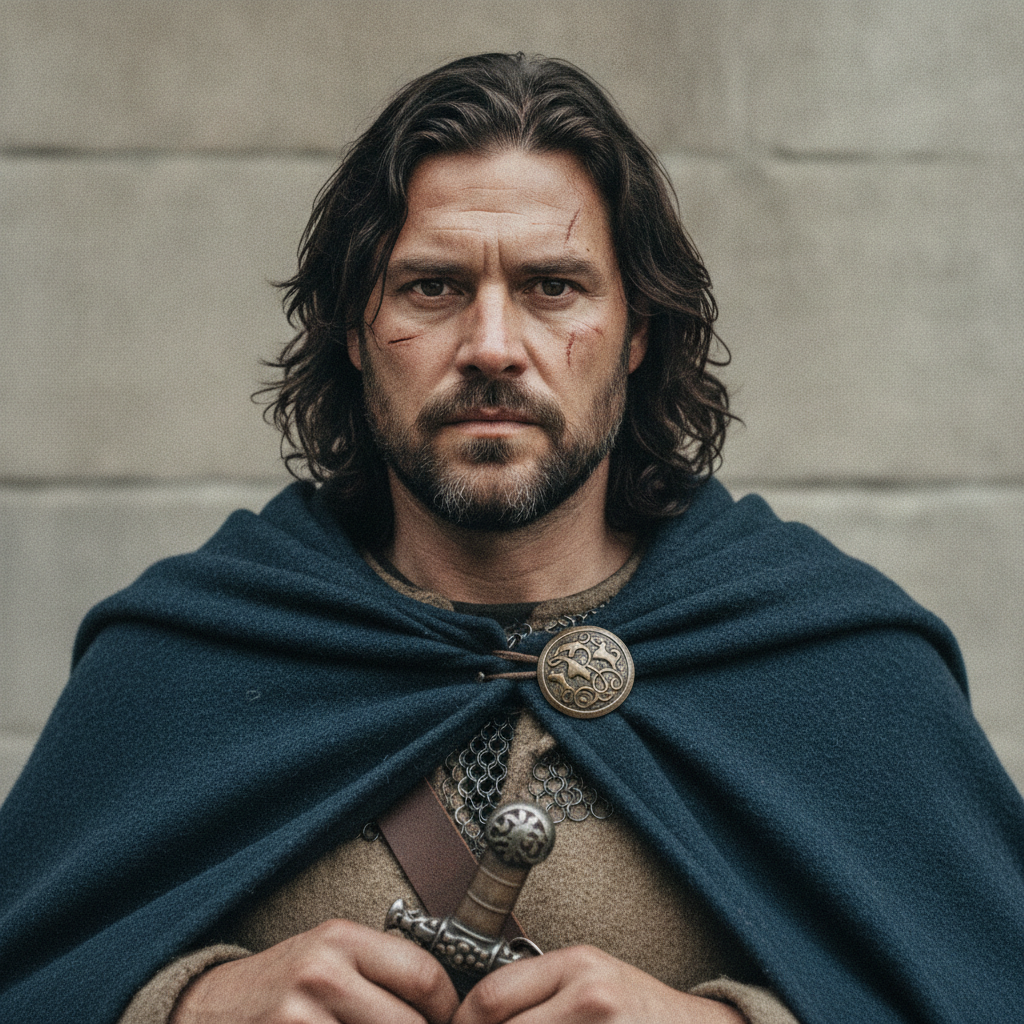
Hair and head: Likely dark hair—brown to black—worn at about shoulder length or slightly shorter, kept tidy or tied back for riding and fighting; a neatly trimmed beard or close stubble would suit a leader who needed to be both imposing and practical. Eyes were probably dark brown, with a weathered, focused expression born of campaign life. Build and face: Compact but powerfully built—broad shoulders, dense musculature from horseback riding and melee combat rather than tall, gaunt height; a square jaw, high cheekbones and a nose that bears the marks of past blows would give a commanding profile. Skin tone would be medium—sun‑bronzed from time outdoors—showing the scars and lines of a seasoned warrior. Clothing and equipment: He would wear a substantial woolen or linen tunic beneath a wealthy cloak fastened by a decorative brooch or fibula, with sturdy trousers and leather boots for riding. His sword would be a prized, well‑made weapon at his hip, paired with a shield and possibly simple mail or layered leather for protection; horse trappings and a visible sign of rank—such as a circlet, torc, or ring—completed the look.
Height / build
Likely tall for his time · Likely robust / athletic
Hair
Likely dark to dark brown · Likely wavy · Likely full, hair worn long (shoulder length or longer)
Eyes
Likely dark (brown)
Complexion
Likely medium, olive‑to‑pale Mediterranean‑Atlantic tone
Face
Likely oval to square · Likely straight to slightly aquiline
Notable features
Commanding presence, possible battle scars and weathered skin, large hands and forearms from weapon use.
Grooming
Probably clean‑shaven or sporting a short trimmed beard · High‑status grooming: cared‑for long hair, trimmed facial hair or clean face, and signs of warrior grooming (short practical styles rather than elaborate courtly beards).
Dress / presentation
Elite Sub‑Roman/early medieval warrior attire: wool tunic, decorated cloak fastened with a brooch, and when fighting a mail shirt/lamellar, sword and shield.
height build
Height
Likely tall for his time
Medieval accounts present Arthur as an imposing leader; leaders in warrior cultures tended to be above average height and stature.
height build
Build
Likely robust and muscular
A campaign‑seasoned warlord would develop broad shoulders and strong arms from fighting and riding.
hair
Hair color
Likely dark to dark brown
Insular British populations of the period commonly had dark hair; medieval romances and illustrations more often show darker tones or simply do not emphasize blondness.
hair
Hair length & style
Likely worn long (shoulder length or longer)
Long hair was a common sign of warrior status in early medieval Britain and medieval depictions often show Arthur with long hair.
eyes
Eye color
Likely dark (brown)
Brown eyes are the most common among western British populations; no strong contrary textual claim survives.
grooming
Facial hair
In Sub‑Roman Britain, masculine authority was tied to martial ability, endurance, and visible signs of service: a weathered but vigorous body, a steady gaze, and practical grooming signaled leadership. Sumptuous ornamentation existed but prestige was often demonstrated by fine weaponry, a strong cloak and a commanding presence rather than delicate courtly fashion.
Arthur would likely have looked like a western British man of the early medieval period: primarily Insular Celtic ancestry with Roman/continental cultural influence, producing dark hair and eyes and a medium skin tone — essentially similar to other inhabitants of Wales, Cornwall and western Britain.
Modern movies often make Arthur overwhelmingly blond, clean‑cut and anachronistically glamorized; the probable historical image is darker, rougher and more practical.
Popular culture often turns Arthur into a blond, clean‑shaven, Hollywood hero or an Edwardian romantic king; historically he was probably darker, rougher, and more rugged — a working war‑leader rather than a polished Renaissance monarch.
Likely tall for his time — portrayed as an imposing leader and plausibly above average stature for an early medieval war‑lord.
Likely dark (brown).
Likely dark to dark brown and worn long (shoulder length or longer).
Probably clean‑shaven or wearing a short, neat beard.
An elite warrior's clothes: wool tunic, decorated cloak fastened with a brooch, and in battle chainmail/lamellar with sword and shield.
No authenticated contemporary portrait or remains exist; this reconstruction draws on medieval descriptions, later imagery and regional archaeological and population evidence.
Geoffrey of Monmouth, Historia Regum Britanniae
Geoffrey of Monmouth · 1136
A highly influential 12th‑century narrative that presents Arthur as an imperial, commanding king and successful general; shapes later visual portrayals though it gives few precise physical details.
Welsh heroic material (e.g., Culhwch ac Olwen, Welsh Triads)
Early Welsh literature and triads · 10th–11th centuries and later manuscripts
Contains early references to Arthur as a heroic figure and warrior; emphasizes martial prowess, hospitality and leadership, which imply a vigorous, war‑seasoned appearance.
Winchester Round Table painting
Winchester Round Table (painted 13th c., refurbished later) · 13th century (painted)
A late medieval painted round table depicting Arthur as a crowned knightly king — influential medieval visual convention showing long hair, royal cloak and martial accoutrements.
Vulgate Cycle and other medieval manuscript illustrations
Medieval romance manuscripts (13th–15th c.) · 13th–15th centuries
Manuscript illuminations repeatedly portray Arthur as a youthful, noble warrior with long hair and regal garments — these images convey later medieval ideals more than historical fact.
Archaeology of early medieval elite dress and weaponry
Archaeological studies of early medieval Britain · 20th–21st century syntheses
Burials and finds show how elites presented themselves: cloaks fastened with brooches, fine swords and horse gear — indicating the practical, martial fashions a leader like Arthur would wear.
Population genetics and osteology for post‑Roman Britain
Archaeogenetic and osteological studies · 21st century research
Genetic and skeletal data characterize western British populations' typical traits (dark hair and eyes, medium skin tones) and provide demographic context for likely appearance.
Probably clean‑shaven or short beard
Many medieval artistic portraits of noble kings show either clean faces or neatly trimmed beards, and warrior grooming favored practical styles.
skin
Complexion
Likely medium, weathered by outdoor life
Insular populations’ typical tones plus prolonged exposure from campaigning produce a sun‑tanned, weathered face.
other
Notable marks
Likely battle scars or weathering
Active combatants commonly carried scars; literature emphasizes his battlefield experience and endurance.
clothing
Typical dress
Elite early‑medieval warrior and ceremonial cloak
As a leader, he would wear high‑status practical clothing: wool tunic, cloak fastened with a brooch, and armed when appropriate.
cultural
Public bearing
Commanding and authoritative
Sources present Arthur as a natural leader and sovereign, which would be expressed through posture, bearing and presence.