skin
Complexion
Likely Mediterranean / olive
As an Israelite from the southern Levant, the most probable skin tone is olive-to-medium, consistent with ancient Levantine populations.
Portrait reconstruction
0–0 · Ancient Israel / Southern Levant · Traditional: 10th century BCE (Ancient Israel)
Solomon likely had olive-brown skin, dark hair and eyes, a neat, well-groomed face, and a stately presence accented by luxurious robes and jewelry.
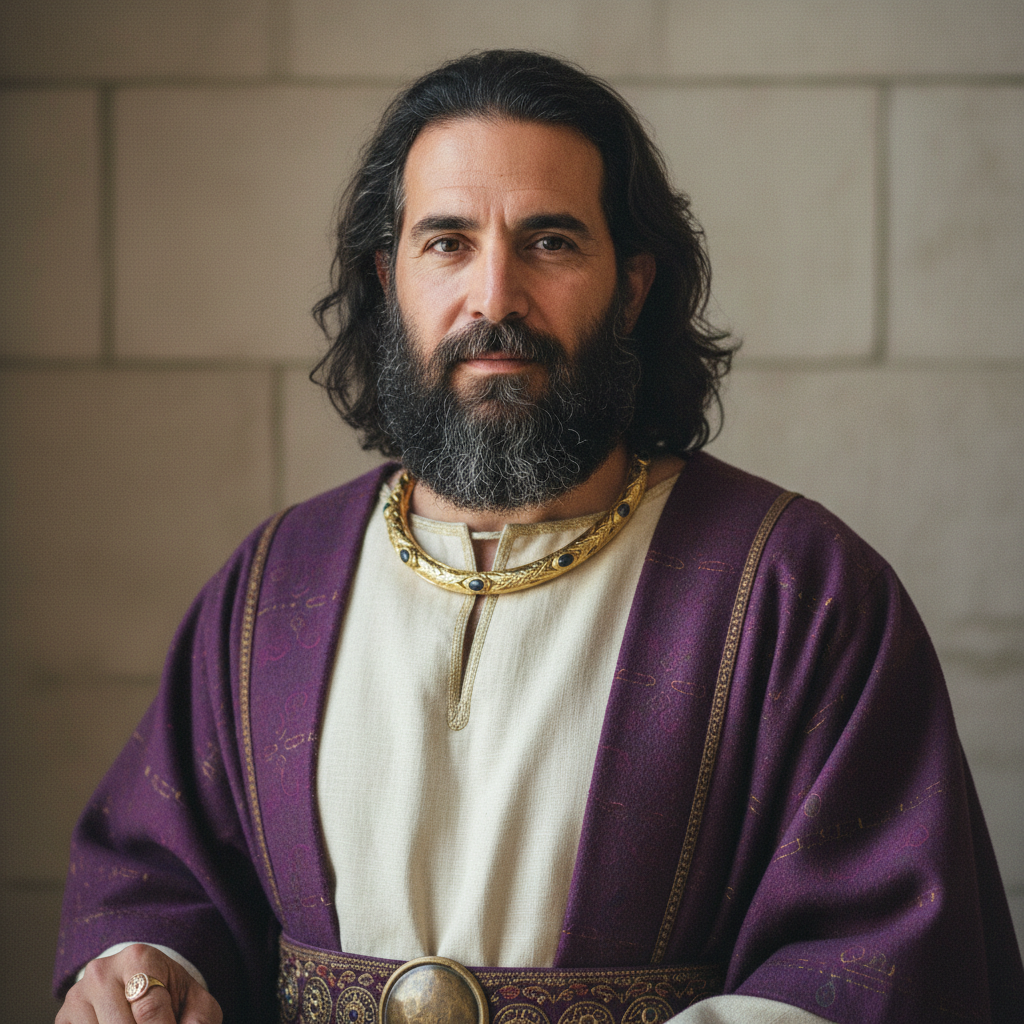
Face and coloring: He most likely had olive to light-brown skin and dark brown eyes—features common in the ancient Levant. His hair was probably dark brown or black, thick and naturally wavy, kept neat as a sign of status rather than long and unkempt. Build and grooming: Solomon would have looked like a well-fed, middle-aged Near Eastern ruler—medium in height by ancient Levantine standards (roughly in the mid-160s to low-170s cm range) and broadly built rather than spare. He was probably clean-shaven or sported a short, carefully trimmed beard, with well-kept hair and skin that reflected regular grooming. Dress and bearing: Appearance was part performance: he would have worn fine linen and wool tunics and cloaks, richly dyed and embroidered when hosting foreign dignitaries, with gold jewelry—neck collars, bracelets, rings—and a decorated headband or simple diadem. Sandals and a decorative sash completed a composed, commanding silhouette rather than a heavily armored look.
Height / build
Likely average height · Likely average to robust build
Hair
Likely dark to graying · Likely wavy to curly · Likely full in youth, possibly receding or graying with age
Eyes
Likely dark (brown)
Complexion
Likely Mediterranean / olive
Face
Likely oval to slightly long · Likely straight to slightly aquiline
Notable features
Regal bearing, rich robes and jewelry, full beard, dark eyes and hair that might gray with age
Grooming
Likely wore a full beard · Likely well-groomed beard and hair, with jewelry and perfumed oils common to elite Near Eastern practice.
Dress / presentation
Luxurious Levantine royal dress — fine linen and wool, dyed fabrics, gold/silver jewelry and imported luxury items (Phoenician influence)
skin
Complexion
Likely Mediterranean / olive
As an Israelite from the southern Levant, the most probable skin tone is olive-to-medium, consistent with ancient Levantine populations.
eyes
Eye color
Likely dark (brown)
Dark brown eyes predominate historically and today in the Levant; no textual tradition emphasizes unusual eye color for Solomon.
hair
Hair color
Likely dark to graying
Levantine males typically have dark hair; references to age and long reign suggest hair may have grayed in later life.
hair
Hair texture
Likely wavy to curly
Mediterranean/Levantine hair is commonly wavy to curly; artistic traditions for Near Eastern elites show wavy/curled hair.
grooming
Facial hair
Likely full beard
Beards were a standard sign of masculinity and status among Near Eastern rulers and elites in the Iron Age.
height build
Height
Likely average height
In Solomon's world, visible signs — expensive textiles, jewelry, perfumed oils, and a well-kept beard and hair — communicated authority and divine favor. Royal appearance emphasized wealth and ritual status more than athletic display; ceremonial regalia and imported luxury goods were part of the public image of power.
Think of Solomon as a typical Iron Age Levantine elite: darker hair and eyes, olive to medium skin tone, and facial proportions common across the eastern Mediterranean. Trade and intermarriage with neighboring peoples (Phoenicians, Arameans, Egyptians) could add variety, but the core appearance was Mediterranean/Levantine.
Modern Western art often depicts Solomon as a European-looking monarch; historically he was a Levantine king with Near Eastern features and different dress and grooming.
European medieval and later paintings often render Solomon with Northern European features and royal costume, detaching him from his Near Eastern roots. These portraits tell more about later artists' ideals than about Solomon's likely look.
Likely average height — comparable to other elite men of the ancient Levant rather than exceptionally tall by modern standards.
Likely dark (brown), the most common eye color in the Levant both then and now.
Likely dark (black to dark brown), wavy to curly; well-groomed and possibly graying in later life.
Probably — a full, well-kept beard was standard for Near Eastern kings and elites.
Luxurious Levantine royal dress: fine linen and dyed textiles, gold and gemstone jewelry, and imported luxury items (often from Phoenicia).
No contemporary portraits survive; reconstructions rely on textual description, regional context and later artistic traditions.
1 Kings 3–10 (Biblical narrative)
Hebrew Bible / 1 Kings · Traditionally 10th century BCE events; composition/compilation later (6th–5th c. BCE)
Describes Solomon's wealth, palace, stagings with the Queen of Sheba and extensive trade; implies regal dress and displays of wealth but gives no physical portrait.
2 Chronicles 1–9 (Biblical parallel)
Hebrew Bible / 2 Chronicles · Compilation c. 5th–4th century BCE
Parallel account emphasizing Solomon's splendor and the ceremonial aspects of his reign; supports likely rich clothing and ornamentation.
Medieval and Renaissance portraits of Solomon
European medieval manuscripts, frescoes and panels · 12th–16th century CE
These images show Solomon as a European-style monarch with crowns and robes; useful for tracing later iconography but not for his historical appearance.
Josephus, Antiquities of the Jews
Flavius Josephus · c. 93–94 CE
A first-century Jewish-Roman historian who narrates Solomon's magnificence and wealth; useful for tradition but written long after Solomon's time.
Qur'an and Islamic tradition (Sulaiman)
Qur'an; Hadith and classical Islamic exegesis · 7th century CE onward
Presents Solomon as a powerful sage-king with miraculous abilities; descriptions emphasize authority and wonders, not literal physical detail useful for reconstructing appearance.
Archaeology & osteoarchaeology of the ancient Levant
Osteological and archaeological surveys (various studies) · 20th–21st century
Provides data on average stature, diet, and typical appearance of Iron Age Levantine populations; grounds population-context in measurable traits.
Average male stature in the ancient Levant was lower than modern averages; elite nutrition could raise robustness but not dramatically increase height.
height build
Build
Likely average to robust
A wealthy king would have good nutrition and likely a solid, well-fed frame rather than a lean, laboring body.
face
Face shape & nose
Likely oval face with straight to slightly aquiline nose
Common Levantine facial types and Near Eastern artistic conventions indicate these features without specific textual contradiction.
clothing
Clothing style
Luxurious Levantine royal dress (fine linen, dyed fabrics, jewelry)
1 Kings and 2 Chronicles emphasize Solomon's wealth, trade links and sumptuous furnishings, implying rich clothing and foreign luxury imports (e.g., from Tyre).
other
Jewelry & ornamentation
Likely wore gold, precious stones and inlaid regalia
Scriptural and later accounts describe Solomon's wealth, gifts, and inlaid palace furnishings; elite Near Eastern kings commonly wore visible jewelry.
cultural
Overall bearing
Commanding and dignified
Accounts stress wisdom, ceremonial reception of foreign delegations, and royal splendor — all suggesting a composed, authoritative manner and appearance.
Ancient Levantine population genetics research
Ancient DNA studies (various authors) · 2017–2022
Genetic studies show continuity of Mediterranean/Levantine ancestry in the region; useful for general phenotype context (skin/hair/eye probabilities) but not for individual identification.