height build
Height
Likely average height
No direct measurement; fits demographic averages for Indigenous women in central Mexico in the early 1500s.
Portrait reconstruction
1496–1529 · Gulf Coast of Mexico (present-day Veracruz) and central Mexico (Tenochtitlán/ Mexico City) · Early 16th century (Spanish conquest of Mexico)
La Malinche was likely a young Indigenous woman with dark hair, brown skin, braided hair, and the woven tunics and skirts typical of Gulf Coast and central Mexican women, sometimes seen later in Spanish dress.
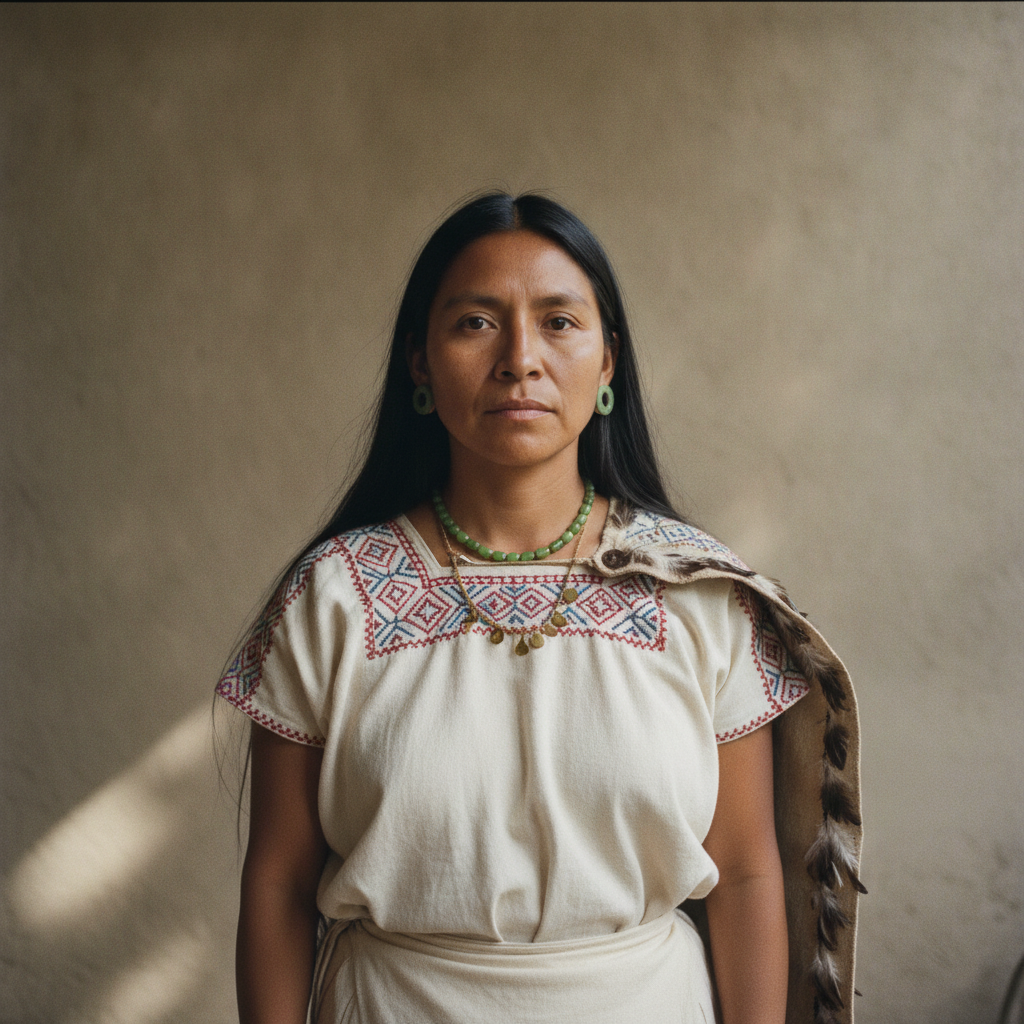
She most likely had dark, straight hair worn long and usually braided or tied back—practical, neat styles visible in indigenous codices and described in early accounts. Her complexion was probably brown in the range typical of Gulf Coast and central Mexican Indigenous peoples, with facial features shaped by regional ancestry; contemporaries called her young and striking. Her clothing would have reflected Indigenous women’s dress: a woven tunic (huipil or similar) and a wrapped skirt, often made of cotton and fastened with a sash, with a rectangular cloak or manta for warmth or modesty when needed. Jewelry was simple but meaningful—necklaces, perhaps small earrings or beads—and textiles could be plain for everyday wear or more finely woven if she held elevated status. Because she moved between Indigenous and Spanish circles, she probably appeared in both styles at different moments: usually in Indigenous dress while serving as interpreter and companion, and at times in Spanish-style garments and a Christian name after baptism, giving her a layered visual presence between two worlds. She was probably clean-shaven and maintained the grooming typical for women of her time and place.
Height / build
Likely average height · Likely slender to average build
Hair
Likely dark (black) · Likely straight to slightly wavy · Likely normal; hair kept long and usually arranged or covered
Eyes
Likely dark (brown)
Complexion
Likely medium brown
Face
Likely oval to rounded · Likely straight to slightly broad
Notable features
Long dark hair, dark eyes, Indigenous facial features, and visible jewelry or textile ornamentation signaling elite origin.
Grooming
None (typical female grooming) · Hair likely braided or tied; jewelry/earrings and textile ornamentation common for noble-born women; later sometimes wore Spanish-style garments and accessories.
Dress / presentation
Initially Indigenous elite dress (huipil/huipilli and wrapped skirts, ornate mantles); occasionally Spanish-influenced robes or cover-ups after contact.
height build
Height
Likely average height
No direct measurement; fits demographic averages for Indigenous women in central Mexico in the early 1500s.
height build
Build
Likely slender to average build
Daily mobility and servant/translator roles plus elite provisioning indicate a lithe but healthy body rather than heavy or heavily muscled.
eyes
Eye color
Likely dark brown
Most Nahua and Gulf-coast Indigenous populations in the region overwhelmingly had dark-brown eyes.
hair
Hair color
Likely black / very dark brown
Contemporary descriptions and Indigenous iconography consistently show dark hair; colonial portraits of her show dark hair.
hair
Hair texture
Likely straight to slightly wavy
Nahua women are typically depicted with straight or gently wavy long hair in codices and colonial images.
hair
Hairstyle & grooming
Long, braided or tied; often ornamented or covered
Nahua culture prized long, well-kept hair, clear skin, and composed bearing—qualities that signaled status and discipline. As a woman from a noble household (and later Cortés’s close intermediary), Malinche likely adhered to these ideals, using tidy dress and hair to project trustworthiness and competence.
Malinche came from the Gulf-coast/Nahua cultural sphere and lived in central Mexican society—populations there typically had dark brown eyes, black hair, and medium-brown skin. Her likely noble origins also meant access to finer textiles and jewelry that visually distinguished her from commoners.
Modern portrayals often either whiten her, over-sexualize her, or show her in anachronistic European dress; historically she would have appeared as an Indigenous woman whose dress and presentation changed after contact.
Modern films and art often either Europeanize her (lightening skin and features) or reduce her to an eroticized stereotype. Historically she would have appeared as an Indigenous woman whose dress and presentation evolved after contact—not a Spanish noblewoman by birth.
Likely average height for an Indigenous woman of her region and time.
Likely dark brown.
Likely black and straight to slightly wavy, worn long and usually braided or tied.
Yes — Spanish chroniclers described her as a young, beautiful woman and noted the attention she received.
Initially elite Indigenous dress (huipil, wrapped skirts, mantles); later she sometimes appears in Spanish-influenced garments in colonial images.
No contemporaneous life portrait is known; later colonial paintings and indigenous codex imagery inform how she is usually pictured.
Bernal Díaz del Castillo — The True History of the Conquest of New Spain
Bernal Díaz del Castillo · c. 1568 (published later)
An eyewitness soldier’s account that describes Malinche as a young, beautiful woman and emphasizes her role as interpreter and companion to Cortés.
Hernán Cortés — Letters (Cartas de relación)
Hernán Cortés · 1519–1526
Cortés’s letters refer to Doña Marina in administrative and personal terms (baptismal name Doña Marina) and document her central role, though they contain little physical description.
Miguel Cabrera — Later Colonial Portraits of Doña Marina (18th century representations)
Miguel Cabrera / Colonial painting tradition · c. 18th century (portrait tradition)
18th-century colonial portraits depict Doña Marina with dark hair and brown skin but often wearing Spanish-style dress—these paintings shaped later visual imagination though they are much later than her life.
Lienzo de Tlaxcala and other indigenous codices
Lienzo de Tlaxcala and regional codices · 16th century (post-contact codices)
Indigenous pictorial documents show Nahua dress, hair, and bodily presentation for elite women—useful for reconstructing how Malinche likely wore clothes and hair.
Diego Muñoz Camargo — History of Tlaxcala
Diego Muñoz Camargo · c. 1585
A colonial-era mestizo historian who provides descriptions of dress and status among central Mexican peoples; helps contextualize Malinche’s likely garments and bearing.
Florentine Codex — Bernardino de Sahagún
Florentine Codex · mid-16th century
Ethnographic descriptions and Nahua illustrations on dress, grooming, and physical types across Mesoamerica—useful for population and style inference.
Indigenous elite women commonly wore long hair in braids or bound, with ribbons or mantles; Spanish sources note her well-kept appearance.
skin
Complexion / skin tone
Likely medium brown
Ethnohistoric accounts and Mesoamerican iconography indicate medium-brown Indigenous skin among Gulf-coast/Nahua women.
face
Facial features
Oval face with indigenous features (straight to slightly broad nose)
Nahua portrait conventions and later colonial depictions show typical indigenous facial proportions rather than European features.
clothing
Dress
Indigenous elite clothing, later sometimes Spanish-influenced garments
Codex images and colonial accounts show elite Indigenous women in huipils and mantles; some later colonial portraits show her in hybrid attire.
other
Perceived attractiveness
Considered attractive/striking
Spanish chroniclers (e.g., Bernal Díaz) describe her as a young, beautiful woman whose presence drew attention.