height build
Height
Likely average to slightly tall for her time
Nobility had better nutrition and living conditions than rural populations, making slightly above‑average stature plausible.
Portrait reconstruction
0–0 · Mercia / Coventry, England · 11th century (Anglo‑Saxon England)
Lady Godiva was likely a well‑dressed Anglo‑Saxon noblewoman with long, dark hair, a fine linen gown, and a cloak fastened with ornate brooches.
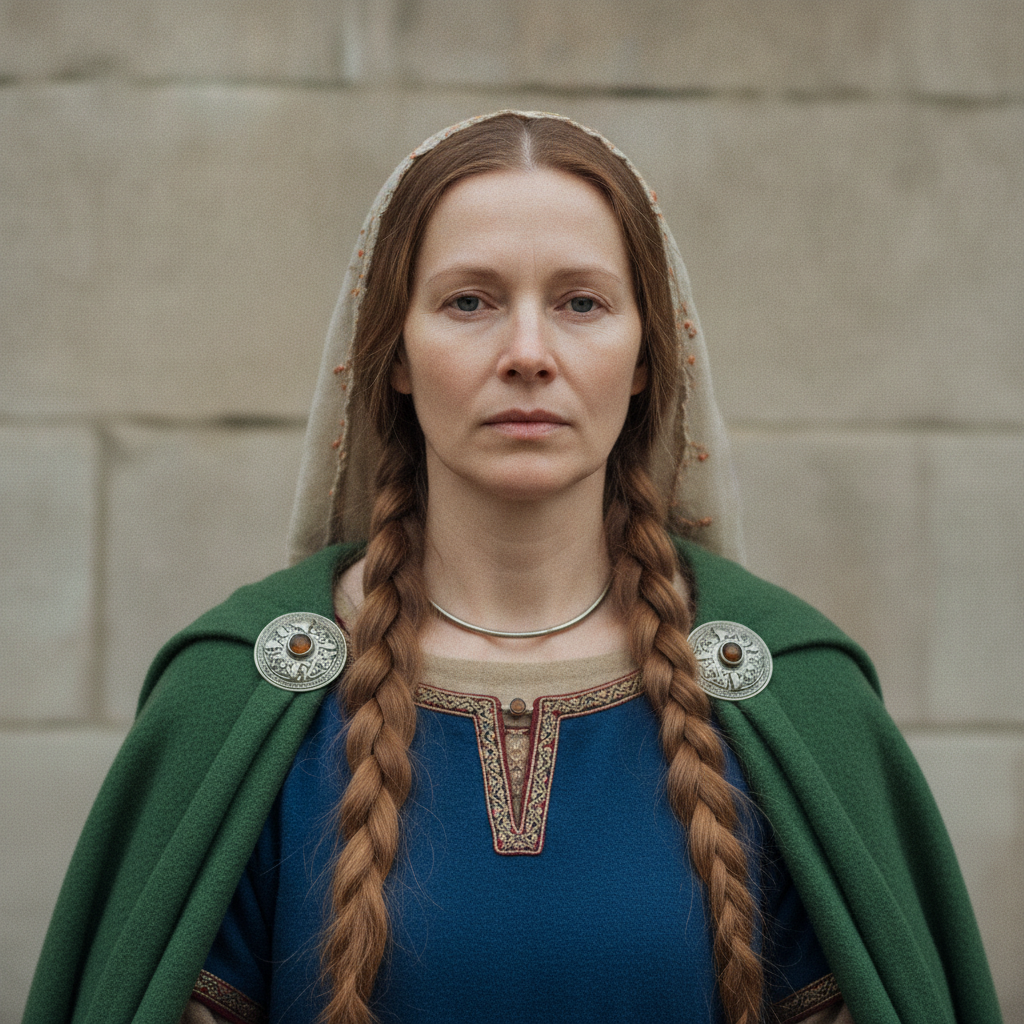
Face and hair: imagine a dignified woman with long, thick hair—probably chestnut to dark brown—kept neatly in braids or plaits and well cared for; her skin would most likely have been fair to lightly tanned from travel and outdoor life, with the clear, clean grooming expected of the aristocracy. Body and stature: as an adult noblewoman she would have carried herself with poise rather than athletic bulk—average medieval female stature, with clothes cut to show status rather than the body beneath. Practical leather shoes or ankle boots and a belt with a small purse or knife would complete her everyday silhouette. Clothing and adornment: her most striking signals of rank would be textiles and metalwork—an ankle‑length linen underdress with a dyed wool overdress, a heavy cloak fastened at the shoulder with one or more metal disc or penannular brooches, and bead or metal necklaces. Rich colors from woad, madder, or weld, and patterned tablet‑woven trims on hems and belts would mark her as upper class without gaudiness.
Height / build
Likely average to slightly tall for her time · Likely slender to medium
Hair
Likely light brown to reddish‑blond · Likely wavy · Likely full, worn long
Eyes
Likely blue or gray
Complexion
Likely fair to light
Face
Likely oval · Likely straight
Notable features
Long braided hair, noble bearing, fine jewelry (brooches, necklace)
Grooming
None · Long hair carefully maintained—braided, bound or veiled—often decorated with ribbons, pins or a fillet.
Dress / presentation
High‑status Anglo‑Saxon dress: long embroidered gown (kirtle), cloak fastened with decorative brooches, veil or headcovering
height build
Height
Likely average to slightly tall for her time
Nobility had better nutrition and living conditions than rural populations, making slightly above‑average stature plausible.
other
Build
Likely slender to medium
As a high‑status woman she would have had fewer years of heavy manual labor and a diet producing a lean but nourished frame.
hair
Hair color
Likely light brown to reddish‑blond
Anglo‑Saxon elite populations commonly show a range of lighter hair colors; later medieval and Victorian images consistently portray her with light hair.
hair
Hair length & style
Long, probably braided and bound or veiled
Contemporary Anglo‑Saxon female fashion emphasized long hair worn in braids or bound and often covered by a veil among married noblewomen.
eyes
Eye color
Likely blue or gray
Northern European populations in medieval England had high frequencies of light eyes; later descriptions and portrayals favor light eyes for idealized noblewomen.
skin
In Godiva’s world long, uncut hair, neat braiding, modest headcoverings for married women, and visible jewelry signaled feminine beauty and social rank. Nobility favored fabrics and embroidered details over revealing clothing; moral virtue and visible status went hand in hand.
Godiva belonged to the Anglo‑Saxon (Germanic) elite of Mercia: ethnically northern European, with a strong chance of light eyes and light-to‑medium hair and a fair complexion. That regional phenotype helps explain why later images emphasize pale skin and light hair.
Modern images usually show her nude with cascading hair; historically a noblewoman would have been clothed, veiled or at least covered, and adorned with jewelry and fine textiles.
Popular portrayals emphasize nudity and flowing loose hair as symbols of bravery and eroticism. Historically, a married noblewoman would appear clothed and veiled in public; the legend’s nudity is symbolic and later artistic invention, not a literal social norm.
Likely average to slightly tall for her time—nobility often stood a bit taller due to better nutrition.
Likely blue or gray, consistent with northern European populations of the period and later portrayals of Anglo‑Saxon elite women.
Likely light brown to reddish‑blond, worn long and styled in braids or bound beneath a veil.
No—facial hair would not be expected for a woman; she would be clean‑faced.
A long, embroidered gown with a cloak fastened by decorative brooches and a veil or head covering, plus jewelry indicating rank.
There are no contemporary portraits; this profile combines medieval textual tradition, later artwork, and archaeological and population context to produce the most plausible visual image.
Roger of Wendover — Flores Historiarum (13th century)
Roger of Wendover · c. 1225–1235
One of the earliest extended narrations of the Lady Godiva ride; presents Godiva as a noble, devout woman whose public act earned civic relief. Textual tradition shaped later images of her dignity and beauty.
Matthew Paris — Chronica Majora (13th century)
Matthew Paris · mid‑13th century
A later chronicler who repeated and embellished Godiva’s story; his manuscript illumination tradition contributed to the iconography of Godiva as a striking noblewoman.
Oxford Dictionary of National Biography entry: Godgifu (Godiva)
Oxford Dictionary of National Biography · modern reference (various editions)
Scholarly biography summarizing documentary evidence, placing Godiva in 11th‑century Mercian aristocracy and describing how later medieval tradition created the familiar legend.
John Collier — Lady Godiva (late 19th century painting)
John Collier (artist) · c. 1897
A Victorian idealized nude depiction that influenced modern visual expectations; emphasizes long flowing hair and an eroticized image rather than historical dress.
Coventry civic statues and public art (19th–20th century)
Coventry civic collection (various) · 19th–20th centuries
Multiple statues and public artworks in Coventry shaped popular visual identity for Godiva—richly dressed or semi‑nude depending on era—reflecting the legend more than historical reality.
Anglo‑Saxon dress and burial archaeology
Archaeological studies (general) · modern archaeology
Grave goods, textile reconstructions and brooch types show how elite Anglo‑Saxon women dressed and accessorized: long gowns, cloaks, brooches, and veils—useful for reconstructing Godiva’s likely dress and adornment.
Complexion
Likely fair to light
Anglo‑Saxon elite women were typically described or depicted with fair skin in literature and art; climate and ancestry support a lighter complexion.
clothing
Typical dress
High‑status Anglo‑Saxon gown with cloak, brooches and veil
Archaeology and contemporaneous costume evidence show noblewomen wore long embroidered gowns fastened with decorative brooches and veils.
grooming
Grooming & adornment
Well‑groomed, wearing jewelry (brooches, necklace, possibly rings)
Objects from noble graves and literary references indicate jewelry was a visible status marker for high‑rank women.
face
Face shape & nose
Likely oval face and a straight nose
General northern European cranial morphology and conventional medieval portraiture of noblewomen favor an oval face and relatively straight nasal profile.
cultural
Public bearing
Dignified and commanding presence
As a noble patron and the central figure in a civic legend, sources and later tradition emphasize her moral authority and public standing.