hair
Hair color
Likely dark to graying
Chinese male hair color in the region is typically dark; later portraits and descriptions present him as an elderly sage with graying hair.
Portrait reconstruction
0–0 · Northern China (traditionally Henan / Zhou cultural area) · Legendary late Zhou (traditionally 6th century BCE)
Laozi would most likely have looked like an elderly northern Chinese sage: dark-haired, long-bearded, in simple robes with a topknot and a calm, weathered face.
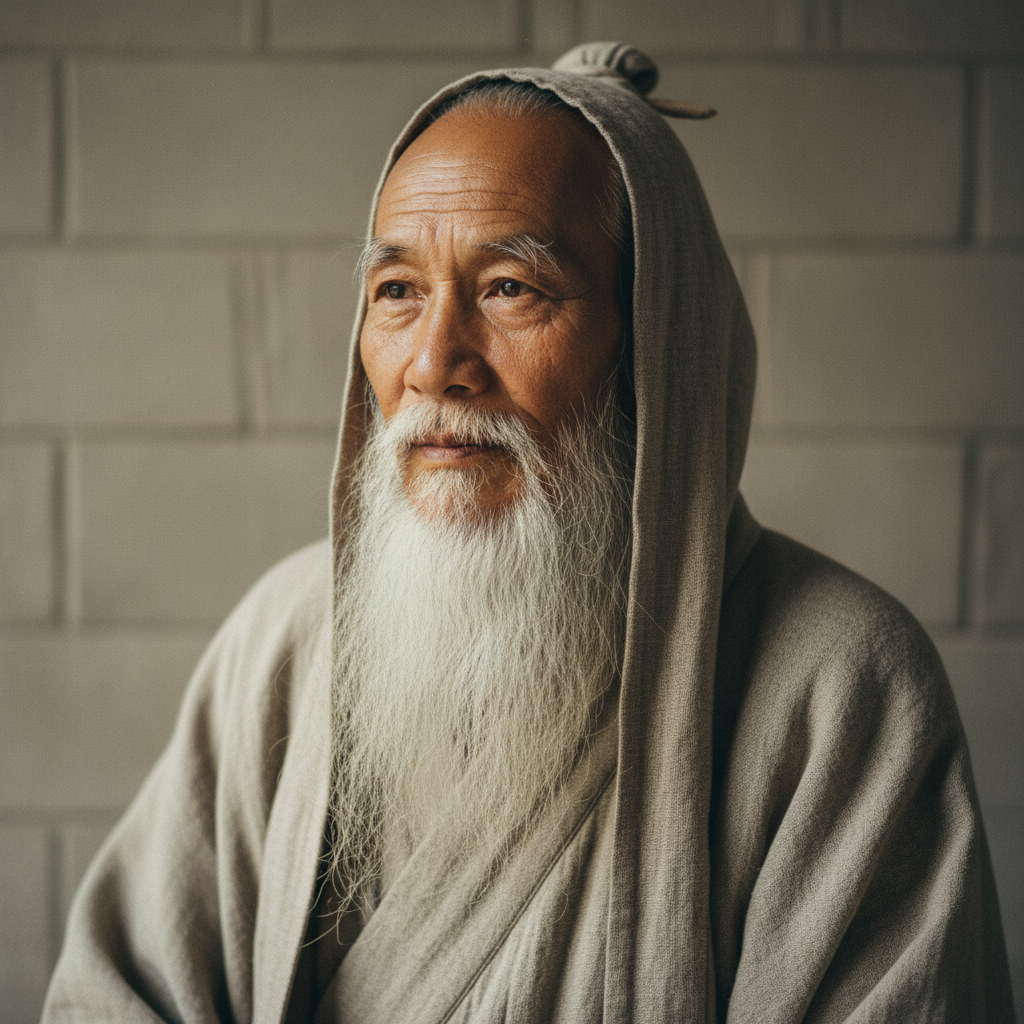
Face and hair: Picture a weathered, angular face with dark hair pulled up into a modest topknot and a long beard that hangs to the chest—an instantly recognizable mark of age and authority in classical Chinese imagery. Eyes would be dark brown, with a steady, calm gaze more thoughtful than fierce. Skin and build: His complexion would read as a warm East Asian tone, browned slightly by outdoor life; not pale courtly skin but not roughened to the point of peasant hardness either. His build would likely be lean and erect rather than heavy—an older man with steady posture, the kind shaped by travel and modest living. Clothing and accoutrements: He would wear plain, flowing robes of simple weave—linen or hemp in muted tones—fastened with a sash, possibly a short outer cloak for travel. Small, practical items like a wooden staff, a cloth satchel, or a simple straw hat when outdoors fit the image; the ox is a frequent companion in visual tradition, suggesting mobility and reclusion. Expression and bearing: The overall impression is of calm reserve: slow, deliberate movements; soft but alert eyes; hands that are steady and practiced. He looks like someone used to reading, writing, and long walks—wise rather than ostentatious, approachable rather than formal.
Height / build
Likely average height for his era · Likely slender to average build
Hair
Likely dark to graying · Likely straight · Likely receding or thinning with age
Eyes
Likely dark (brown/black)
Complexion
Likely medium yellow‑brown (East Asian tone)
Face
Likely long to oval face · Likely straight to slightly broad nose
Notable features
Long beard, aged face with wrinkles, calm/distant eyes, traditional scholar’s topknot or hooded robe silhouette
Grooming
Probably long, full beard (white or graying in later life) · Tended toward simple, well-kept but unadorned grooming—long hair tied in a topknot or loose bun and a maintained beard.
Dress / presentation
Simple, long flowing robes (hemp/linen), earth tones or plain dye; scholar/Daoist sage attire rather than armor or court regalia
hair
Hair color
Likely dark to graying
Chinese male hair color in the region is typically dark; later portraits and descriptions present him as an elderly sage with graying hair.
other
Beard
Probably long, full beard (graying in old age)
Nearly all historic and religious images and temple statues depict Laozi with a long beard; beard was a sign of age and wisdom in Chinese cultural imagery.
eyes
Eye color
Likely dark (brown/black)
Typical phenotype for northern Chinese populations; no source suggests non-dark eye color.
hair
Hair texture and style
Likely straight; hair tied in topknot or simple bun
East Asian hair is typically straight; historical Zhou-era men commonly tied long hair up; later depictions show a topknot or wrapped robe hood.
skin
Complexion
Likely medium yellow-brown (East Asian)
Regional population characteristics for northern China; temple portraits follow similar tonal palettes.
height build
Height
In Laozi’s cultural world age, simplicity, and signs of long life communicated authority. Wrinkled skin, a full beard, and plain clothing signaled experience and detachment—traits admired in sages. Ornament and bright finery would be inappropriate for someone embodying Daoist humility.
Laozi originates in the northern-China cultural sphere (the Zhou milieu). That context suggests straight, dark hair; dark eyes; and an East Asian yellow‑brown skin tone—features typical of the region’s agricultural populations that formed the cultural core of early China.
Modern art often exaggerates his age into mythical extremes or makes him exotic (green faces, fantastical robes); traditional imagery is a later conventionalized sage portrait, not a contemporary likeness.
Contemporary portrayals often turn Laozi into a caricature—over-white-bearded, exotically colored, or whimsically rotund. These amplify later religious symbolism (longevity, immortality) rather than reflecting a plausible historical elder from the Zhou era.
Likely average height for his era.
Probably—a long, full beard is the standard trait in virtually all traditional images of Laozi.
Likely dark (brown/black).
Likely had dark hair that became graying with age and probably a receding hairline or thinning typical of an elderly man.
Simple, long flowing scholar/Daoist robes in plain, earth tones—unadorned and modest.
They show the conventional image of an aged sage shaped by centuries of tradition rather than a verified contemporary portrait.
Records of the Grand Historian (Shiji)
Sima Qian, Shiji · ca. 94 BCE
Gives the foundational biographical tradition: Laozi as an older archivist (Li Er) who met Confucius and later left China; supplies the departure-on-ox story that shaped visual tradition but provides little physical description.
Zhuangzi (Master Zhuang)
Zhuangzi (compiled texts) · 4th–3rd century BCE (core material)
Philosophical writings that reference Laozi’s ideas and sometimes portray him in anecdotal scenes; contains cultural portrayals of sages but no contemporary likeness.
Dao De Jing
Attributed text: Dao De Jing · Traditionally 6th century BCE; compilers later
The foundational text associated with Laozi; offers no physical description but sets the persona (old master, wise recluse) that informs visual representation.
Medieval and later portraits of Laozi
Tang–Song–Ming dynasty paintings and portraits · 7th–17th centuries CE
Consistent artistic tradition: elderly man with long beard, topknot, flowing robes, often riding an ox; these images shaped the popular concept of Laozi’s appearance.
Daoist temple statues and icons
Temple statuary across China · Tang dynasty onward (widespread in later eras)
Three-dimensional images consistently render Laozi as an aged bearded sage in simple robes; useful for understanding how worship and culture visualized him.
Later hagiographies and chronicles
Various medieval Daoist biographies and local gazetteers · Tang–Ming eras
Expand on episodes of Laozi’s life and often describe him as an old man; these sources underlie much of his visual tradition.
Likely average height for his era
Zhou-era agricultural populations tended to be shorter than modern populations; no textual claim of exceptional stature exists.
height build
Build
Likely slender to average
As a scholarly/ascetic figure and elder, he was likely lean rather than heavily built; iconography emphasizes a spare silhouette.
clothing
Typical clothing
Simple, long flowing scholar/Daoist robes in plain colors
Traditional imagery and the Daoist ideal of simplicity both point to unadorned long robes, often hemp or linen, with wide sleeves.
face
Age appearance
Likely elderly (deep wrinkles, sagging skin)
Laozi's name ('Old Master') and legend emphasize advanced age; pictorial tradition always shows him as old and weathered.
grooming
Grooming style
Well-kept but plain grooming, hair tied and beard maintained
Confucian and Daoist literati maintained neat grooming without ornamentation; later iconography shows a tidy beard and hair.
other
Distinctive iconography
Often shown riding an ox or accompanied by an ox
The story of Laozi leaving China on an ox is a central motif shaping his image as a traveling sage.
Iconographic motif: Laozi on an ox
Folklore and temple imagery · Recorded from Han/Tang onward
The ox motif derives from textual legends and is central to lasting visual identity; it informs assumptions about attire and age in depictions.
Regional anthropological context
Studies of ancient northern Chinese population features · Modern scholarship
Provides population phenotype context (dark hair, dark eyes, East Asian complexion) used to inform plausible physical traits.