height build
Height
Likely tall for his time
Scandinavian populations in the Viking Age were relatively tall and leaders often noted for commanding presence; seafaring leaders needed physical robustness.
Portrait reconstruction
970–1020 · Norse Greenland / Iceland / Norway · Viking Age (late 10th–early 11th century)
Leif Erikson likely looked like a tall, broad-shouldered Norse leader with light brown–to–dark blond hair, a trimmed beard, weathered fair skin, and practical high-status clothing.
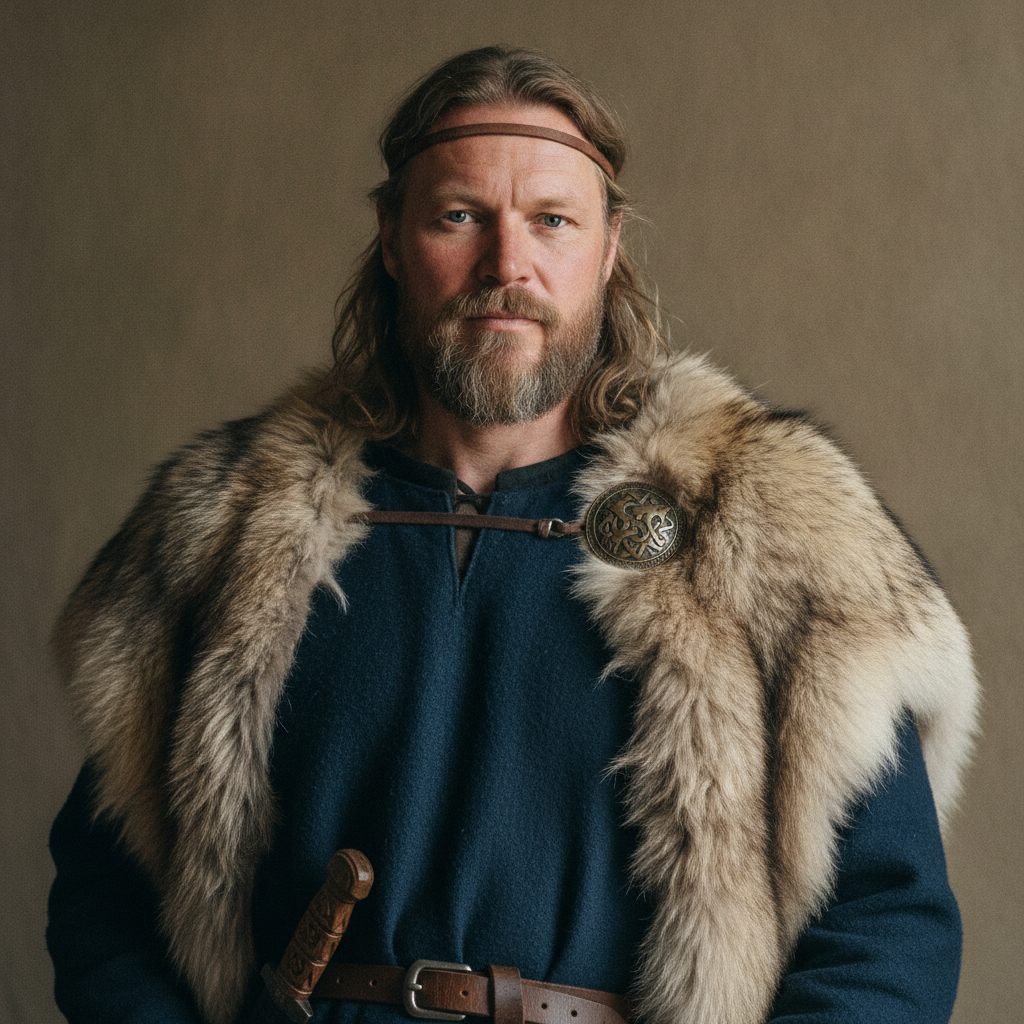
Face and hair: Imagine a strong, angular face with sun- and wind-tanned skin from years at sea; hair probably light brown to dark blond, cut to about collar length and kept tidy with frequent combing, and eyes likely a pale blue or gray common in the North. He would have worn a trimmed beard or close stubble—groomed rather than wild—giving a controlled, authoritative look. Build and bearing: Above-average height and a sturdy, muscular frame from rowing, hauling sails, and fighting; not hulking but athletic and compact. He would have carried himself with the calm confidence of a chieftain—straight posture, broad shoulders, and hands weathered and callused from seafaring. Dress and accoutrements: Practical, well-made wool tunics and trousers layered for cold, a heavy wool or fur-lined cloak fastened with a decorated brooch, sturdy leather boots, and a plain leather belt holding a knife and possibly a seax or short sword. Small metal brooches, quality stitching, and trimmed furs signaled status without showiness; colors were muted earth tones brightened by dyed accents and simple patterned trim.
Height / build
Likely tall for his time · Likely sturdy and muscular
Hair
Likely fair to light brown, possibly blond · Likely straight to slightly wavy · Likely normal hairline for adulthood (not markedly receding)
Eyes
Likely blue-gray or light (Probably blue-gray)
Complexion
Likely fair to ruddy Caucasian complexion
Face
Likely long to oval face with strong jawline · Likely straight to slightly aquiline
Notable features
Fair hair, light eyes, commanding height, ruddy weathered skin, trimmed beard
Grooming
Likely a trimmed full beard (Probably bearded) · Practical grooming — beard well-kept, hair shoulder-length or shorter, reflecting Norse elite styles.
Dress / presentation
High-quality wool tunic and trousers, fur cloak or mantle, leather boots; accessories like brooches and a belt knife indicating status
height build
Height
Likely tall for his time
Scandinavian populations in the Viking Age were relatively tall and leaders often noted for commanding presence; seafaring leaders needed physical robustness.
other
Build
Likely sturdy and muscular
A lifetime at sea, manual tasks, and combat would produce a broad, muscular frame rather than slenderness.
hair
Hair color
Likely fair to light brown, possibly blond
Leif descended from Norse stock—many Scandinavians of the period had blond to light-brown hair; his father’s epithet (Erik the Red) indicates family hair-color awareness but not Leif's exact color.
hair
Hair texture & style
Likely straight to slightly wavy; shoulder-length or shorter
Norse men commonly wore hair at medium length, practical for seafaring and consistent with elite grooming of the period.
eyes
Eye color
Likely blue-gray or light
Light eyes were common in Norse populations; many contemporary descriptions of Norse people emphasize pale/light eyes.
grooming
Norse ideals prized practical grooming, visible strength, and clear markers of status: cleanly kept hair and beard, well-made wool and fur garments, and functional jewelry like brooches. A chieftain like Leif would balance seaworthy practicality with status signals—nothing overly ornamental, but visibly high quality.
Leif belonged to Norse settlers from Norway via Iceland—physically that most often meant fair skin, frequent light eyes, and a range of fair to light-brown hair. Think northern-European features tempered by a life at sea: sun- and wind-weathered skin, with hair and beard maintained but not ostentatious.
Modern images often exaggerate Viking tropes (horned helmets, wildly long hair) or romanticize facial features; the real look was more practical and varied.
Modern images often show horned helmets, wildly unkempt hair, or hyper-romanticized redheads; in reality, helmets with horns are a 19th-century myth, and Norse leaders favored practical, groomed hair and functional helmets when used. Stature and facial features vary; Leif would have been recognizably human and practical rather than theatrical.
Likely tall for his time — taller than many contemporaries and with a commanding presence.
Likely blue-gray or light — light eyes were common in Norse populations.
Likely fair to light brown, possibly blond — consistent with Norse ancestry.
Probably — a trimmed full beard is the most likely style for a Norse chieftain.
Practical, high-quality wool tunic and trousers with a fur-lined cloak or mantle, leather boots, and status items such as brooches and a belt knife.
Indirect — no contemporary portraits or remains conclusively linked to Leif survive; the portrait is reconstructed from sagas, archaeology, and Norse cultural norms.
Greenlanders' Saga (Grœnlendinga saga)
Medieval Icelandic saga · 13th century
One of the main narrative sources recounting Leif Erikson's voyage to Vinland and presenting him as a prominent, capable leader; provides cultural context though little physical description.
Saga of Erik the Red (Eiríks saga rauða)
Medieval Icelandic saga · 13th century
Contains accounts of Leif as son of Erik the Red and episodes of his life (including conversion to Christianity) that portray status and character, informing assumptions about appearance and dress.
20th-century statues and monuments to Leif Erikson
Public statuary (e.g., Reykjavik, Boston, Oslo monuments) · early–mid 20th century
Public sculptures shaped modern visual ideas of Leif—tall, bearded, heroic—reflecting early 20th-century nationalist and romantic conventions more than documentary detail.
Archaeological clothing and grave goods from Viking Age Scandinavia
Archaeological reports and museum collections · various (20th–21st c. excavations)
Wool garments, fur trims, brooches, and combs indicate Norse dress and grooming practices appropriate to a chieftain—used to infer likely clothing and grooming for Leif.
Medieval Scandinavian stature and population studies
Bioarchaeological research (stature and isotope analyses) · 20th–21st century
Skeletal studies indicate Viking Age northern Europeans were often relatively tall and robust for medieval Europe, supporting estimates that Leif would be above average height.
Facial hair
Likely a trimmed full beard
Beards were a common sign of masculinity and status among Norse men; chieftains often kept them maintained.
skin
Complexion
Likely fair to ruddy
Scandinavian ancestry implies fair skin; exposure to elements would produce a weathered, ruddy quality.
clothing
Typical dress
Wool tunic and trousers with fur cloak — status accents like brooches
Norse chieftains wore practical but fine wool garments and furs; metal brooches and belts signaled rank.
face
Face shape & nose
Likely long to oval face with straight to slightly aquiline nose
Common northern European craniofacial traits and artistic depictions of Norse elites suggest these features.
cultural
Public bearing
Commanding, rugged, charismatic
Sagas present Leif as a leader and respected figure, implying confident bearing and a presentable, commanding look.