height build
Height
Likely tall for his time
Renaissance biographers describe him as notably tall compared with contemporaries.
Portrait reconstruction
1452–1519 · Vinci / Florence (Republic of Florence) · Italian Renaissance
Leonardo da Vinci was likely a tall, graceful man with a long face, prominent nose, dark hair that greyed, and a long flowing beard in later years.
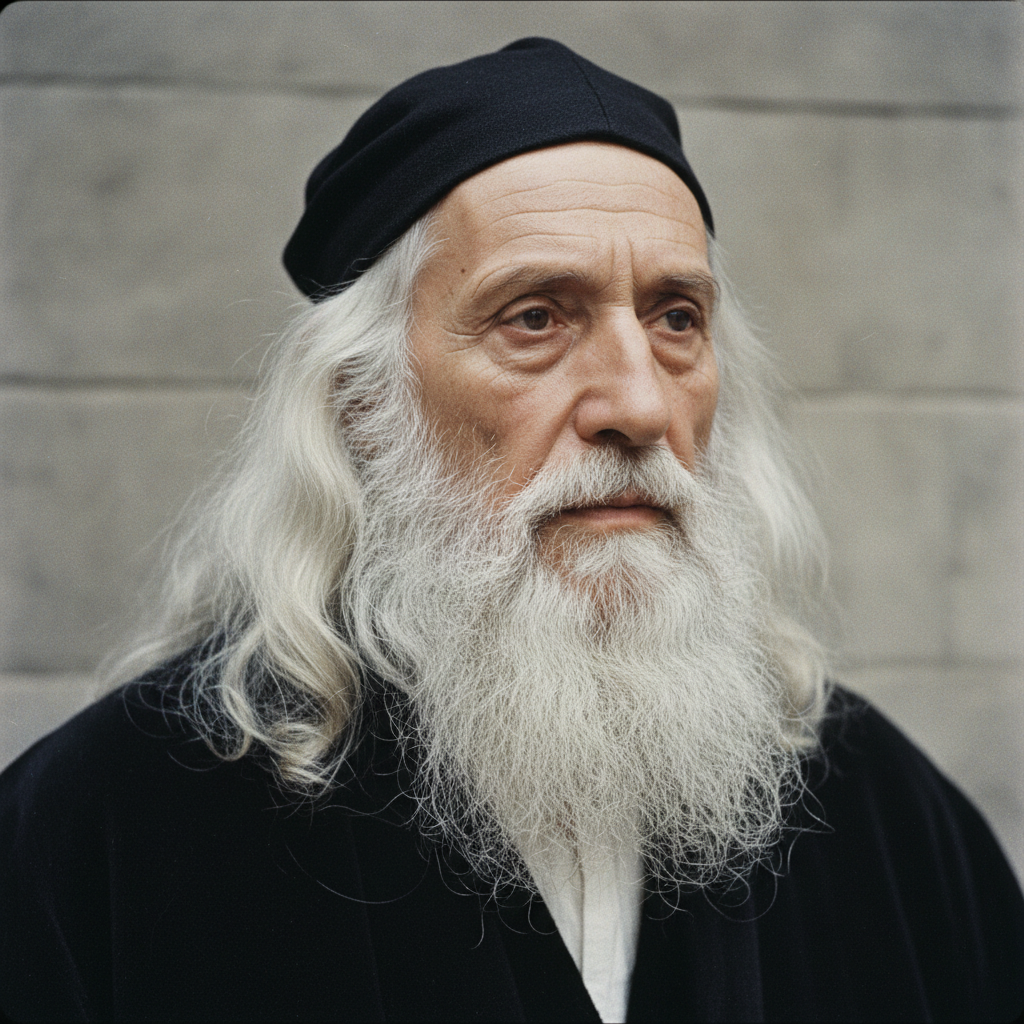
Leonardo’s face is best imagined as long and narrow, with a high forehead and an aquiline, prominent nose that gives his profile strong character. His eyes were deep-set and observant—often described as bright and intelligent—set beneath straight brows and matched to an olive-tinged complexion common in Tuscany. In youth he probably had dark hair and a neatly kept face; by middle and old age his hair had begun to grey and he commonly appears with long hair falling toward the shoulders and a full, long beard and moustache. The famous red‑chalk likeness presents him as an elderly man with flowing beard and long, dignified features, a look echoed in later workshop portraits and reconstructions. He likely carried himself with a tall, slender, and graceful bearing—descriptions note a noble presence. His hands and fingers were often singled out for their long, capable appearance, fitting the image of a practical scientist and inventor as much as an artist.
Height / build
Likely tall for his time · Likely slender
Hair
Likely dark to graying · Likely wavy · Likely receding / high forehead
Eyes
Likely dark
Complexion
Likely Mediterranean complexion
Face
Long, narrow face · Prominent aquiline (hooked) nose
Notable features
Long white beard (later), high forehead, deep-set/penetrating eyes, prominent aquiline nose
Grooming
Long flowing beard in later life; shorter or less developed earlier · Tended toward long hair and a full beard in later life; generally groomed in the fashion of a scholarly gentleman rather than a soldier.
Dress / presentation
Renaissance scholar / artist garments—long dark robes, simple caps; practical, non-military dress befitting an educated court artist
height build
Height
Likely tall for his time
Renaissance biographers describe him as notably tall compared with contemporaries.
height build
Build
Likely slender
Portraits and accounts emphasize a lean, active figure consistent with long travel and study rather than heavy labor.
hair
Hair color
Likely dark to graying
The familiar red-chalk likeness shows white hair in old age; youth would have been darker—typical for Tuscan men.
hair
Hair texture
Likely wavy
Surviving drawings and portraits show wavy hair and beard in later-life depictions.
hair
Hairline
Likely receding / high forehead
Multiple late portraits emphasize a high forehead and thinning at the temples.
eyes
Eye color
Likely dark
Regional population context and the tonal rendering in portraits point to dark (brown) eyes.
Renaissance Florentine culture prized signs of learning and gravitas—high forehead, beard, calm demeanor and sober dress signaled wisdom and social standing. For an artist-engineer like Leonardo, an appearance that emphasized intellect and cultivated dignity mattered more than martial or aristocratic flash.
Leonardo came from Vinci, a Tuscan town: the regional phenotype was Mediterranean—dark hair and eyes, olive-leaning skin. That context helps explain why earlier-life depictions likely show darker hair and why his features fit central-Italian norms of the era.
Modern images often exaggerate leonine hair, theatrical mysticism, or make him look either wildly romanticized or anachronistically modern; surviving portraits give a more sober, scholarly image.
Films and popular images often turn Leonardo into a mystical eccentric with wild hair or anachronistic clothing. In surviving portraits he looks less theatrical—more like a reserved, scholarly gentleman whose beard and long hair signal age and authority.
Likely tall for his time — contemporary biographers describe him as above average in stature.
Likely dark — as typical for Tuscan men and suggested by portrait tonality and regional context.
Likely dark in youth, turning to gray/white in later life; wavy and worn long, often with a receding hairline.
He wore a long flowing beard in later life; earlier he may have been less bearded.
Described as graceful and noble in presence—commanding and distinguished more than classically handsome.
Often not — popular portrayals over-dramatize hair, mysticism, or dress; surviving portraits show a more sober, scholarly figure.
Portrait of a Man in Red Chalk (often identified as a self‑portrait)
Biblioteca Reale, Turin · c.1512–1515 (attributed)
A red‑chalk drawing of an elderly man with long beard, long face, high forehead and prominent nose; widely used as the canonical likeness of Leonardo.
Giorgio Vasari — Lives of the Most Excellent Painters, Sculptors, and Architects
Giorgio Vasari · 1568 (expanded edition)
Biographical account describing Leonardo's tall stature, graceful bearing, and noble presence; a foundational near-contemporary literary source shaping later impressions.
Later portraits and workshop images attributed to Leonardo's circle
Various/Follower works (e.g., portraits by pupils and followers) · 16th century
Portraits and copies by pupils/followers echo the long face, beard, and prominent nose found in the red-chalk likeness and support a consistent visual tradition.
Modern reconstructions inspired by portraits
Various forensic and art-historical reconstructions · 20th–21st century
Contemporary reconstructions translate the red-chalk features into three-dimensional, lifelike faces—useful visualizations though dependent on interpretation of sketches and texts.
Contemporary and near‑contemporary notes (apprentices, patrons)
Various biographical notes and letters · late 15th–early 16th century
Scattered references in letters and notes depict Leonardo as well‑dressed for courtly service, learned and of dignified presence—supporting visual cues from portraits.
face
Nose
Prominent aquiline nose
The red-chalk likeness and later portrait tradition consistently depict a hooked/prominent nose.
grooming
Facial hair
Long flowing beard in later life
Familiar late-life portraits show a full, long beard; textual descriptions note his long hair and beard.
skin
Complexion
Likely Mediterranean complexion
As a Tuscan native, he likely had an olive-leaning Mediterranean skin tone typical of central Italy.
clothing
Clothing style
Renaissance scholar / artist dress (long dark robes, cap)
Portraits and period practice show him in sober, scholarly dress rather than armor or courtly finery.
other
Overall presence
Commanding, scholarly, dignified
Biographers stress grace and nobility of presence; his appearance conveyed learned authority more than conventional handsomeness.