hair
Hair color
Likely black
Andean populations and Inca iconography consistently show dark/black hair; chroniclers describe native appearance in terms that match this.
Portrait reconstruction
0–0 · Cusco region, central Andes (modern Peru) · legendary; often placed in the early second millennium CE (pre-Columbian Andes)
Manco Cápac likely looked like a dignified highland leader: dark-haired, deep‑brown eyed, stocky and sun-weathered, clothed in elite patterned textiles and wearing the red llauto headband of rulership.
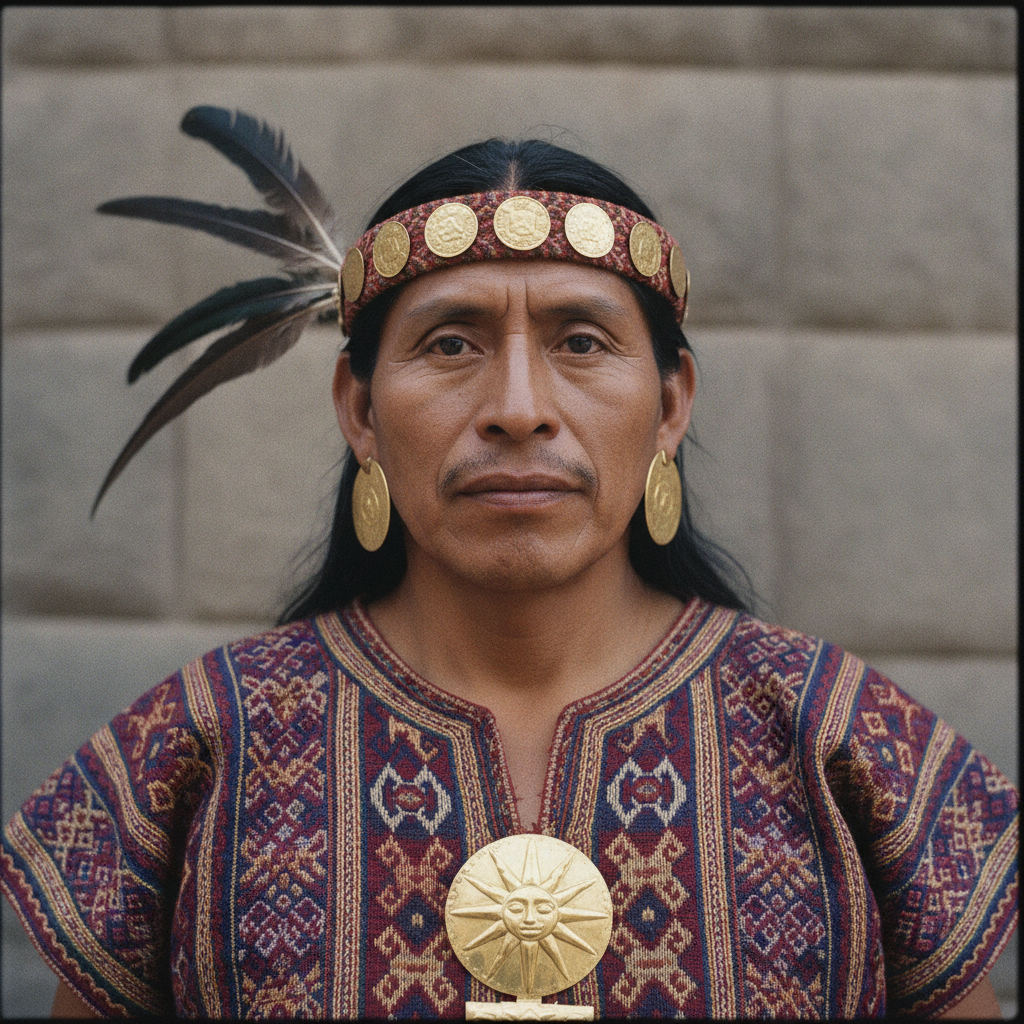
Skin and face: He probably had a warm bronze to coppery complexion typical of central Andean highland peoples, with strong cheekbones, a broad nose and a firm, squared jaw that conveyed presence and authority. His skin would have been sun-darkened and wind‑weathered from life in highland valleys and ridgelines. Hair and beard: Hair was likely straight to slightly wavy and black, worn relatively long or tied back beneath his headband; men of status often kept their hair neat rather than unkempt. Facial hair was probably sparse or closely trimmed—think clean‑shaven or sporting only a light moustache—presenting a smooth, disciplined face rather than a heavy beard. Build and bearing: Expect a compact, muscular build—stocky and well‑proportioned for working and moving at altitude, with broad shoulders and a confident, upright posture. As a founding ruler in iconography, he would appear composed and dignified rather than gaunt or exaggeratedly bulky. Clothing and regalia: He would have worn an unku (tunic) with tightly woven, geometric patterns in deep reds, yellows and blacks, possibly layered with a colorful mantle; sandals on his feet. The most distinctive element was the llauto or mascaipacha— a red fringed diadem across the forehead—plus signs of status such as gold ear spools, a pectoral or necklace of precious shell or metal, and perhaps feather accents reserved for elite ceremonial dress.
Height / build
Likely average height · Likely average to solid build
Hair
Likely black · Likely straight to coarse · Likely normal hairline; possibly worn long and tied or wrapped under a headband
Eyes
Likely dark (brown)
Complexion
Likely medium–dark brown
Face
Likely broad/oval face with prominent cheekbones · Likely straight to slightly broad nose
Notable features
Royal headband (llauto/mascaipacha), high cheekbones, composed posture, richly patterned tunic
Grooming
Probably minimal to light facial hair; likely clean-shaven or with sparse mustache · Likely well-groomed for a leader: neatly maintained hair, polished textiles, and ritual adornments like gold or feather ornaments.
Dress / presentation
Regal Inca elite dress: finely woven uncu (tunic), llauto (royal headband/mascaipacha), gold and feather ornaments
hair
Hair color
Likely black
Andean populations and Inca iconography consistently show dark/black hair; chroniclers describe native appearance in terms that match this.
eyes
Eye color
Likely dark brown
Pre-Columbian Andean populations overwhelmingly display dark brown eyes in accounts and genetic/anthropological data for the region.
skin
Complexion
Likely medium–dark brown
Highland Andean groups traditionally have medium to darker brown skin tones; Inca elites are not described as unusually pale.
grooming
Facial hair
Probably minimal to clean-shaven
Spanish chroniclers noted that many Andean men had little facial hair; elite grooming favored neatness and ritual presentation.
clothing
Regal dress
Likely finely woven tunic (uncu) and royal headband (llauto/mascaipacha)
All accounts of early Inca rulers emphasize distinctive royal textiles and the llauto as symbols of authority.
face
Facial shape and features
The Inca ideal for a ruler stressed ordered presentation: immaculate textiles, symbolic headbands (llauto), and ritual accessories that signaled sacred authority. Personal grooming and symbolic dress mattered more than ostentatious musculature—appearance communicated lineage and divine sanction.
Visualizing Manco Cápac means starting with highland Andean anatomy: dark hair and eyes, medium–dark skin, and a stocky, resilient build shaped by life at altitude. Elite status added finely made textiles and metal ornaments that set leaders apart from commoners.
Modern art often portrays him as a Greco-Roman-style heroic figure or as exoticized fantasy; historically he would have been recognizably Andean in dress and physiognomy.
Modern depictions often borrow Greco‑Roman heroic poses or Hollywood tropes—turning Manco Cápac into a musclebound warrior or an exoticized 'noble savage.' Historically he would appear as a composed ritual leader in carefully made textiles and symbolic headgear, not a toga-clad or bare-chested fighter.
Likely average height for a pre-Columbian Andean man.
Likely dark brown.
Likely black, straight to coarse, worn long and bound or wrapped under a royal headband.
Probably little to no facial hair; many Andean men had minimal beard and elites favored a clean, groomed face.
Regal Inca attire: a finely woven uncu (tunic), the llauto or mascaipacha royal headband, and gold/feather ornaments.
We combine Andean chronicles, iconography, textiles, and population studies to create a likely visual profile.
Comentarios Reales de los Incas
Inca Garcilaso de la Vega · 1609
Presents the canonical Inca origin stories and descriptions of royal dress, ritual headbands, and the sacred status of early rulers—useful for reconstructing symbols and grooming for Manco Cápac.
Crónicas del Perú
Pedro Cieza de León · 1553
Early Spanish observations reporting on indigenous appearance, clothing, and social differentiation in the Andes; helps anchor likely physical traits such as dark hair and eyes.
Narrative of the Incas
Juan de Betanzos · 1551
Contains descriptions of Inca rulers, courtly dress, and ritual paraphernalia (mascaipacha/llauto) that inform appearance of founding rulers.
Colonial-era Cusco statuary and paintings
Cusco School and colonial sculptures · 16th–18th centuries
Statues and paintings in and around Cusco show how native elites and founders were later pictured: patterned tunics, headbands, and dignified poses that reflect Andean visual conventions.
Andean textile and iconography corpus
Archaeological and museum collections · pre-Columbian to colonial
Fine textiles and ceramic imagery record patterns of elite dress, headgear, and ornamentation—helpful for reconstructing what a founder's clothing would look like.
Bioarchaeological studies of central Andean populations
Modern anthropological literature · 20th–21st century
Offers population-level data on stature, body proportions, and physical traits among highland Andean groups, supporting estimates for height, build, and complexion.
Likely broad/oval face with high cheekbones
High cheekbones and sturdy facial structure are common in Andean populations and appear in Inca statuary and pottery portraits.
height build
Height and build
Likely average height with a solid build
Pre-Columbian Andean male statures place most adults in an average range; elite lifestyle suggests a well-fed, sturdy physique.
hair
Hair texture and styling
Likely straight to coarse; worn long and tied or wrapped under headband
Andean hair tends to be straight/coarse; elite males were often shown with long hair bound by headbands or wrappings.
other
Adornment
Likely gold/copper ornaments and possibly feathers
Inca royalty used metalwork and featherwork as visible markers of status in ritual and daily dress.
cultural
Expression and bearing
Commanding, composed, ritualized bearing
Founding rulers are described in chronicles and iconography as calm, authoritative figures more associated with ritual authority than battlefield fodder.