skin
Skin tone
Likely dark brown
Contemporary Arabic descriptions label him as a 'black' African and period European maps depict him with dark skin; fits West African population context.
Portrait reconstruction
0–0 · Mali Empire (West Africa) · 14th century
Mansa Musa would have appeared as a dark‑skinned West African king, richly robed and heavily adorned with gold, wearing a crown or ceremonial headdress.
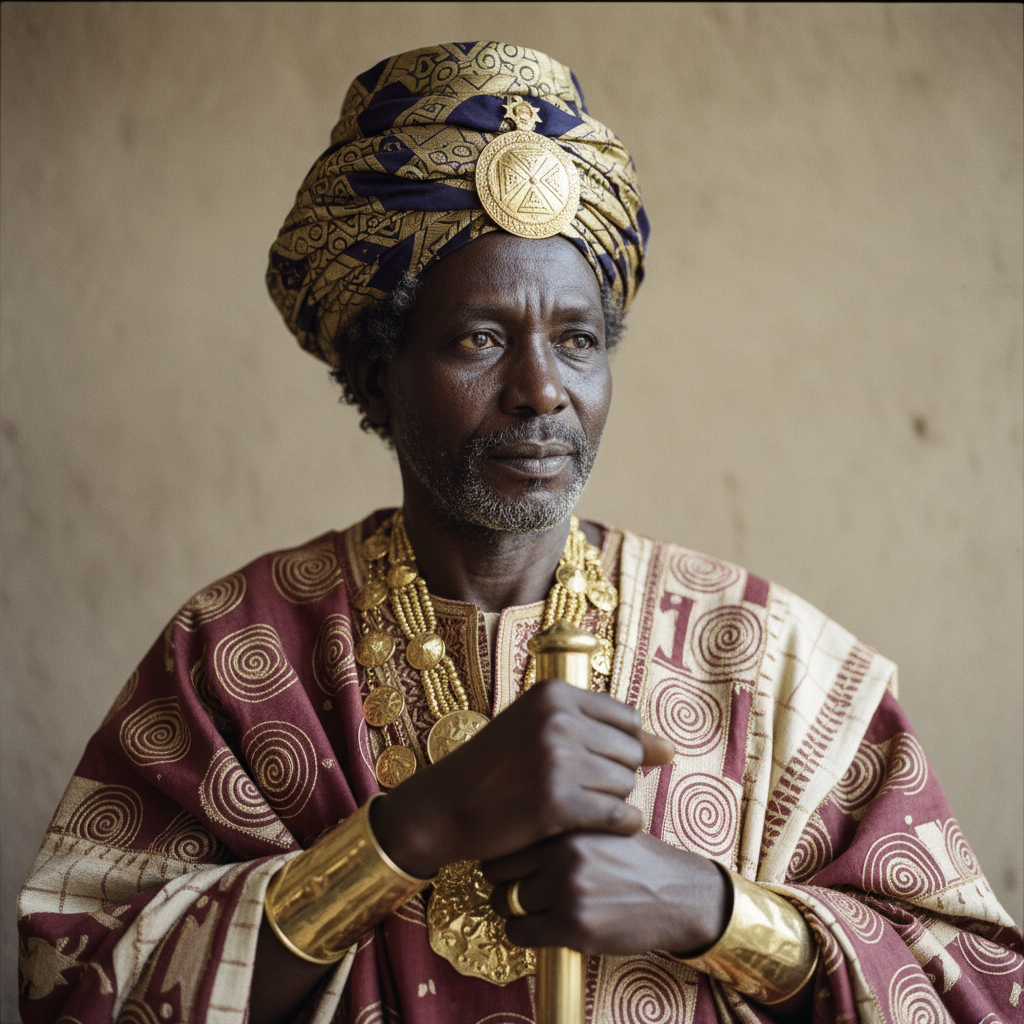
Skin tone: deep brown to very dark — a West African complexion that contemporary maps and chronicles emphasize. Facial features would have aligned with Mande traits: a broad nose, full lips, and strong cheekbones. Hair and facial hair: likely dark, tightly coiled hair, often kept short or wrapped beneath a turban or headdress; probably clean‑shaven or with a neatly trimmed beard common among elites of the region and era. Dress and regalia: lavish layered robes of fine cloth, richly dyed and embroidered, with heavy gold necklaces, bracelets, rings, and a visible gold object or ingot as a symbol of wealth; a crown or jeweled ceremonial headdress (sometimes shown in European maps) and possibly a staff or pendant of authority would complete his royal appearance. Bearing: mature and dignified, with a commanding, composed presence—seated or standing with an expectation of deference from a large retinue, his look designed to communicate power, piety (during the hajj) and boundless wealth.
Height / build
Likely tall for his time · Likely average to robust build
Hair
Likely black to dark, possibly graying · Likely tightly coiled (kinky) hair · Likely normal to slightly receding with age
Eyes
Likely dark (brown)
Complexion
Likely dark brown
Face
Likely broad to rounded face · Likely broad nose with rounded tip
Notable features
Dark skin, heavy gold jewelry, regal robes and turban/crown, commanding stature
Grooming
Probably a trimmed beard · As a Muslim ruler he likely wore a well‑kept beard, fashionable turbans or head coverings, and maintained visible signs of royal grooming.
Dress / presentation
Luxurious Mande/Mali royal robes and turbans with abundant gold ornaments and regalia
skin
Skin tone
Likely dark brown
Contemporary Arabic descriptions label him as a 'black' African and period European maps depict him with dark skin; fits West African population context.
height build
Height
Likely tall for his time
Rulers with superior nutrition and status often stood out physically; chroniclers emphasize his commanding presence during the hajj.
hair
Hair color
Likely black to dark, possibly graying
Typical pigmentation of Mande populations and age at the time of the hajj suggest dark hair that may show some graying.
hair
Hair texture
Likely tightly coiled
Tightly coiled/kinky hair is common in West African (Mande) populations and consistent with period descriptions and images.
eyes
Eye color
Likely dark (brown)
Brown eyes are overwhelmingly typical for the region and are the best-supported estimate.
grooming
Facial hair
Probably trimmed beard
Mansa Musa’s public image blended West African royal display with Islamic courtly norms: robes, turbans, ritual piety and visible generosity. In his world, lavish clothing and gold signaled legitimate rule and religious prestige—especially during a pilgrimage where public acts of charity reinforced both faith and status.
Mansa Musa came from the Mande (Mandinka) cultural sphere of the Sahel: populations there typically have dark brown skin, tightly coiled hair, and broad facial features. Imagining him in this regional context gives a responsible, humanized portrait rather than a generic or exoticized image.
Modern images often exaggerate gold or turn him into a caricature (purely mercantile 'gold king') or depict him with lighter or Europeanized features; period sources show a dark‑skinned, dignified African monarch whose regalia signaled wealth.
Modern depictions often reduce Mansa Musa to a one‑note 'gold king' caricature or portray him with Europeanized facial features. In reality, contemporary sources show a devout, dignified African monarch whose wealth was expressed through refined court dress and ritual generosity—not flamboyance alone.
Likely tall for his time—his status and nutrition would have made him stand out physically and he is described as commanding in contemporary accounts.
Likely dark brown, the typical eye color for West African populations of his region.
Likely black and tightly coiled; he may have had some graying by the time of his famous pilgrimage.
Probably a trimmed beard, consistent with elite Islamic grooming and the appearance of male rulers in his cultural sphere.
Luxurious Mande royal robes and turbans, with abundant gold jewelry and regalia—dress that emphasized piety and wealth.
We combine near‑contemporary written descriptions, a famous 14th‑century map image, and regional population context to form the most historically grounded image possible.
Catalan Atlas depiction of Mansa Musa
Catalan Atlas (Abraham Cresques project) · 1375
A seated, dark‑skinned king labeled 'Mansa Musa' wearing a crown and holding a gold object—an influential, stylized European depiction that highlights his skin tone and regalia.
Shihab al‑Umari’s account of Mansa Musa's hajj
Shihab al‑Umari, Masalik al‑Absar (14th century) · c. 1340s
A near‑contemporary Arabic chronicler describes Mansa Musa’s pilgrimage, emphasizing his wealth, the scale of his retinue, and that he was a 'black' African ruler who distributed vast amounts of gold.
Ibn Khaldun on the Mali Empire
Ibn Khaldun, Muqaddimah (14th century) · c. 1370s
Ibn Khaldun references the wealth and power of the Mali rulers; his work helps place Mansa Musa in regional political and cultural context though it is not a personal portrait.
European and North African chronicles and maps
Various 14th–16th century sources (European maps, chronicles) · 14th–16th c.
Later maps and chronicles often repeated an image of Mansa Musa as dark‑skinned and richly robed; these are derivative but show how his image was transmitted.
Regional/population studies (Mande peoples)
Anthropological and historical studies of the Mande (Mandinka) population · Modern scholarship
Provides population context for likely physical traits (skin tone, hair texture, facial proportions) appropriate for an educated visual reconstruction.
As a devout Muslim king who performed the hajj, he likely kept a neatly trimmed beard in line with elite Islamic grooming norms.
clothing
Regal dress
Luxurious robes, turbans/crown, heavy gold jewelry
Textual accounts stress his abundant gold and the Catalan Atlas shows a crowned, robed figure holding gold; West African rulers commonly wore robes and turbans to denote status.
face
Face shape
Likely broad to rounded
Typical facial proportions in the region and in later West African figurative art point to a broader face shape.
other
Sign of rank
Wore conspicuous gold and regalia
Multiple sources emphasize his extreme wealth and use of gold as visible regalia during the hajj and in diplomatic contexts.
comparison
Presence in a crowd
Would have appeared commanding and richly attired compared with most contemporaries
Chroniclers focused on his large retinue, gold gifts and the spectacle of his hajj—visual cues that made him stand out.