hair
Hair color
Likely dark to graying
Venetian origin and later portraits show dark hair often depicted turning gray in older depictions; Mediterranean populations of the time commonly had dark hair.
Portrait reconstruction
1254–1324 · Republic of Venice (traveller to Yuan China) · Late Medieval (13th–14th century)
Marco Polo most likely had dark hair, a Mediterranean complexion, and dressed like a Venetian merchant or a Yuan courtier when serving the Mongol elite.
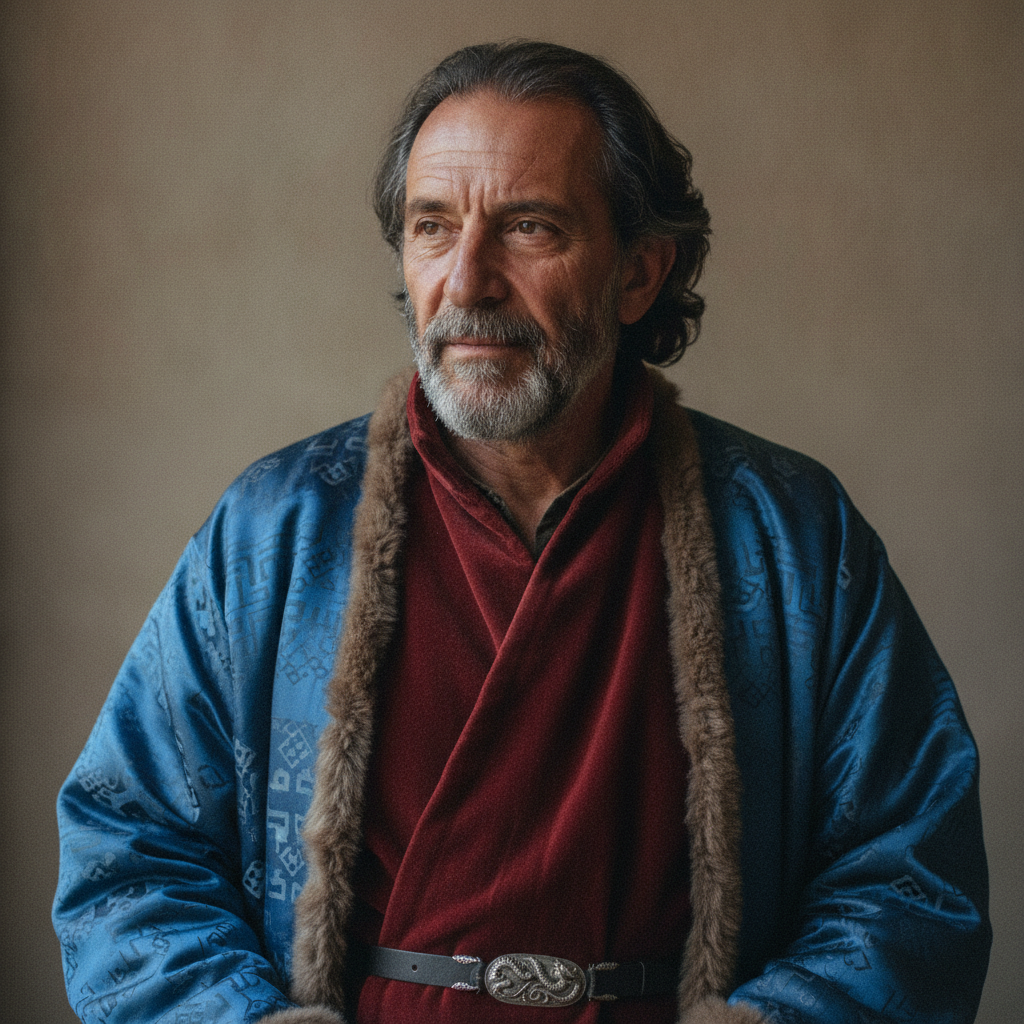
Hair was probably dark brown to black, cut simply and kept practical for travel; portraits and manuscript images repeatedly show him with dark hair and a high forehead, so a neatly trimmed style is a good working image. His skin tone would lean toward an olive or medium-tan Mediterranean complexion, with brown eyes and an alert, purposeful expression shaped by years on the road. Facial hair seems to have evolved: in younger years he was likely clean-shaven or with minimal moustache, while by middle age he is commonly shown with a short, well-kept beard rather than a long, flowing one. The overall face would read as mature and weathered by travel rather than idealized or heavily stylized. Build and bearing fit a merchant-adventurer: a moderate, wiry frame hardened by travel, practical hands, and the posture of someone used to negotiation and long journeys. Clothing varied with place—fine wool or silk robes, layered tunics and hoods in Venice; when at the Yuan court he would wear the richer, fur-trimmed robes and boots appropriate to Mongol elite fashion—still tailored for movement and status rather than armor or theatrical exoticism.
Height / build
Likely average height · Likely average to stocky build
Hair
Likely dark to graying · Likely straight to wavy · Likely receding with age
Eyes
Likely dark (brown)
Complexion
Likely Mediterranean complexion
Face
Likely oval to slightly angular · Likely straight to aquiline
Notable features
Trimmed beard, high forehead (often shown), prominent nose, worldly expression
Grooming
Probably a trimmed beard or short beard with moustache · Typically well-groomed for a merchant and courtier — trimmed facial hair, modestly kept hair, and clothing indicating status.
Dress / presentation
Venetian merchant dress with documented instances of Mongol/Yuan court garments while at Kublai Khan's court
hair
Hair color
Likely dark to graying
Venetian origin and later portraits show dark hair often depicted turning gray in older depictions; Mediterranean populations of the time commonly had dark hair.
eyes
Eye color
Likely dark (brown)
Brown eyes are dominant in Mediterranean populations and later portraits habitually show dark eyes or shaded eyes consistent with brown irises.
other
Beard
Probably trimmed beard
Most later portraits and popular images show Marco Polo with a short or medium beard; Venetian merchants and court officials commonly wore trimmed facial hair.
skin
Complexion
Likely Mediterranean complexion
Venetian origin and Adriatic maritime contacts make an olive to light‑brown Mediterranean complexion the likeliest description.
height build
Height
Likely average height
Medieval adult male height in northern Italy averaged at levels we would call average today; Polo's role as a merchant gives no reason to assume exceptional stature.
height build
In 13th‑century Venice, merchants signalled status through high‑quality fabrics, well‑cut garments, tidy facial hair and modest but visible jewelry; ostentation was balanced by mercantile respectability — Marco Polo would have dressed to show wealth, travel credibility, and reliability as a negotiator.
Marco came from a Venetian patrician‑merchant family whose people typically displayed Mediterranean physical traits—dark hair, brown eyes and olive skin—shaped by centuries of Adriatic trade and genetic exchange across the Mediterranean basin.
Modern films and later paintings often exoticize or orientalize him (e.g., turbaned or highly romanticized features) or make him look like a generic swashbuckling adventurer rather than a weathered merchant-courtier.
Films and romantic paintings often turn Marco into a swashbuckling hero or an exoticized East‑West hybrid (turbaned, overly ‘Oriental’), whereas historical evidence points to a Venetian merchant-courtier appearance: practical, status-conscious, and influenced by Mongol court dress only during parts of his life.
Probably average height for a 13th‑century Venetian man.
Likely dark (brown).
Likely dark, often shown graying in older depictions.
Probably a trimmed beard or short beard with mustache.
Venetian merchant clothing for public life, sometimes luxurious Mongol/Yuan court robes during his service at Kublai Khan's court.
No authenticated contemporary portrait survives; our visual picture relies on illustrated manuscripts and later portraits that reflect evolving traditions.
The Travels of Marco Polo (as told to Rustichello da Pisa)
Rustichello da Pisa — Il Milione (c.1298) · c.1298
Primary narrative source describing Marco Polo's life, roles and activities (rarely provides direct physical description but establishes roles and contexts that inform likely appearance).
14th–15th century illustrated manuscripts of Il Milione
Medieval illuminated copies of Marco Polo's Travels (various European libraries) · 14th–15th century (illustrations produced later than the text)
Early illustrated manuscripts show Polo in Venetian dress or in Mongol court garb and establish an early visual tradition, often depicting beard, high forehead and dark hair.
Renaissance printed portraits and woodcuts
Renaissance compilations and prints (e.g., Ramusio and later editions) · 15th–16th century
Renaissance portraits codified a familiar image of Marco Polo — bearded, middle‑aged, wearing robes — which influenced later popular representations.
Public statues and sculptural depictions
Later public statuary of Marco Polo (Venice and elsewhere) · 19th–20th century (various)
Modern statues reflect the long tradition of Polo's image: bearded, robed, and dignified — useful for popular imagination but shaped by later tastes.
Encyclopaedia and scholarly summaries
Encyclopaedia Britannica and academic reference works · 20th–21st century
Synthesize textual and iconographic evidence to give context for likely appearance (ancestry, social class, activities).
Studies of medieval Venetian population and dress
Scholarly works on medieval Italian dress and population · 20th–21st century
Provide background on typical physical traits, grooming and clothing of Venetian merchants that inform reconstructions of Polo's look.
Build
Likely average to stocky
A life of travel, provisioning and court duties suggests a solid, robust merchant body rather than a slender ascetic or heavily muscled warrior.
face
Nose
Likely straight to aquiline
Later iconography and Mediterranean facial types frequently depict a straight or slightly aquiline nose in Venetian portraits.
grooming
Hairline
Likely receding with age
Many later portraits show a high forehead and receding hairline consistent with an older man; Polo lived into middle/old age when depicted.
clothing
Dress
Venetian merchant dress; sometimes Mongol/Yuan court garments
As a merchant and envoy at Kublai Khan's court, sources and illustrations depict him both in Venetian-style mercantile clothing and in exotic court robes acquired during travels.
other
Overall presence
Worldly and authoritative
Repeated textual emphasis on his role as an envoy, interpreter and senior merchant imply a commanding, experienced appearance rather than youthful bravado.