other
Regional ancestry
Likely Galilean / Levantine Jew
Gospels identify her as 'of Magdala' (a Galilean town), so she most plausibly belonged to the local Jewish population.
Portrait reconstruction
0–0 · Magdala / Galilee (Roman Judea) · 1st century CE
Mary Magdalene most likely had dark hair, brown eyes, and an olive Mediterranean complexion, dressed modestly in first‑century Galilean clothing.
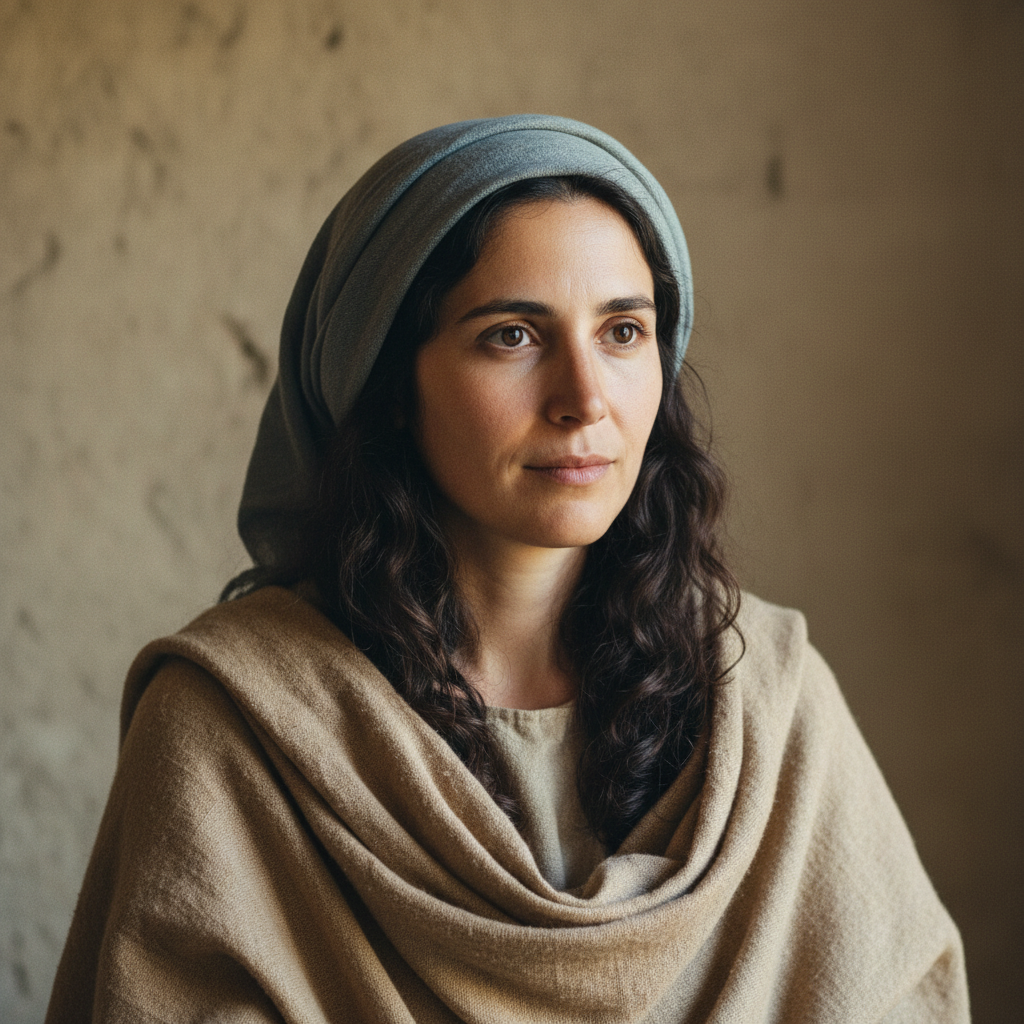
Face and hair: She likely had dark, coarse hair—worn long but commonly braided, bound, or covered when she was in public—and brown eyes with an olive to light‑brown complexion typical of the Levant. Facial features would read as Mediterranean: straight or gently shaped nose, full brows, and compact facial proportions rather than the high‑Cheekboned northern European ideal. Build and bearing: As an adult woman from a busy Galilean town, her build was probably sturdy and practical—muscular enough from daily work and movement, with hands and posture shaped by a life of household, community, or trade tasks. Height would fit regional averages for the period; she would present as healthy and active rather than delicate. Clothing and grooming: She would have worn layered garments—a simple linen or wool tunic topped by a heavier mantle—and practical sandals. Head coverings and veils were common for women in public, so her hair was often hidden or wrapped; when visible it was braided or tied back rather than loose. Modest jewelry or small personal ornaments were possible, and basic grooming like oiling the hair and using perfumes when available would be consistent with local practice.
Height / build
Likely average height · Likely average build
Hair
Likely dark (brown to black) · Likely wavy to curly · Likely full; hair usually tied or covered in public
Eyes
Likely dark (brown)
Complexion
Likely Mediterranean (olive to light brown)
Face
Likely oval to slightly angular · Likely straight to slightly prominent (Mediterranean profile)
Notable features
Dark eyes and hair, Mediterranean features, likely long hair (later tradition accentuates this)
Grooming
None · Modestly groomed—hair probably neat and tied up or covered; limited jewelry if any.
Dress / presentation
First‑century Galilean Jewish woman's garments: a simple linen/wool tunic (chiton), mantle (himation or outer cloak), and a head covering/scarf
other
Regional ancestry
Likely Galilean / Levantine Jew
Gospels identify her as 'of Magdala' (a Galilean town), so she most plausibly belonged to the local Jewish population.
hair
Hair color
Likely dark (brown to black)
Levantine populations overwhelmingly had dark hair; this is the standard for Jewish women of the region and era.
eyes
Eye color
Likely dark (brown)
Brown eyes predominate historically in the eastern Mediterranean; no sources suggest a different color.
skin
Complexion
Likely Mediterranean (olive to light brown)
Galilean Jews typically had olive/light‑brown skin tones consistent with the Levantine gene pool.
hair
Hair texture & style
Likely wavy to curly; long but usually tied or covered
Regional hair types and cultural practice of women covering hair in Jewish communities make this the most plausible presentation.
height build
Height
Likely average height
In 1st‑century Jewish Galilee, modesty, cleanliness, and conformity to communal norms mattered. Women signaled respectability through covered hair and simple, well‑kept clothing; attention to piety and service could be as socially important as outward adornment.
Picture a bustling lakeside town: fishermen, market sellers, synagogue-goers. Mary would look typical among them—olive skin, dark hair tied back, plain but practical garments—fitting the Levantine mix of Semitic features common across Galilee.
Modern art often depicts her as a European, blonde, or sexualized penitent; historically she was a Middle Eastern Jewish woman who likely dressed modestly.
Western art and films often recast Mary as a European beauty—fair skin, light hair, stylized robes—or as a sexualized penitent with exaggerated hair. Historically she was a Middle Eastern Jewish woman whose everyday appearance emphasized modesty over theatricality.
Likely average height for a 1st‑century Galilean woman.
Likely dark brown.
Likely dark—brown to black.
Probably yes—Jewish women commonly tied their hair and used a scarf or covering in public.
Likely modestly attractive by local norms—respected for piety and presence rather than striking ornamentation.
By combining her identification as 'of Magdala' (a Galilean town) with archaeological, anthropological, and dress‑history evidence to produce a likely portrait.
New Testament Gospels (Mark, Matthew, Luke, John)
Christian New Testament · late 1st century – early 2nd century CE (texts)
Identify Mary as 'of Magdala' (a Galilean town) and as a prominent female follower and witness; provide no physical description but establish location and role.
Archaeology of Magdala (first‑century synagogue, local finds)
Magdala archaeological project · excavations 2009–present (site 1st century CE)
Material culture from Magdala helps reconstruct the social and economic setting and likely dress/grooming practices of its inhabitants.
Population and anthropological studies of the ancient Levant
Anthropological and genetic surveys · 20th–21st century scholarship
Skeletal and genetic studies outline the common physical traits (dark hair, brown eyes, Mediterranean complexion) of Levantine populations in antiquity.
Byzantine icons and medieval hagiography
Byzantine icon tradition; Golden Legend · 6th–15th centuries
Later Christian art and legends developed a recognizable image of Mary (long hair, often shown penitentially), shaping Western visual memory though not reflecting 1st‑century reality.
Renaissance and Baroque paintings (e.g., Titian, Caravaggio)
European art tradition · 15th–17th centuries
These works popularized the long‑haired, often European‑featured Mary Magdalene and the repentant penitent imagery familiar today.
Early Christian writings and traditions (apocrypha, church fathers)
Various early Christian texts · 2nd–6th centuries
Later traditions expand her role and attributes but do not provide contemporary physical description; useful for understanding evolving image.
Skeletal data and historical studies place average female height in Roman Judea at a modest range—Mary would likely match local norms.
height build
Build
Likely average/slender
Everyday physical activity and nutrition in Galilean life suggest a lean-to-average build rather than corpulence.
clothing
Typical dress
Simple tunic and mantle with head covering
First‑century Jewish women's clothing was practical and modest—tunic (chiton), outer cloak, and head covering were typical.
grooming
Grooming & jewelry
Modestly groomed; little jewelry in public
Jewish norms and contemporary etiquette favored modest presentation; costly display would be less common among female disciples.
face
Facial features
Likely oval face with expressive features
Mediterranean facial proportions and typical portraits of Levantine women suggest an oval, expressive face; later art often emphasizes long hair and expressive eyes.
other
Public presentation
Respected, devout appearance
As a known follower who served in early Christian community, she'd likely present herself in a way reflecting piety and respectability.
Studies of first‑century Jewish dress and grooming
Scholarly works on ancient dress · 20th–21st century scholarship
Reconstructs typical clothing, head coverings, and grooming norms for Jewish women in Galilee, informing probable appearance.