height build
Height
Likely average to slightly below average height
Contemporary accounts describe her passing as a seaman without being noted for great height; practical seamanship suggests solid but not tall stature.
Portrait reconstruction
1685–1721 · English (active in Caribbean) · Early 18th century (Golden Age of Piracy)
Mary Read most likely looked like a tanned, broad‑shouldered sailor with short dark hair, a masculine bearing, and rough, work‑scarred hands.
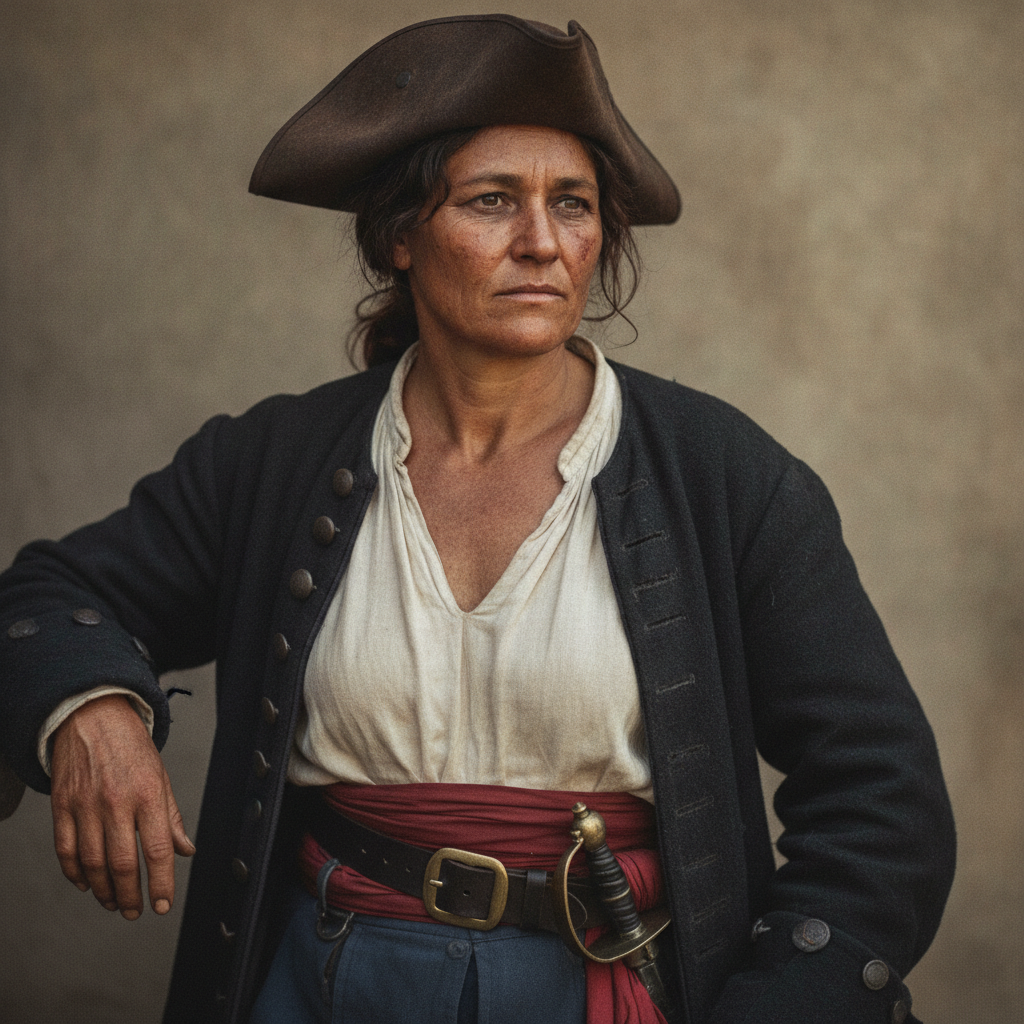
Face and hair: Probably dark brown hair kept short, cropped, or tied up beneath a cap or bandana so it wouldn’t catch on rigging; she would have shown little to no cosmetic adornment. Her skin was likely sun‑bronzed and wind‑chapped from long months at sea, with a lean, angular face and a steady, direct gaze—eyes likely brown or hazel. Build and bearing: Read would have had an athletic, compact frame shaped by hauling ropes and fighting—broad shoulders, strong forearms, and callused hands rather than a delicate silhouette. Contemporary descriptions emphasize a masculine bearing: erect posture, sure movements, and the physical confidence of someone used to the hard labor of a ship’s deck. Clothing and small details: She dressed as a man in common seafaring gear—linen shirts, breeches, a short coat or frock, a sash or belt for a cutlass, and sturdy boots—rarely anything decorative. Grooming was pragmatic: hair kept out of the way, no powdered wig or makeup, fingernails short, and an overall smell of tar, sweat, and sea salt; any pregnancy she later claimed would have been concealed within the same plain garments.
Height / build
Likely average to slightly below average height · Likely compact and muscular / sturdy
Hair
Likely dark brown to black · Likely wavy to straight · Likely full; often kept short or bound under caps
Eyes
Likely dark (brown)
Complexion
Likely weathered/tanned from long sea exposure
Face
Likely square to broad-jawed · Likely straight to slightly broad
Notable features
Masculine bearing, sturdy hands and forearms, likely scars or calluses from ship work; piercing dark eyes
Grooming
None (clean-shaven); may have used false whiskers when disguised · Practical short or tied hair, plain grooming, often wearing men's caps or wide-brim hats; functional rather than fashionable.
Dress / presentation
Men’s sailor / pirate clothing: coat, shirt, breeches, boots, sash, and hat—practical, utilitarian, and masculine
height build
Height
Likely average to slightly below average height
Contemporary accounts describe her passing as a seaman without being noted for great height; practical seamanship suggests solid but not tall stature.
height build
Build
Likely compact and muscular
Accounts emphasize her strength, fighting ability, and life doing shipboard work, which produces a sturdy, muscular build.
face
Facial appearance
Likely square/broad-jawed and masculine-presenting
Johnson’s narrative and trial descriptions emphasize a masculine aspect that helped her pass as a man at sea.
eyes
Eye color
Likely dark (brown)
As an English woman of probable British Isles ancestry, dark brown eyes are the best-supported estimate.
hair
Hair color
Likely dark brown to black
Contemporary and later descriptions do not emphasize fair hair; British/Irish background and typical portraits of sailors point to dark hair.
hair
Hair style
Pirate life rewarded toughness, practicality, and the ability to fight; flashy finery was less important than sturdy clothes, quick hands, and a hard face that could take a rope or a cutlass. Mary Read’s masculine, work-worn presentation would be an asset among crews that judged capability by action rather than by genteel refinements.
Born and raised in the British cultural sphere, Mary Read likely shared common regional traits—dark hair and eyes, medium stature—then added tropical sun-darkening. She would have looked recognizably British to other Europeans, but physically seasoned by long sea service and Caribbean climate.
Modern portrayals often either sexualize her or show her as overtly romanticized; the real Mary Read was more utilitarian and physically tough than glamorous versions suggest.
Movies and paintings tend to either glamorize female pirates (stylish, overtly sexualized) or turn them into caricatured swashbucklers; Mary Read was practical and roughened by her work. Her disguise relied on clothes and comportment, not on cinematic makeup or stylized beauty.
She was likely average to slightly below average height—sturdy rather than tall.
Likely dark (brown).
Likely dark brown to black, kept short or bound and usually covered by a cap or hat.
She was seen as commanding and rugged rather than conventionally delicate; contemporaries emphasized her masculine bearing and competence.
No—she was clean-shaven, though she used men's clothing and manner to appear male and may have used false facial accoutrements when needed.
They combine trial narratives, Johnson’s 1724 account, seafaring and population context, and later historical analysis to form a best-supported visual estimate.
A General History of the Pyrates
Charles Johnson (1724) · 1724
Principal near-contemporary narrative describing Mary Read’s life, her service disguised as a man, her strength, masculine bearing, and behaviour at trial; provides most of the surviving descriptive details about her appearance and presentation.
Kingston, Jamaica trial records (Calico Jack, Anne Bonny, Mary Read)
Court records and trial summaries (1720–1721) · 1720
Court proceedings record Mary Read’s capture, trial, and pleas (including the pregnancy plea); contemporary courtroom descriptions and witness statements confirm her male dress and that she served as a seaman.
19th–20th century illustrations and romantic portraits
Various artists and popular histories · 1800s–1900s
Several later images romanticize Mary Read—often showing her as glamorous or eroticized—which reflect imagination more than contemporary reality.
Modern historical syntheses
David Cordingly, Under the Black Flag; Marcus Rediker, Villains of All Nations · 1990s–2000s
Modern historians summarize primary accounts, place Read in social context, and emphasize her masculine presentation and maritime competence; useful for contextual appearance judgments.
Population and seafaring context
British Isles demographic and naval clothing sources · period reference
General data on regional phenotypes and seafaring grooming/clothing norms used to infer hair/eye color, skin tanning, and clothing choices.
No known contemporary portrait or mask
Survey of archives and portrait collections · modern survey
No authenticated life portrait, death mask, or likeness of Mary Read survives; later images are imaginative rather than documentary.
Short or bound under caps (practical)
To pass as a man and for shipboard practicality, she would keep hair short or tied and covered by hats or caps.
skin
Complexion / skin tone
Likely weathered/tanned
Years at sea and in the Caribbean would darken and weather the skin compared with indoor populations.
grooming
Facial hair / disguise
No natural facial hair; likely used male accoutrements to appear masculine (clothing, hat, possibly false whiskers)
Trial and narrative sources describe her successfully passing as a man; disguises included clothing and manner rather than actual facial hair.
clothing
Typical clothes
Men’s sailor/pirate clothing (coat, breeches, shirt, boots, hat)
Accounts repeatedly note she served dressed as a seaman and used male attire to move within ship life and in ports.
other
Presence
Commanding, obviously practical and tough in a room of civilians
Trial testimony and narratives emphasize her soldierly bearing and readiness for close combat, which would stand out among non-seafarers.