height build
Height
Likely tall for his time
Legendary descriptions and his role as an imposing leader/advisor imply an above‑average, authoritative stature.
Portrait reconstruction
0–0 · Britain (Brittonic/Arthurian tradition) · Early medieval & medieval legend
Merlin probably looked like an elder Brittonic sage—long dark hair and a full beard, keen brown eyes, robed and carrying a staff, equally at home in court or the wild.
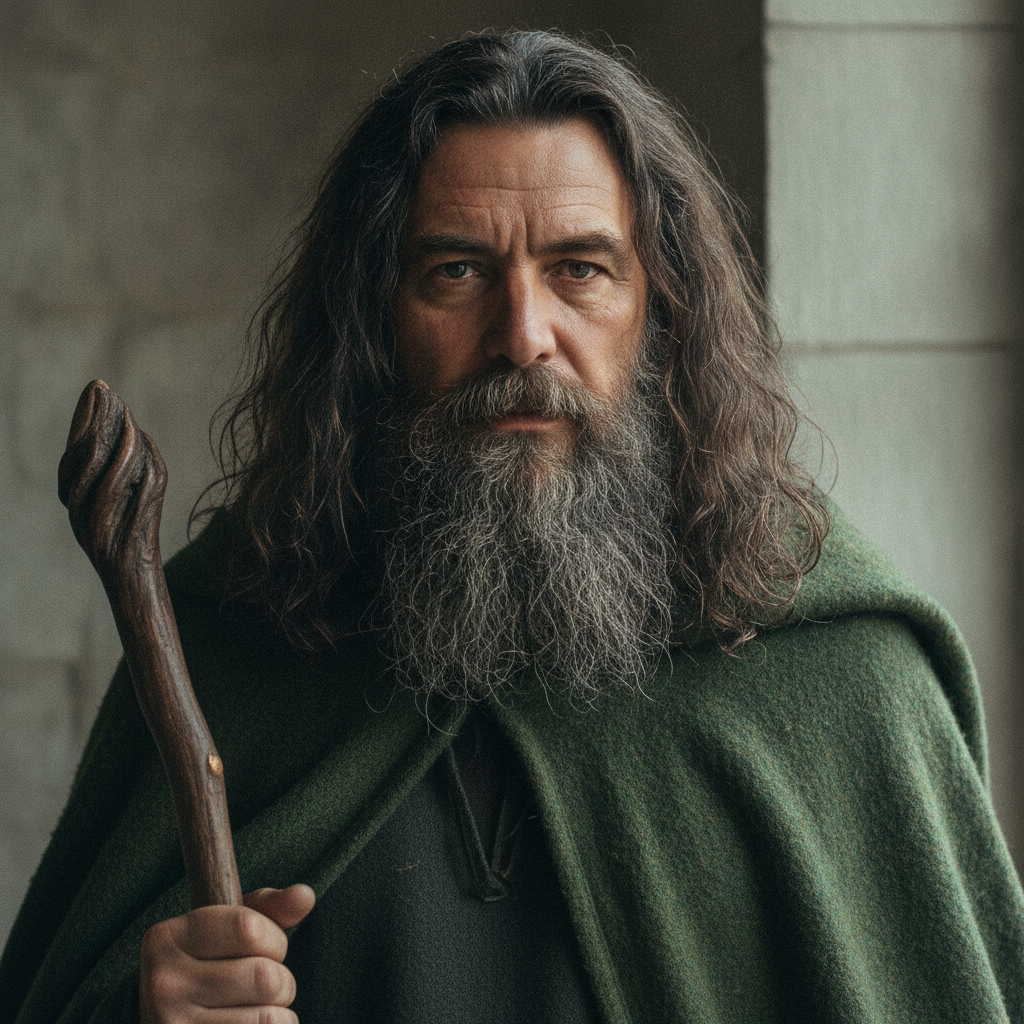
Silhouette and bearing: Picture a man whose presence commands attention rather than spectacle. He would likely be of middle to advanced age in most portrayals—stooped a little by years but steady, with a compact, purposeful posture and hands used to gestures of counsel or conjuration. Face, hair, and eyes: He probably had dark hair—long enough to brush his shoulders in many images—and a full beard framing a lined, weathered face. His eyes would be described as keen or intense; brown eyes are the likeliest choice for a Brittonic figure of this era. Complexion would range from olive-tinged to fairer tones depending on season and lifestyle, with a sun-weathered quality if he spent time outdoors. Grooming and movement: Merlin’s hair and beard could be either carefully kept when serving at court or wild and unkempt when living as a forest prophet; both looks appear in the tradition. Expect strong, expressive hands, a steady gait, and a voice that carries authority—small signs of scholar and wanderer combined.
Height / build
Likely tall for his time · Likely lean to wiry
Hair
Likely dark to graying · Likely wavy · Likely mature (slightly receding to full) with long length
Eyes
Likely dark
Complexion
Likely medium/fair but weathered
Face
Likely long/rectangular · Likely prominent, straight
Notable features
Piercing, prophetic gaze; long beard and hair; weathered skin and a commanding bearing
Grooming
Full long beard · Often long and either carefully kept in courtly depictions or deliberately unkempt in the 'wild prophet' tradition.
Dress / presentation
Long woolen cloak or robe, hood or mantle; sometimes a simple staff and symbolic accoutrements
height build
Height
Likely tall for his time
Legendary descriptions and his role as an imposing leader/advisor imply an above‑average, authoritative stature.
height build
Build
Likely lean to wiry
Traditions present him as active—formerly martial and/or living in the wild—favoring a sinewy, muscular frame.
hair
Hair color
Likely dark to graying
Brittonic population norms combined with frequent depiction of Merlin as an older man whose hair is dark but streaked with gray.
hair
Hair texture & style
Likely wavy, long
Medieval images and poetic depictions favor long hair for sages and druids; Celtic hair often described as wavy.
other
Facial hair
Full, long beard
Across medieval sources and images Merlin is typically bearded—symbolic of age and wisdom.
eyes
Eye color
Likely dark
Brittonic populations commonly had brown/dark eyes; texts emphasize keen, piercing eyes rather than specific color.
In early medieval and medieval Brittonic culture age, visible learning, and grave bearing were primary marks of authority. A long beard, tall stature, calm but intense eyes, and the garments of a learned man (long cloak, mantle) communicated wisdom and leadership far more effectively than youth or ornament.
Merlin should be pictured as a Brittonic man of post‑Roman Britain: likely dark hair and brown eyes were common, with a skin tone ranging from fair to olive depending on ancestry. Regional variation existed, but a slightly sun‑tanned, weathered look fits both court life and time spent outdoors.
Modern portrayals amplify the pointy hat, white wizard beard, and theatrical accoutrements; medieval sources emphasize prophetic gravitas, mixed courtly polish and sometimes wildness.
Contemporary fantasy often reduces Merlin to a white-bearded 'wizard stereotype' with a pointy hat and starry robe. Medieval sources rarely describe such theatrical costume; they emphasize age, prophecy, and a mix of courtly polish and, in some traditions, wild, uncanny appearance.
Likely tall for his time—legend presents him as imposing and authoritative.
Likely dark—brown or deep hazel, often described as keen or piercing.
Likely dark that is partially graying with age.
Yes—typically a full, long beard (a primary sign of age and wisdom).
Long woolen robes or a cloak, often hooded or mantled; sometimes a staff or symbolic object.
Probably not exactly—the iconic white‑bearded, pointy‑hat wizard is a later fantasy stereotype; medieval sources stress a bearded, grave sage in robes, not theatrical costume.
Historia Regum Britanniae (The History of the Kings of Britain)
Geoffrey of Monmouth · c. 1136
Geoffrey fused Welsh prophetic material with other traditions to produce the courtly, prophetic Merlin—shaping the image of a wise, often elder advisor who appears in robes and exercises authority.
Myrddin (Myrddin Wyllt) poems
Black Book of Carmarthen and other Welsh sources · poems recorded c. 12th century (traditions older)
Welsh prophetic poems portray a ‘wild’ Myrddin — a forest‑dwelling prophet with unkempt appearance and intense visionary eyes, shaping the 'mad prophet' aspect of Merlin.
Robert de Boron and the Vulgate Cycle
Late 12th–13th century romances · c. 1190–13th c.
Courtly romances develop Merlin as magician and tutor—emphasizing learned robes, magical tools, and a role at court that informs his later typically robed, sage-like appearance.
Le Morte d'Arthur
Thomas Malory · 1485
Malory’s compilation cements popular medieval imagery of Merlin as an aged, bearded counselor figure present at court and in prophetic episodes.
Medieval and early modern manuscript illustrations
Various Arthurian manuscripts and woodcuts · 12th–17th centuries
Illustrations repeatedly show Merlin with long hair and a full beard, robed and often holding a staff—visual templates that informed later popular images.
Regional/population studies of post‑Roman Britain
Scholarly syntheses · Modern scholarship
Demographic context for Brittonic phenotypes: dark hair and brown eyes were common; complexion ranged regionally. This informs likely hair and eye color choices.
skin
Complexion
Likely medium/fair but weathered
Brittonic background allows fair to olive tones; a life outdoors or at court would give a sun‑weathered appearance.
grooming
Grooming
Either neatly kept (court) or deliberately unkempt (wild prophet)
Two main traditions: Geoffrey and courtly romances depict a polished advisor; Welsh 'Myrddin Wyllt' poems depict a mad/wild prophet living outdoors.
clothing
Clothing style
Long woolen cloak/robe, hood or mantle
Courtly advisers and learned men are shown in robes; later imagery adds druidic or ecclesiastical cloaks and a staff.
other
Distinctive presence
Piercing, prophetic gaze and commanding bearing
Literary descriptions emphasize his prophetic power and authority more than decorative features—this is the most striking trait.
face
Facial shape & nose
Likely long face with a prominent straight nose
Conventional medieval portraits and descriptions of leaders present prominent, straight noses and elongated faces as signs of authority.