hair
Hair color
Likely dark to graying
As a Levantine male raised in Egypt and living decades outdoors, dark hair that grays with age is the expected pattern and fits many later descriptions.
Portrait reconstruction
0–0 · Lev ant / Egypt · Late Bronze Age / Ancient Near East
Moses most likely had olive-toned skin, dark brown hair, brown eyes, a commanding, weathered face, and the beard or facial hair typical of a male leader in his world.
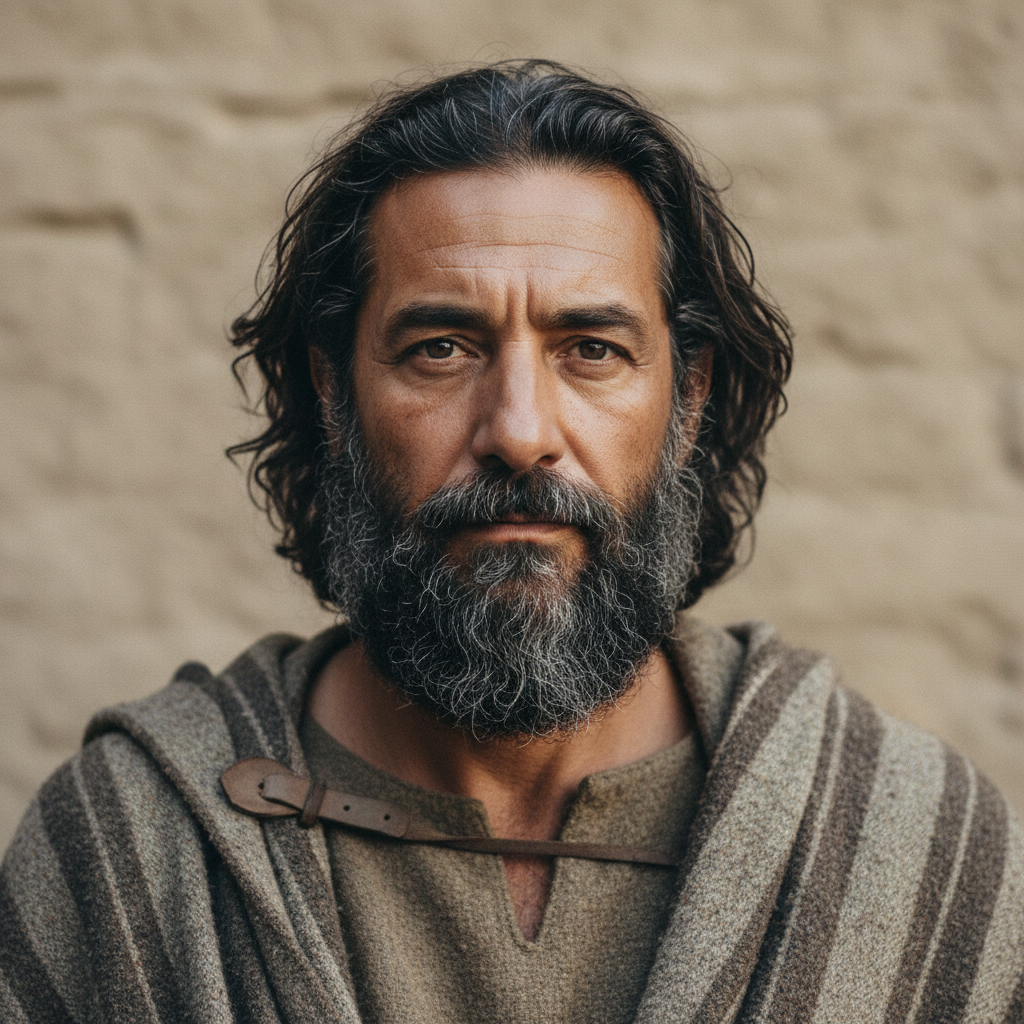
Skin and coloring: Picture an olive to warm brown complexion common across the Levant—sun-darkened from outdoor life but not extreme desert-burnished bronze. His hair was likely dark brown or black, full and coarse rather than fine, with deep brown eyes and strong, direct features. Face and facial hair: He probably had a prominent, slightly aquiline nose and defined cheekbones that gave his face authority when he spoke; descriptions of a ‘‘radiant’’ face suggest an expressive, light-catching visage—lined with age and experience rather than smooth or youthful. As a mature male leader he would most often wear a beard or neatly trimmed facial hair, groomed to signal status and seriousness. Hair, grooming and headwear: Raised in an Egyptian court but rooted in Levantine culture, his grooming could shift—Egyptian-style close shaving or wigs for ceremonial contexts, and practical shoulder-length or shorter hair with a wrapped headcloth while travelling. Clothing would be simple, layered tunics and a cloak, with hair and head coverings adapted to sun and sand. Build and bearing: Think of a lean, sturdy frame shaped by years of shepherding and long desert journeys rather than heavy armor or bulk; his posture would be upright and authoritative, with weathered hands and a presence that read as resilient, sober, and commanding.
Height / build
Likely average height · Likely lean and sturdy
Hair
Likely dark to graying · Likely wavy to curly · Likely full in youth, graying and possibly receding in later life
Eyes
Likely dark (brown)
Complexion
Likely Mediterranean / olive
Face
Oval to angular · Straight to slightly prominent (aquiline‑leaning)
Notable features
Commanding expression; tradition emphasizes a ‘radiant’ face after Sinai; likely a prominent nose and deep set eyes.
Grooming
Likely full beard · Beard worn as a sign of manhood and authority, trimmed for practicality and ritual cleanliness.
Dress / presentation
Simple Semitic shepherd/leader robes and cloak (wool or linen), sandals; when in Egypt or courtly settings, finer garments may appear.
hair
Hair color
Likely dark to graying
As a Levantine male raised in Egypt and living decades outdoors, dark hair that grays with age is the expected pattern and fits many later descriptions.
eyes
Eye color
Likely dark (brown)
Dark brown eyes are overwhelmingly common in ancient and modern Levantine populations; no contemporary text gives a contrary detail.
skin
Complexion
Likely Mediterranean / olive
Regional ancestry and sun exposure from outdoor life make an olive tone most probable.
grooming
Facial hair
Likely full beard
Beards were a Near Eastern marker of manhood, leadership and ritual status in Hebrew and neighboring cultures.
height build
Height
Likely average height
Late Bronze Age Levantine male statures cluster in the modern 160–168 cm range; no source claims unusual height.
height build
Build
Likely lean and sturdy
In the ancient Near East, leadership appearance emphasized age, maturity (beard and gray hair), cleanliness for ritual, and practical dress that communicated status without ostentation. A weathered but dignified face, an orderly beard, and modest yet well‑kept robes would signal Moses’ authority to both peasants and officials.
Moses would have belonged to the Late Bronze Age Levantine pool—genetically and visually close to Canaanite, early Israelite, and some Egyptian populations. Think Mediterranean features: olive skin, dark eyes, dark wavy hair—regional continuity makes these traits the default mental image.
Modern Western images often show Moses as a white European with flowing pale hair or (from a translation error) with horns; historically he was almost certainly a dark‑haired Levantine with olive skin and a beard.
Many Western artworks and films present Moses as a white European with pale skin and light hair; a famous sculptural tradition even gave him horns because of a mistranslation. Historically, Moses was almost certainly a dark‑haired, olive‑skinned Levantine with a beard—not a Nordic stereotype nor literally horned.
Probably average height for a Late Bronze Age Levantine male (roughly 160–168 cm / 5'3"–5'6").
Likely dark brown.
Likely dark and wavy to curly, turning gray with age.
Yes—most likely a full beard, a standard sign of maturity and authority in his culture.
Practical Semitic robes: a wool or linen tunic, a cloak, and sandals; in certain scenes he may be shown in finer garments linked to his time in Egypt.
A Latin translation quirk turned the Hebrew term for 'radiant' into a word that suggested 'horns,' and European artists then depicted him as white and often horned—an artistic tradition disconnected from his Levantine origins.
Hebrew Bible — Exodus 34 (Moses' face described as radiant)
Hebrew Bible, Exodus 34:29–35 · Traditionally 1st millennium BCE (text compiled later)
Describes Moses' face as 'radiant' after meeting God on Sinai; this textual image strongly influenced later portrayals of a striking, luminous visage.
Josephus — Antiquities of the Jews (descriptive presentations of Moses)
Flavius Josephus, Antiquities · 1st century CE
A Jewish–Roman historian's account that portrays Moses as a noble and authoritative figure; useful for tracing later ancient perceptions though not contemporary description.
Philo of Alexandria (Moses as ideal philosopher-prophet)
Philo · 1st century BCE–1st century CE
Hellenistic Jewish philosopher presents Moses in idealized philosophical terms—shaping Hellenistic visual and textual images of him.
Michelangelo — Moses (statue)
Michelangelo Buonarroti · 1513–1515 CE
Renaissance sculpture that popularized the horned Moses (from a Vulgate mistranslation) and a bearded, older leader figure; influential for Western visual imagination.
Jerome's Latin Vulgate (translation note leading to 'horns')
Saint Jerome, Vulgate · 4th–5th century CE
Rendering of Hebrew 'keren' in a way that gave rise to horned depictions of Moses in medieval and Renaissance art.
Ancient Near Eastern art and dress corpus
Archaeological studies of Levant/Egypt dress · archaeological record; studied modernly
Provides parallels for clothing, grooming, and hairstyles (tunics, cloaks, sandals, beards) appropriate to a Levantine leader and shepherd.
A shepherd and nomadic‑leader lifestyle with long marches and manual tasks produces a wiry, enduring physique.
face
Facial appearance / notable feature
Commanding expression, tradition reports a 'radiant' face after Sinai
Exodus describes Moses' face as shining after meeting God—this shaped later visual traditions of a striking, luminous appearance.
hair
Hair texture
Likely wavy to curly
Wavy to curly hair textures are common among Levantine populations and appear in ancient Near Eastern art.
clothing
Dress
Simple Semitic shepherd/leader robes; cloak; sandals
Biblical narratives place Moses as a shepherd, nomadic leader, and time in Egyptian court—practical wool/linen robes and a cloak fit all roles.
comparison
Relative attractiveness
Commanding and respected, not idealized beauty
Tradition emphasizes authority, piety, and presence (radiance) over classical notions of beauty.
Levantine population genetics and osteology summaries
Lazaridis et al.; Haber et al. (population studies) · 2016–2017 (modern research)
Genetic and osteological studies showing continuity of Mediterranean/Levantine traits (olive skin, dark hair, brown eyes) in ancient Near Eastern populations—useful context for likely appearance.
Rabbinic and Midrashic descriptions
Various rabbinic texts and Midrashim · Classical rabbinic period (1st–6th centuries CE and later compilations)
Later Jewish tradition often elaborates on Moses' looks and stature and preserves the theme of a radiant, authoritative figure; useful for tracing how appearance was remembered and idealized.