hair
Hair length
Very long—hip to knee length was common
Heian aristocratic women wore suberakashi—long, uncut hair was a principal beauty marker in period paintings and texts.
Portrait reconstruction
0–0 · Heian-kyō (modern Kyoto), Japan · Heian period (c. late 10th–early 11th century)
Murasaki Shikibu likely presented with long black hair, a pale powdered face with painted brows and lips, and many layered silk robes of the Heian court.
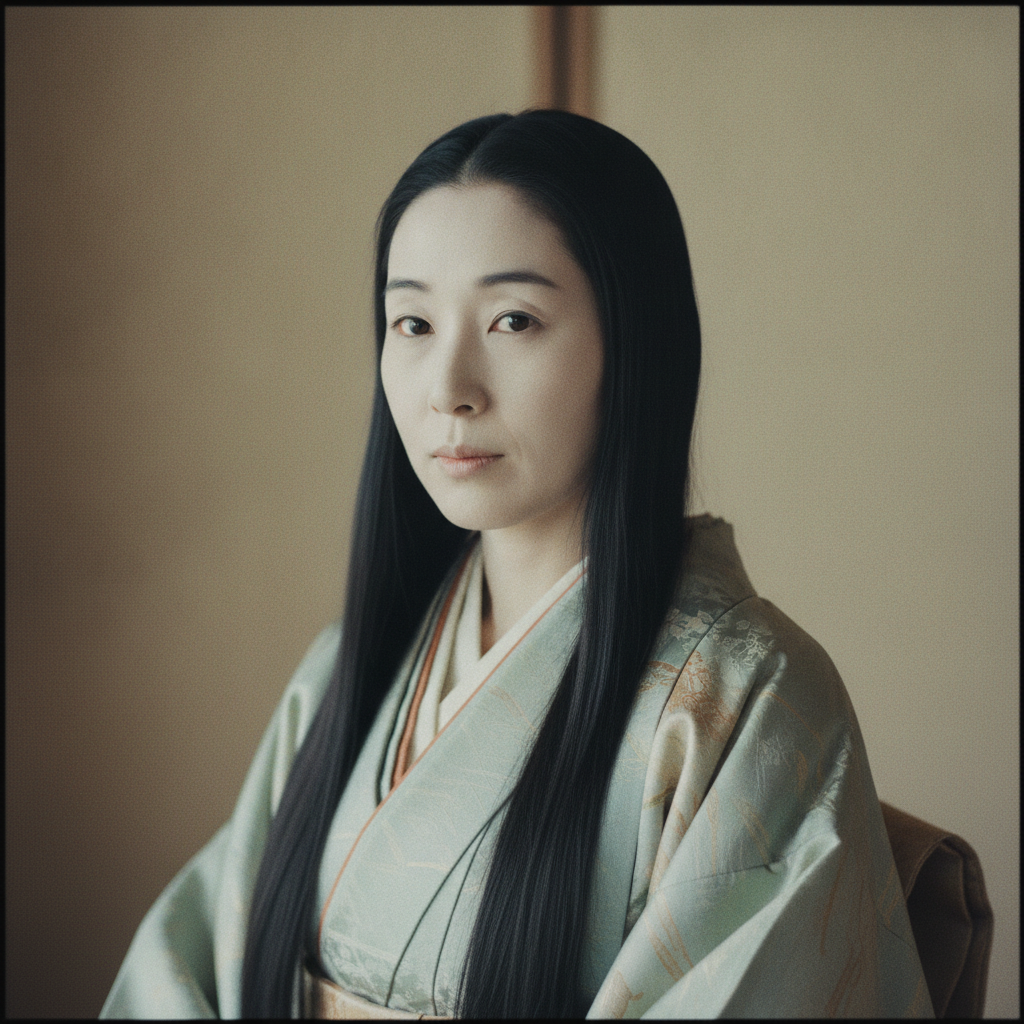
Her hair was probably the most striking feature: long, straight, and glossy black worn loose or flowing down her back in the taregami style that Heian noblewomen favored. Eyes would have been dark brown, set in a face made intentionally pale with white powder (oshiroi) to match the court ideal of delicacy. Her brows were likely plucked or shaved and repainted higher on the forehead (hikimayu), and her mouth small and defined with red pigment (beni) applied to suggest the fashionable tiny mouth. Facial hair would not have been visible — she was probably clean-shaven in the sense of having no beard or mustache and presenting a smooth, deliberate visage. For formal occasions she would have worn multiple layers of silk—jūnihitoe-style robes—with long sleeves and careful color combinations; these voluminous layers hid the body’s contours and emphasized graceful posture and measured movement. In quieter moments at court she likely chose simpler robes and lighter makeup, but the same essentials—long black hair, pale face, painted brows and lips—remained the visual shorthand of her rank and role.
Height / build
Likely average height for Heian court women · Likely slender
Hair
Likely black · Likely straight, smooth · Likely natural; hair usually worn long and center-parted or tied back
Eyes
Likely dark
Complexion
Likely very pale (white facial powder applied)
Face
Likely oval to soft-rounded · Likely small to medium, low-to-moderate bridge
Notable features
Very long black hair, pale powdered face, painted high eyebrows, layered silk robes (jūnihitoe)
Grooming
Probably none · Long uncut hair (suberakashi) styled simply; painted brows (hikimayu) and white face powder (oshiroi) were part of court grooming; she may have had blackened teeth if following some aristocratic customs.
Dress / presentation
Heian court dress—multiple layered silk robes (jūnihitoe), subtle colors and patterns indicating rank
hair
Hair length
Very long—hip to knee length was common
Heian aristocratic women wore suberakashi—long, uncut hair was a principal beauty marker in period paintings and texts.
hair
Hair color
Likely black
Native Japanese population and visual sources consistently depict dark/black hair for Heian court women.
hair
Hair texture
Likely straight and smooth
Period art and literary praise emphasize long, straight, lustrous hair as an ideal for aristocratic women.
skin
Complexion
Likely very pale (white-powdered)
Heian beauty practices used o-shiroi (white powder); painted portraits and texts highlight pale faces as fashionable.
grooming
Eyebrows
Hikimayu — eyebrows redrawn higher on the forehead
Heian court women practiced hikimayu (plucking/moving eyebrows) and this is visible in paintings and described in contemporary accounts.
clothing
Typical dress
Jūnihitoe—multi-layered court kimono
In Heian court culture appearance was a coded language: long black hair, ivory-white powdered faces, and carefully placed eyebrows signaled nobility, marriageability, and taste. Murasaki's look would therefore be less about unique facial features and more an expression of rank and cultivated restraint.
As a daughter of a provincial noble and later a lady at the capital, Murasaki belonged to a court population characterized by dark hair and eyes and East Asian facial proportions; her visible differences would be social markers—hair length, powdered face, robes—rather than exotic physiognomy.
Modern images often romanticize her as either a dreamy adolescent or a cinematic beauty; in reality she likely appeared as a literate, composed adult court lady whose elegance came from dress and manner more than striking individual features.
Popular portrayals often show Murasaki as either a coquettish ingénue or a modern glamorized beauty; in contrast, period sources and paintings present court women as stylized and abstracted—distinctive for costume and grooming more than individualized facial likeness.
Likely average height for Heian court women—shorter than modern averages but unremarkable among her peers.
Likely dark (brown to black).
Likely long, straight black hair worn loose or tied back in court styles.
Probably regarded as elegant and refined—an appearance valued at court—rather than famed for an extraordinary individual beauty.
No—adult court women would not have facial hair.
No authenticated contemporary portrait survives; our image is built from early emaki, later portraits, and textual descriptions that reflect Heian court styles.
Murasaki Shikibu nikki (The Diary of Murasaki Shikibu)
Murasaki Shikibu · early 11th century (diary entries)
Personal diary entries place her at court and describe social life, grooming habits, and court dress indirectly informing her probable appearance and comportment.
The Tale of Genji (Genji Monogatari)
Murasaki Shikibu · c. 1000–1010 CE
Literary descriptions and the novel's milieu provide cultural ideals of beauty—long hair, white faces, restrained comportment—that inform reconstructions of Murasaki's look.
Genji Monogatari Emaki (The Tale of Genji handscroll illustrations)
Heian–Kamakura period emaki (12th century) · 12th century (illustrations)
Early illustrated scrolls depict Heian aristocratic women with long black hair, white powdered faces, painted brows, and multi-layered robes—establishing the visual conventions for court female appearance.
Nō and emakimono portraits of Murasaki (later medieval and early modern portraits)
Various artists and schools (13th–17th c.) · 13th–17th century
Later painted portraits standardize Murasaki's image according to Heian ideals—long black hair, white face, court robes—though these are idealized rather than documentary likenesses.
Museum studies on Heian court dress
Metropolitan Museum of Art and other museum catalogs · modern scholarship
Detailed reconstructions of jūnihitoe and court grooming practices clarify how a court lady like Murasaki would have looked in formal dress and what visual signals rank conveyed.
Encyclopaedia Britannica entry: Murasaki Shikibu
Encyclopaedia Britannica · modern reference
Concise modern scholarly overview of her life, court position, and cultural milieu used to ground physical appearance in social context.
Heian court ladies of her rank wore several layered silk robes whose colors and arrangement signaled rank and season.
eyes
Eye color
Likely dark (brown to black)
Native East Asian populations in Heian Japan had dark irises; emaki depict dark eyes without western irises.
height build
Build
Likely slender
Court etiquette, heavy layered robes, and literary descriptions emphasize elegance and slender silhouettes rather than robust build.
other
Facial hair
Probably none
Adult aristocratic women in Heian Japan did not have facial hair; grooming norms stress smooth pale faces.
cultural
Public bearing
Reserved, composed, literary elegance
Court life prized quiet composure and refined manners; Murasaki's diary and literary role indicate a dignified, bookish presence.