height build
Height
Likely slightly above average height
Elite nutrition and the imposing presentation in royal contexts make a slightly above‑average stature plausible.
Portrait reconstruction
634 BCE–562 BCE · Babylon (Mesopotamia; modern Iraq) · Neo-Babylonian (7th–6th century BCE)
Nebuchadnezzar II likely appeared as a broad‑shouldered, dark‑haired Mesopotamian king with a long, elaborately curled beard and richly ornamented robes.
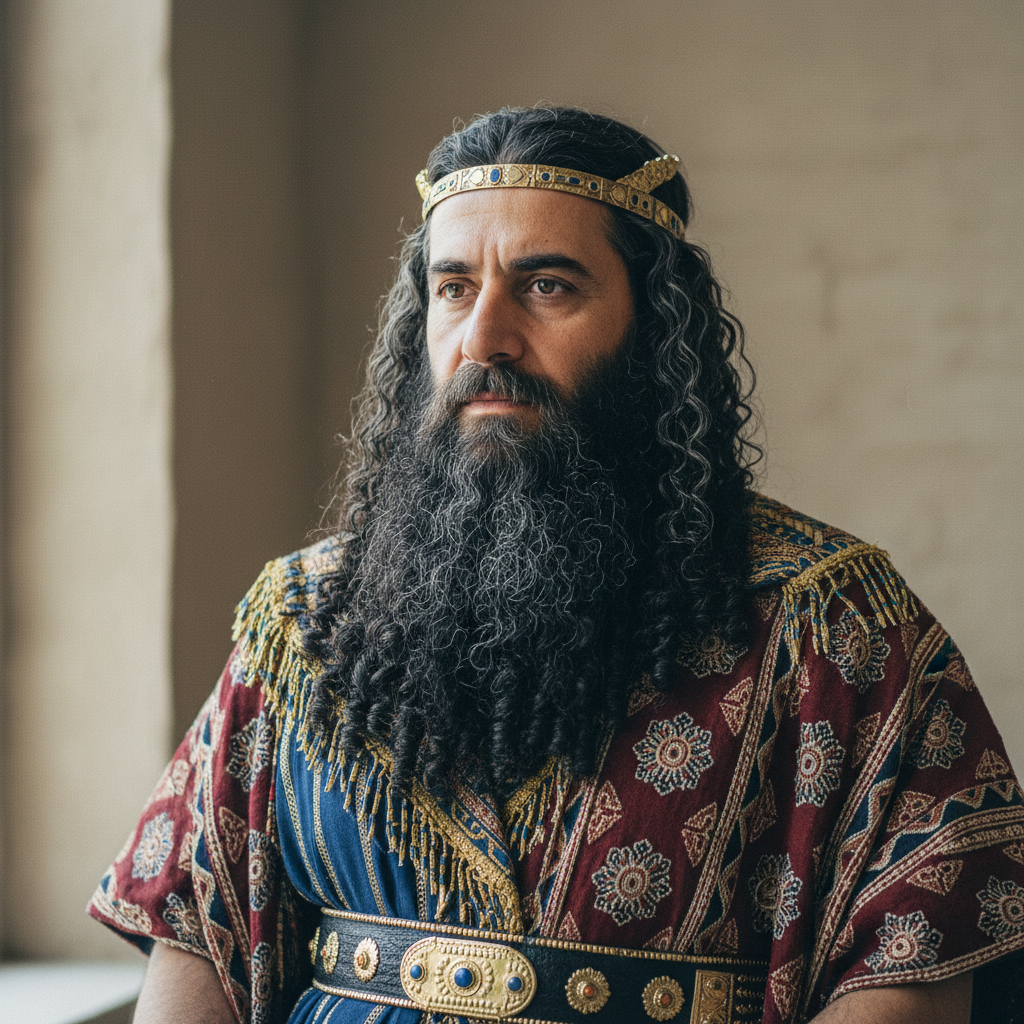
Face: Expect a broad, commanding face with a straight to aquiline nose, full cheeks, and deep-set, almond-shaped eyes—features emphasized in Mesopotamian royal art to convey presence and authority. Skin tone would have aligned with southern Mesopotamian populations: olive to darker hues and dark eyebrows framing the gaze. Hair and beard: He most likely wore dark hair arranged in the formal, ordered rows seen on seals and statues, falling to the shoulders or tied at the back; the beard would have been long, thick, and carefully styled into tight, horizontal curls or ringlets—an explicit symbol of kingship and masculinity in his culture. Regalia and dress: Nebuchadnezzar would have worn richly patterned robes with wide, decorated borders and embroidered fringes, often in deep blues, golds, and earth tones that echoed Babylon’s glazed-brick color palette. A narrow diadem or fillet—decorated with metalwork or precious stones rather than a horned crown—would sit at the hairline, accompanied by collars, armlets, and occasionally a ceremonial staff. Bearing and scale: In public he projected compact, muscular strength—broad shoulders, upright posture, and a measured, authoritative expression designed to read well at processions and on reliefs rather than a fragile individualized likeness.
Height / build
Likely slightly above average height for his time · Likely stocky / robust
Hair
Likely dark to graying · Likely wavy to curly · Likely mature (possibly receding at temples) in later life
Eyes
Likely dark
Complexion
Likely olive to light‑brown
Face
Likely broad to oval face · Likely prominent/aquiline nose
Notable features
Full curled beard, prominent nose, strong jawline, authoritative bearing
Grooming
Likely long, full, elaborately curled and styled beard · Highly groomed — royal beard and hair arranged in stylized rows/curls, with visible attention to trimming and presentation.
Dress / presentation
Elaborate Neo‑Babylonian royal robes: fringed tunic, patterned cloak, decorative belt, and a royal crown/diadem (sometimes horned to imply divinity)
height build
Height
Likely slightly above average height
Elite nutrition and the imposing presentation in royal contexts make a slightly above‑average stature plausible.
height build
Build
Likely stocky / robust
Mesopotamian rulers are typically shown as solid and well‑nourished; ruling lifestyle supports a robust build.
hair
Hair color
Likely dark to graying
Regional population traits and artistic depictions indicate dark hair; later images and descriptions imply aging with graying temples.
hair
Hair texture
Likely wavy to curly
Contemporary seals and reliefs show stylized wavy/curled hair rows common across Mesopotamian royal depictions.
grooming
Facial hair
Likely long, full, elaborately styled beard
Babylonian and Assyrian royal images consistently portray kings with long, curled, and carefully arranged beards as a symbol of masculinity and authority.
hair
Hairline
In Neo‑Babylonian culture a king's appearance was a public statement of power and piety: elaborate textiles, a long styled beard, and symbolic headgear identified him as an intermediary with the gods and as a stable, commanding figure. Groomed hair and beard signaled masculinity and authority rather than mere vanity.
Nebuchadnezzar belonged to a West Asian/Mesopotamian population mix typical of southern Iraq: people with olive to light‑brown complexions, dark eyes, and dark hair. Elite lifestyle, foreign retinues, and slavery introduced diversity, but his core appearance would reflect local Mesopotamian types.
Modern images often exaggerate fantasy features (very pale skin, Europeanized faces, or totally bald caricatures); actual Mesopotamian royal imagery emphasizes dark hair, beards, and richly patterned garments.
Many films and paintings either Europeanize Nebuchadnezzar with pale skin and light eyes or turn him into a fantasy monster; historically, he would have looked Near Eastern with dark features, carefully styled hair and beard, and rich but regionally typical garments.
Likely slightly above average height for his time.
Likely dark.
Likely dark, wavy to curly — probably graying at the temples in later life.
Probably a long, full, carefully curled and styled beard.
Elaborate royal robes and a diadem or crown, with decorative fringes and patterned textiles.
No single confirmed life portrait survives; reconstructions rely on Neo‑Babylonian royal iconography and contemporary artifacts.
Neo‑Babylonian royal statuary and votive images (general corpus)
Neo‑Babylonian archaeological record · 7th–6th century BCE
Various statues and reliefs from the Neo‑Assyrian/Neo‑Babylonian world show kings with long, curled beards, stylized hair, and richly ornamented garments — stylistic templates likely applied to Nebuchadnezzar as well.
Ishtar Gate and Processional Way (Babylon)
Archaeological finds / British Museum reconstruction · Constructed c. 575 BCE under Nebuchadnezzar II
Monumental glazed brick work from Nebuchadnezzar’s building program demonstrates royal taste for rich patterns, color and ceremonial display informing clothing and regalia reconstructions.
Neo‑Babylonian cylinder seals and seal impressions
Various museum collections (British Museum, Louvre) · 7th–6th century BCE
Cylinder seals depict bearded figures, royal scenes, and hair/beard styling that match descriptions of Mesopotamian kings’ grooming.
Nebuchadnezzar II building inscriptions and royal letters
Cuneiform inscriptions attributed to Nebuchadnezzar II · c. 605–562 BCE
Royal inscriptions emphasize building works, piety and royal prerogatives; they provide context for ceremonial dress and public presentation even if they do not give a physical portrait.
Classical and Biblical traditions (Berossus, Hebrew Bible)
Berossus (3rd c. BCE fragments); Hebrew Bible · 3rd century BCE and 6th–5th century BCE texts
Later narrative traditions depict Nebuchadnezzar as powerful and imposing; while not visual sources, they shape later iconography and public imagination.
Assyrian royal reliefs (comparative stylistic evidence)
Neo‑Assyrian relief corpus (e.g., Nineveh, 9th–7th centuries BCE) · 9th–7th centuries BCE
Likely mature/receding at temples
Statues and visual conventions often show mature rulers with receding temples or a hairline suggesting age.
eyes
Eye color
Likely dark
West Asian populations of the region overwhelmingly had dark eyes; no evidence for light eyes.
skin
Complexion
Likely olive to light‑brown
Geography and population context indicate an olive‑to‑light brown skin tone typical of Mesopotamia.
face
Nose / facial profile
Likely prominent / slightly aquiline nose
Mesopotamian royal depictions often emphasize strong noses; textual metaphors also praise imposing facial features.
clothing
Clothing style
Elaborate Neo‑Babylonian royal robes and diadem/crown
Contemporary monuments and inscriptions describe and depict kings in richly patterned robes, fringes, and royal crowns or horned symbols.
other
Overall demeanor
Commanding and regal
Royal art and inscriptions present kings as authoritative and divine‑linked figures whose appearance projects power.
comparison
Compared to contemporaries
Likely more elaborately dressed and groomed than commoners
Royal regalia, textiles and beard styling distinguished kings from ordinary people in Mesopotamian images.
Assyrian portrayals of kings provide a close stylistic parallel for beard curling, hair rows, and how Near Eastern kings were represented visually, informing reconstructions for Babylonian rulers.