face
Face shape
Likely long oval with high cheekbones
The Berlin bust and Amarna reliefs consistently show an elongated face and pronounced cheekbones in royal images of Nefertiti.
Portrait reconstruction
0–0 · Ancient Egypt (Akhetaten / Thebes) · Amarna Period, 18th Dynasty Egypt (c. 14th century BCE)
Nefertiti is best visualized as an elegant, long‑faced Egyptian queen with high cheekbones, almond kohl‑lined eyes, a slender straight nose, and the iconic flat‑topped blue crown.
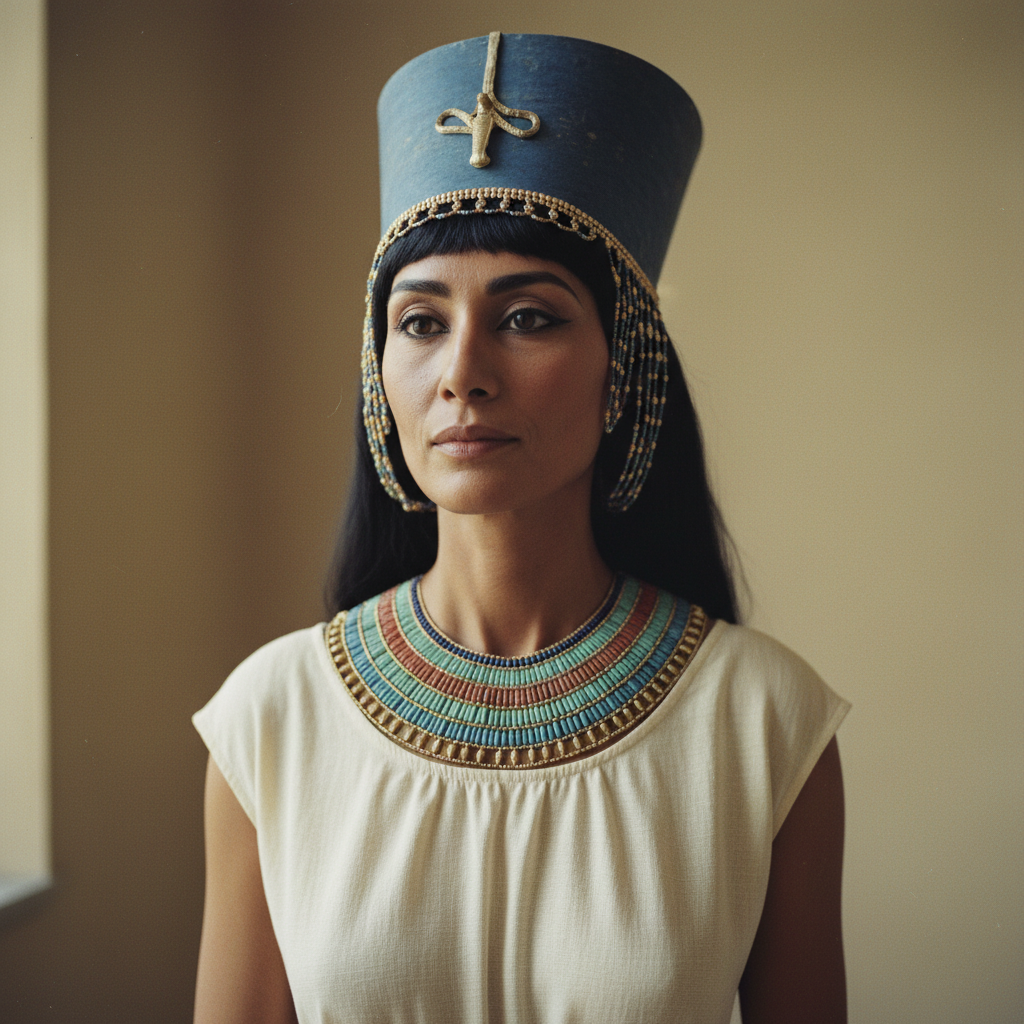
Her face reads as deliberately refined: a long, narrow plane framed by a smooth jawline, high prominent cheekbones, and a straight, slender nose. The eyes are almond shaped and heavily outlined in kohl, with arched brows that draw attention to a poised, attentive expression. Lips are full but controlled, giving her a composed, noble look. She is almost always shown wearing headgear that defines her silhouette. The best‑known image presents a tall, flat‑topped blue crown that covers the hairline and makes her neck look even longer; in other portraits she wears close‑fitting cap wigs or decorative crowns and veils. Wherever the hair is implied, it would have been dark and typically tucked neatly under wigs or crowns rather than worn loose. Skin tone in Amarna art trends to a warm, medium brown for royal women, and Nefertiti’s painted portraits follow that palette; her complexion would have been enhanced by cosmetics—kohl around the eyes, carefully modeled brows, and subtle rouge. Her posture and dress emphasize a slender, graceful neck and shoulders, with tight, fine linen garments and broad decorative collars that mark royal status.
Height / build
Likely average height · Likely slender
Hair
Likely dark (black or very dark brown) · Likely straight to slightly wavy (often worn under wigs) · Likely even, typically concealed by wigs or headdresses
Eyes
Likely dark (brown)
Complexion
Likely Mediterranean / olive to medium brown
Face
Likely long oval with high cheekbones · Likely straight and refined
Notable features
Long graceful neck, high cheekbones, large almond eyes, straight refined nose, often shown with the iconic flat-topped blue crown.
Grooming
Probably none (clean-shaven face) · Regularly worn cosmetics (kohl, painted brows, red ochre on lips/cheeks), wigs, and the royal flat-crowned tiara or other headdresses.
Dress / presentation
Royal Amarna dress: form-fitting sleeveless gown, broad beaded collar, and royal crowns/tiaras and elaborate wigs.
face
Face shape
Likely long oval with high cheekbones
The Berlin bust and Amarna reliefs consistently show an elongated face and pronounced cheekbones in royal images of Nefertiti.
face
Nose
Likely straight and refined
Surviving sculptures and painted portraits depict a narrow, straight nose rather than a broad or hooked profile.
eyes
Eye shape and color
Almond-shaped, likely dark (brown)
Amarna art emphasizes large almond eyes, and Nile‑valley populations overwhelmingly had dark irises; kohl makeup further accentuated the eyes.
hair
Hair color and style
Likely dark hair, usually worn under wigs/headdress
Egyptian royals commonly had dark hair and used wigs and crowns; most portraits show Nefertiti wearing a flat-topped blue crown or elaborate wig rather than natural loose hair.
hair
Hair texture
Likely straight to slightly wavy
Contemporary depictions and surviving Egyptian hairstyles suggest predominantly straight to gently wavy textures, often stylized under wigs.
skin
The Amarna court favored an elegant, elongated aesthetic—slender bodies, long necks, and refined facial planes—expressed in both male and female royal portraiture. Cosmetics, wigs, and crowns amplified status and beauty: heavy kohl-lined eyes, painted brows and lips, and elaborate headdresses were central to a queen’s public image.
Think of Nefertiti as a Nile‑valley Mediterranean figure: dark eyes, dark hair, olive to medium brown skin—traits common in ancient Egypt and the eastern Mediterranean. Political and family connections in the 18th Dynasty made cultural and genetic mixing with Levantine neighbors plausible, but her visual portrayal remains grounded in local Egyptian royal style.
Modern images often Eurocentricly blonde or soft‑featured; the historical Nefertiti was a dark‑haired, dark‑eyed Nile‑valley queen who wore wigs and heavy eye makeup and is best known from highly idealized royal art.
Popular culture often paints Nefertiti as a light‑skinned, blonde beauty or softens her distinctive Amarna elongation; in reality, the historical queen was dark‑haired, dark‑eyed, and typically shown with strong, stylized features and heavy makeup. Also, many modern portraits ignore that most royal women wore wigs and crowns in formal depictions.
Likely average height for an elite Egyptian woman of her time.
Likely dark brown; her eyes were shown as large and almond‑shaped in portraits.
Likely dark (black or very dark brown), typically covered by wigs or the royal crown in portraits.
Yes—she is depicted as a striking, idealized beauty and likely represented a royal standard of attractiveness.
No; like other royal women, she would have been clean‑shaven.
They show a consistent royal style—long face, high cheekbones, almond eyes—so modern images generally combine both as the best-supported portrait.
Painted limestone bust of Nefertiti (Thutmose workshop)
Neues Museum (Berlin) · c. 1345 BCE (Amarna Period)
The iconic painted bust shows a highly idealized, elegant visage: long neck, high cheekbones, slender straight nose, almond eyes, and the blue flat-topped crown—key visual basis for modern images of Nefertiti.
Amarna wall paintings and reliefs (Tell el‑Amarna)
Akhetaten (Amarna) site reliefs and frescoes · c. 1350–1330 BCE
Multiple painted reliefs and frescoes show Nefertiti in profile and frontal views: elegant, long-faced, heavily made-up eyes, wearing crowns and close-fitting garments—confirming the stylistic traits seen in the bust.
Limestone and painted statuettes and heads attributed to the royal workshop
Thutmose workshop finds at Amarna · c. 14th century BCE
Fragments and finished statuettes display consistent facial proportions and crown types associated with Nefertiti, reinforcing her characteristic royal portrait features.
Contemporary royal inscriptions and titulary
Amarna-era inscriptions and formal titulary · c. 14th century BCE
Texts confirm Nefertiti’s prominent status and role, supporting interpretations of her consistent presentation with royal regalia in portraits, though they do not describe her physical traits in detail.
Modern reconstructions and museum displays
20th–21st century forensic and artistic reconstructions · Various modern dates
Recent reconstructions use the Berlin bust and Amarna imagery as a template; they illustrate possible three-dimensional realism but reflect interpretive choices about skin tone, hair, and age.
Complexion
Likely Mediterranean / olive to medium brown
Amarna paintings and population context point to Nile‑valley complexions; painted portraits of Nefertiti use warm brown and ochre hues.
height build
Build
Likely slender
Royal iconography of the Amarna period favors a lithe, graceful torso and posture in queens; clothing shows a slim silhouette.
grooming
Makeup and grooming
Heavy eye makeup, painted brows and lips, wigs
Visual evidence frequently shows dark kohl-lined eyes, defined brows, and the use of wigs and headdresses for royal females.
clothing
Typical dress
Form-fitting sleeveless gown, broad collar, royal crown/tiara
Amarna-era queens appear in fitted gowns and broad beaded collars; Nefertiti is often shown wearing a distinctive flat-topped blue crown.
other
Distinctive attribute
Iconic flat-topped blue crown in many portraits
Multiple contemporary images and the famous bust show Nefertiti wearing the unique cylindrical/flat-topped blue crown associated with her.