hair
Hairstyle
Forward-combed fringe of wavy locks
Coin and bust portraits repeatedly show hair arranged in short rows of waves combed forward across the forehead.
Portrait reconstruction
37–68 · Rome / Italy · Roman Imperial (Julio-Claudian)
Nero probably had a rounded, youthful face with large eyes, forward-combed wavy dark hair, and was likely clean-shaven.
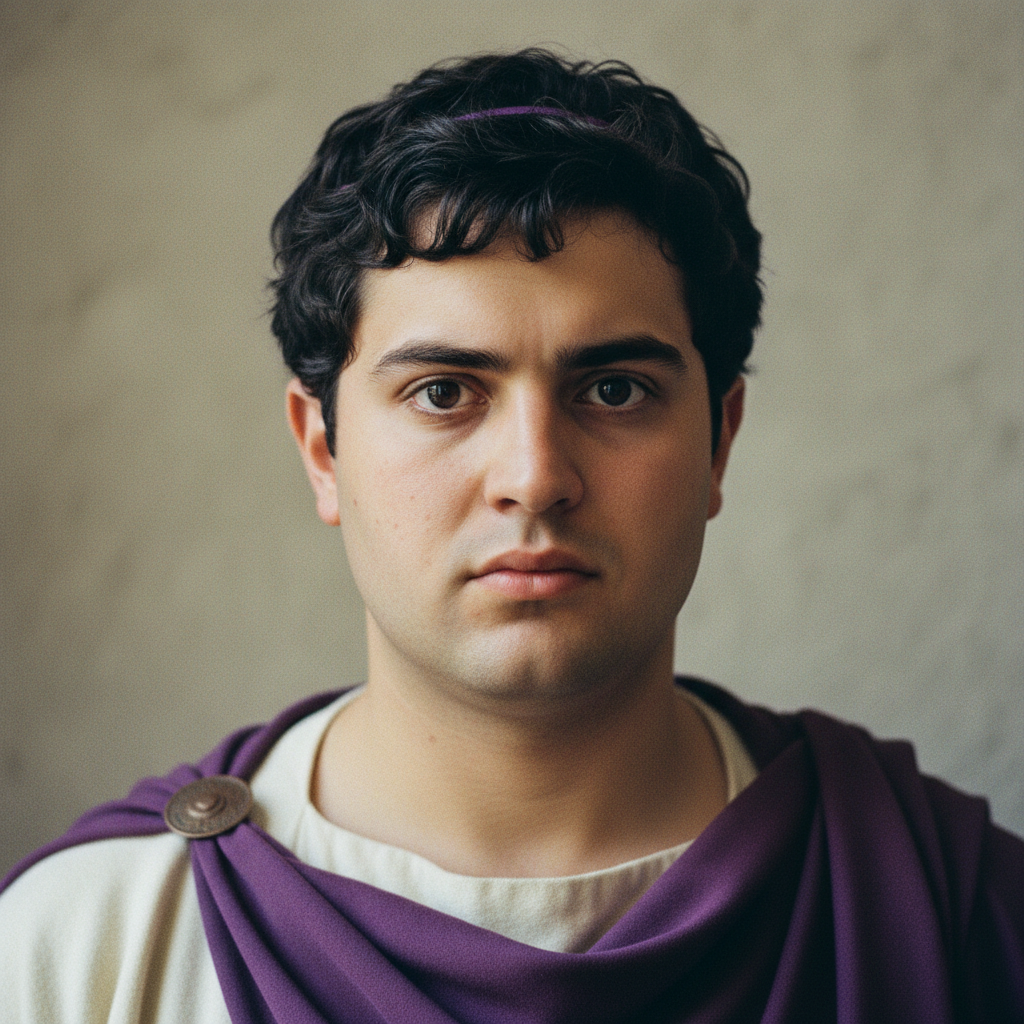
Nero’s face in surviving portraits is soft and rounded rather than rugged: full cheeks, a gently curved jawline, and a broadly set forehead give a youthful, almost boyish look. His eyes appear large and prominent—a feature emphasized by sculptors to make his gaze striking at a distance. His hair is one of the clearest visual trademarks: wavy locks combed forward into a patterned fringe that falls across the forehead in small tufts. That coiffure appears consistently on marble busts and on coins, suggesting a deliberately cultivated imperial hairstyle. The hair was likely dark, matching the typical Mediterranean coloring of the Roman elite. Sculptural and numismatic images present Nero clean-shaven, with smooth skin and no facial hair, in keeping with Julio-Claudian court fashions. Full-figure statues show a poised, slender neck and a posture designed to project youthful authority rather than military bulk or rugged masculinity.
Height / build
Likely average height · Likely somewhat stocky or moderately fleshy
Hair
Likely dark to black · Likely wavy, somewhat curly · Fringed/forward-combed hairstyle rather than receding
Eyes
Likely dark
Complexion
Likely Mediterranean complexion
Face
Likely rounded to full · Likely straight to slightly aquiline
Notable features
Large, prominent eyes with heavy upper lids; full lips; rounded cheeks; distinctive forward-combed wavy hair.
Grooming
Probably clean-shaven · Carefully styled hair with a characteristic forward-set fringe and smooth, shaved face in elite Roman fashion.
Dress / presentation
Imperial Roman elite dress — tunic, toga or paludamentum in statuary, ceremonial laurel or purple insignia when shown in official portraits.
hair
Hairstyle
Forward-combed fringe of wavy locks
Coin and bust portraits repeatedly show hair arranged in short rows of waves combed forward across the forehead.
hair
Hair color
Likely dark to black
Typical Mediterranean coloring for Roman elites and dark hair shown in most surviving portraits and descriptions.
face
Face shape
Rounded, somewhat full face
Multiple marble busts emphasize a full cheek and rounded chin rather than a gaunt or angular profile.
eyes
Eye appearance
Large, prominent eyes (likely dark)
Sculptures and coins exaggerate large eyes with heavy upper lids; dark eyes are likely given Mediterranean ancestry.
skin
Complexion
Likely Mediterranean complexion
Regional ancestry and classical portrait convention point to an olive/light-brown Mediterranean skin tone.
grooming
Facial hair
Probably clean-shaven
In Nero’s Rome, authority was signaled through groomed youthfulness, smooth (shaved) faces, carefully arranged hair, and the clothes and insignia of office. Emperors cultivated an image that balanced approachability (youthful features) with unmistakable rank (purple, laurel, and ceremonial dress).
Nero belonged to the Julio-Claudian dynasty, an Italian aristocratic line with typical Mediterranean features; picture olive-toned skin, dark eyes, and dark wavy hair—features common in Rome’s ruling families and echoed in surviving portraits.
Modern media often exaggerates eccentric or monstrous traits; surviving portraits show a confident, deliberately cultivated imperial image not always reflected in sensationalized depictions.
Modern portrayals often amplify Nero’s excesses into grotesque physical traits. In contrast, surviving images present a carefully groomed, handsome ruler; physical monstrosity is more a product of later moralizing than of his visual evidence.
Likely average height for a Roman male of his era.
Likely dark.
Likely dark, wavy to slightly curly, worn in a forward-combed fringe.
Probably clean-shaven.
No — portraits show a full head of hair arranged as a distinctive fringe.
From multiple consistent sources: surviving marble busts, statues and coin portraits that circulated during his reign, supported by contemporary and near-contemporary literary descriptions.
Capitoline Museum marble head of Nero
Musei Capitolini (Capitoline Museums) · mid-1st century CE (imperial portrait)
A widely cited imperial portrait showing Nero’s rounded face, large eyes, and characteristic forward-combed wavy hair.
Palazzo Massimo portrait(s) of Nero
Museo Nazionale Romano, Palazzo Massimo · 1st century CE
Several marble portraits here reinforce the recurring hairstyle, full cheeks, and youthful visage found across imperial portraiture.
Denarii and sestertii with Nero’s portrait
Roman coinage (various mints, 54–68 CE) · 54–68 CE
Coinage circulated Nero’s image across the empire: consistent hair treatment, facial proportions, and imperial insignia provide a standardized visual record.
Tacitus, Annals (references to Nero)
Tacitus · early 2nd century CE (Annals written c. 100–120 CE)
Tacitus’s narrative comments on Nero’s public behavior and reputation; provides contextual impressions rather than precise physical description but supports portrait interpretations of a youthful, indulgent ruler.
Suetonius, Life of Nero
Suetonius · early 2nd century CE (Lives of the Caesars c. 121 CE)
Suetonius includes descriptive anecdotes about Nero’s appearance and tastes; useful for interpreting image and grooming choices though colored by moralizing tone.
Imperial statues and votive portraits
Various Roman sites and collections · 1st century CE
Full-figure statues show clothing and imperial insignia used to present Nero’s status; these confirm ceremonial dress and public styling choices.
Imperial male portrait conventions in Nero’s circle show him clean-shaven and Roman elites typically went shaved.
height build
Build
Likely moderately fleshy or stocky
Rounded facial features and imperial images suggest a well-fed appearance rather than marked athletic slenderness.
other
Nose
Likely straight to slightly aquiline
Portraits commonly show a straight or gently hooked nose—not strongly hooked or snubbed.
clothing
Typical attire
Imperial tunic/toga; ceremonial purple and laurel in official images
Statues and coinage present him in the garments and insignia of an emperor rather than everyday dress.
comparison
Perceived attractiveness
Likely seen as attractive/striking in youth
Youthful portraits emphasize smooth skin, full features and a fashionable hairstyle consistent with Roman tastes for handsome rulers.