face
Age
Likely elderly
Biblical chronology and later traditions emphasize great age; artistic tradition consistently depicts him as old.
Portrait reconstruction
0–0 · Ancient Near East (Mesopotamia / Levant context) · Antediluvian / Biblical tradition
Noah would most often be pictured as an elderly, bearded Near Eastern patriarch—dark-haired, olive-skinned, sturdy from labor, and dressed in a plain tunic and cloak.
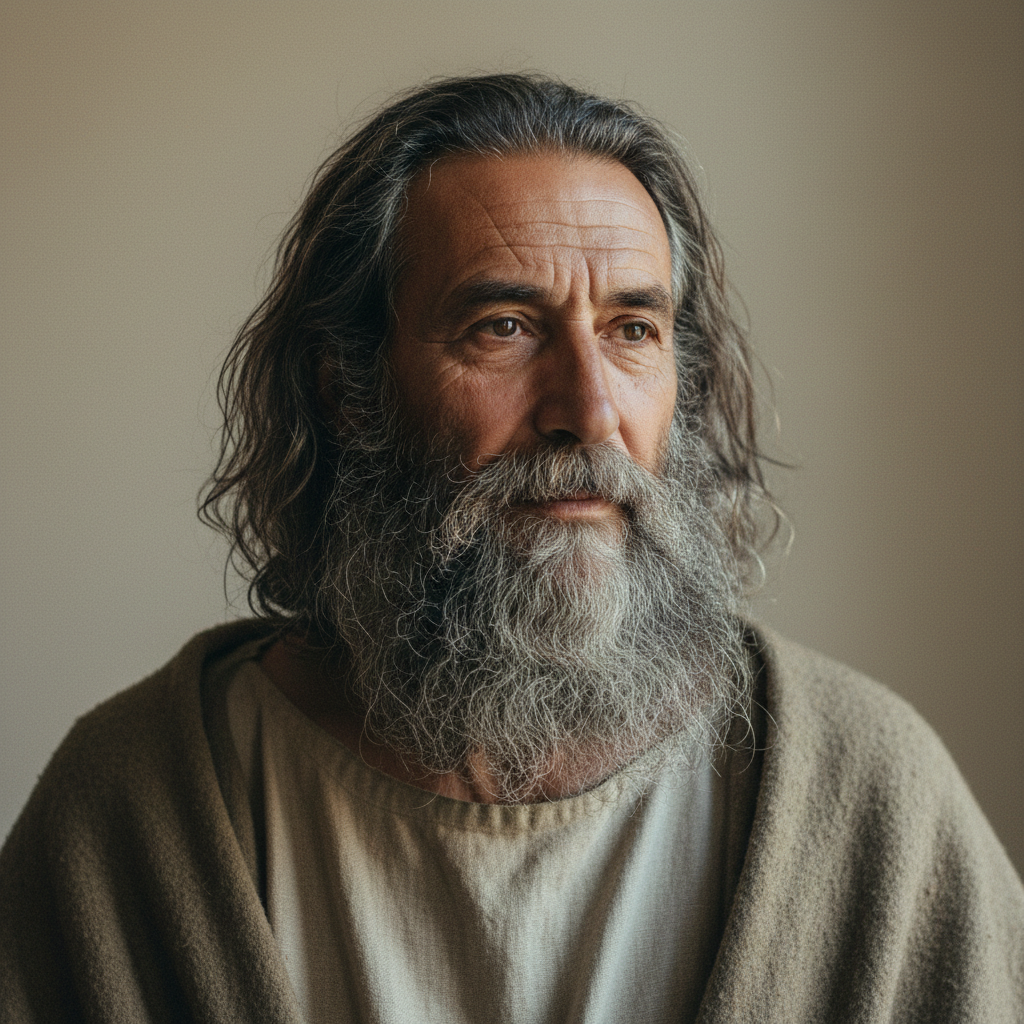
Age and authority would define his face: a full beard long enough to be streaked with white, deep-set brown eyes, heavy brows and creased forehead lines that speak of many years. His hair was likely dark originally and now salt-and-pepper with age, giving him the venerable, grandfatherly look common in later portrayals. His body would read as capable rather than frail: broad shoulders, strong forearms and callused hands from building and managing, a stocky frame shaped by physical labor rather than delicate refinement. Skin tones would run toward olive or light brown, with weathering from outdoor work—wind-creased cheeks and sun-darkened hands. Clothing and grooming would be practical and dignified: a simple woven tunic, a heavy mantle or cloak for colder weather, sandals and perhaps a head covering; no elaborate armor or jewelry, but a long, well-kept beard and modest personal adornment appropriate to a respected patriarch and prophet.
Height / build
Likely average height · Likely robust / stocky
Hair
Likely dark to graying · Likely wavy to curly · Likely receding or high with age
Eyes
Likely dark
Complexion
Likely Mediterranean / olive
Face
Likely broad to oval · Likely straight to slightly aquiline
Notable features
Full graying beard, weathered skin, prominent nose, aged eyes
Grooming
Likely long, full beard (dark to graying) · Long beard and unstyled or simply cared-for hair; often shown with a head covering or mantle in art.
Dress / presentation
Ancient Near Eastern tunics and mantles — simple linen or wool robes, sometimes sackcloth or skins in penitential scenes
face
Age
Likely elderly
Biblical chronology and later traditions emphasize great age; artistic tradition consistently depicts him as old.
height build
Height
Likely average height
No textual claim of extraordinary stature; population averages for ancient Near East suggest average male height.
height build
Build
Likely robust / stocky
As an ark-builder and pastoral patriarch, he would have developed a sturdy, work-hardened physique reflected in traditional depictions.
skin
Complexion
Likely Mediterranean / olive
Ancestral location in Mesopotamia/Levant indicates West Semitic skin tone common to the region.
hair
Hair color
Likely dark to graying
Regional hereditary traits point to dark hair; age and textual tradition suggest graying in depictions.
hair
Hair texture
Likely wavy to curly
Typical hair textures among West Semitic populations are wavy to curly; many pictorial traditions show textured hair.
In Noah's cultural milieu (and later Jewish-Christian-Islamic traditions), age and a full beard were visual shorthand for authority, wisdom, and piety. The elders who transmit law and ritual were older men with beards; artists continued that cue for millennia when depicting patriarchs.
Noah’s story is set in the ancient Near East; imagining him as a West Semitic man helps place likely traits: olive/ Mediterranean skin, dark eyes, dark wavy hair, and facial proportions common in Levantine populations. This provides a realistic, historically grounded baseline for his appearance.
Modern images often westernize Noah (European features) or turn him into a Hollywood action-hero; medieval and Renaissance art standardized an elderly, bearded look that modern audiences now assume.
Western art and films often Europeanize Noah—fair skin, light eyes—or turn him into an action hero. Medieval and Renaissance artists standardized an image of a muscular yet elderly white-bearded man; modern media then amplifies either Western features or rugged, youthful heroism that clashes with older textual portrayals.
Likely average height for an ancient Near Eastern man.
Likely dark (brown).
Likely dark to graying with age.
Probably a long, full beard — a standard marker of elder authority.
Simple ancient Near Eastern tunic and mantle (linen or wool), sometimes shown with a head covering or sackcloth.
They combine the story's regional context and millennia of artistic tradition to make a likely visual profile.
Genesis (Book of Genesis, Hebrew Bible)
Genesis (chapters 5, 6–9) · compiled by tradition c. 1st millennium BCE
The primary narrative identifying Noah: gives age and role (ark-builder, patriarch) but no physical description; supports a venerable, aged portrait by tradition.
Qur'an references to Nuh (Noah)
Qur'an (Surahs mentioning Nuh) · 7th century CE (text comp.)
Islamic tradition treats Nuh as an ancient prophet and often depicts him as an elder with a long mission; visual and textual traditions emphasize his age and prophetic authority.
Jewish Midrash and Later Traditions
Midrashim (e.g., Genesis Rabbah) and rabbinic commentary · compiled centuries CE
Rabbinic literature expands on Noah’s life and age, reinforcing traditions that lead to later iconography of an old, pious patriarch.
Michelangelo — Sistine Chapel, Genesis frescoes
Michelangelo Buonarroti · 1511–1512
Iconic Renaissance images of Noah that show a muscular yet aged, bearded man; influential in later Western portrayals of Noah's appearance.
Medieval illuminated manuscripts and mosaics
Various medieval Jewish, Christian, and Byzantine images (e.g., Golden Haggadah, Ravenna mosaics) · 6th–15th centuries CE
Consistent medieval depictions show Noah as an elderly, bearded figure in tunic and mantle; these images shaped later popular conceptions.
Islamic manuscript miniatures depicting Nuh
Persian and Ottoman miniatures · 12th–17th centuries CE
Depictions in Islamic art often portray Nuh as an older prophet with a beard and regional features, reinforcing a non-European visual tradition.
grooming
Facial hair
Likely long, full beard
Biblical and Near Eastern cultural norms prize beards for elder male authority; artistic canon consistently shows a long beard.
hair
Hairline
Likely receding or high with age
Artistic portrayals and expectation of advanced age imply thinning hairline.
eyes
Eye color
Likely dark
Dark brown eyes are most common in West Semitic populations and are the default in ancient Near Eastern portrayals.
clothing
Clothing style
Ancient Near Eastern tunic and mantle
Biblical and Near Eastern texts and images depict patriarchs in simple tunics, robes, and head-coverings.
Modern film and popular portrayals (e.g., Noah, 2014)
Noah (2014 film) and other modern media · 2014 / contemporary
Contemporary portrayals vary widely—from rugged action-heroes to stoic elders—showing the range of modern imagination about Noah’s look.