height build
Stature
Likely tall for her time
Contemporary Portuguese and Dutch accounts emphasize her imposing presence and command; historians infer above-average height and an erect bearing appropriate to a military leader.
Portrait reconstruction
1583–1663 · Ndongo and Matamba (present-day Angola) · 17th century, Early Modern
Nzinga likely appeared as a tall, dark‑skinned, commanding ruler who mixed local royal dress with imported cloth and masculine regalia.
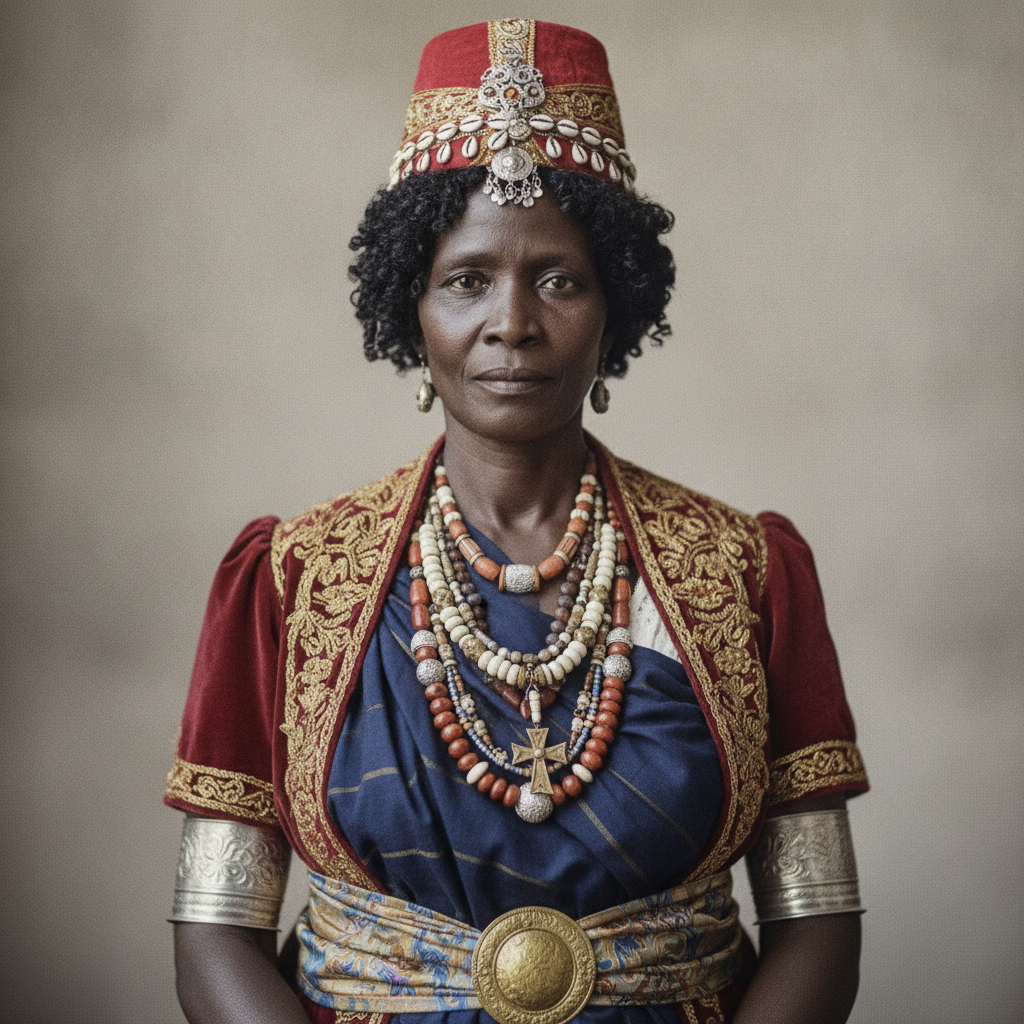
Skin tone and hair: Nzinga most likely had dark brown to deep‑black skin and dark, tightly coiled hair—worn close, wrapped, or braided rather than long and loose; she probably presented without facial hair. Her complexion and hair texture fit the West‑Central African population of Ndongo and Matamba. Build and bearing: Contemporary observers emphasized her erect, broad‑shouldered posture and a strong, athletic build. She is best imagined with a firm jaw, high cheekbones, keen eyes and a resolute, controlled expression—features that reinforced a commanding presence rather than delicate femininity. Dress and accoutrements: Nzinga dressed to be seen. She combined locally significant royal textiles with imported Portuguese silks and metalwork—layered patterned cloths, heavy bracelets and gorgets, decorative chains, and other metal ornaments. In public and diplomatic rituals she sometimes adopted masculine garments and insignia—broad cloaks or male‑styled sleeves, staffs, weapons, or other symbols of authority—presenting a theatrical, purposeful mix of feminine and masculine visual cues.
Height / build
Likely tall for her time · Likely robust / powerful build
Hair
Likely dark to black · Likely tightly coiled / kinky · Likely full; often styled, braided, or covered by headdresses
Eyes
Likely dark
Complexion
Likely dark brown
Face
Likely broad face with high cheekbones · Likely broad nose
Notable features
Regal posture, heavy jewelry and headdresses, military accoutrements when in campaign, striking public bearing.
Grooming
Probably none · Well groomed: elaborate hairstyles or head coverings, body ornamentation (beads, metals, feathers), and possibly body paint used for ritual and public display.
Dress / presentation
Royal Central African dress blended with imported Portuguese silks, metalwork and beads; sometimes masculine military garments for diplomatic/military theatre.
height build
Stature
Likely tall for her time
Contemporary Portuguese and Dutch accounts emphasize her imposing presence and command; historians infer above-average height and an erect bearing appropriate to a military leader.
height build
Build
Likely robust / powerful
Active military leadership, horseback riding and battlefield presence imply a strong, capable body rather than a frail one.
skin
Complexion
Likely dark brown
Nzinga belonged to Mbundu-speaking Central African groups whose members characteristically have dark brown skin tones.
hair
Hair color
Likely dark to black
Typical hair color among West-Central African populations and implied by contemporary descriptions of her appearance and hairstyles.
hair
Hair texture / styling
Likely tightly coiled; often braided or worn with headdresses
Regional hair texture norms and written reports that describe elaborate hair and headdresses used by Central African nobles.
face
Facial features
In Ndongo and Matamba, visible wealth—beads, metalwork, feather headdresses, and distinctive cloth—marked legitimacy. Nzinga used elaborate dress, jewelry and staged dress (including masculine military garb) as a visual language of authority that blended local ritual signifiers with European goods.
Nzinga belonged to the Mbundu-speaking peoples of central Angola; imagine her with the dark-brown complexion, tightly coiled hair, and robust physique common among West-Central African leaders—features that communicated health, vigor, and fitness for leadership in her world.
Modern images often Europeanize her features or depict her with exaggerated warrior fantasy tropes; historically she combined Central African royal dress with Portuguese-influenced textiles and diplomatic costume.
Contemporary media sometimes casts Nzinga as a Eurocentric beauty or as a fantasy 'Amazon' with exaggerated armor. Historically she combined Central African royal display with imported cloth and metals—her power came from ritualized dress and presence, not Hollywood-style warrior tropes.
Probably taller than average for her community—sources emphasize an imposing, commanding presence.
Likely dark (brown/black).
Likely dark to black and tightly coiled; often braided, arranged, or covered with elaborate headdresses.
She was regarded as striking and commanding—her authority and public bearing, not conventional beauty alone, defined impressions of her.
Royal Central African regalia combined with imported Portuguese textiles, metal ornaments, beads and feathered headdresses; sometimes masculine or military garments for theatre and diplomacy.
From 17th-century Portuguese/Dutch textual reports, later European engravings, and modern historical and ethnographic synthesis—combining dress, behavior and regional traits to produce a likely portrait.
Portuguese diplomatic and Jesuit letters about Nzinga
Portuguese 17th-century reports and missionary correspondence · 17th century
Contemporary Portuguese envoys and Jesuits recorded Nzinga’s diplomatic theater, dress choices (including adoption of masculine forms), bearing and the use of imported cloth and metal ornaments—providing primary textual impressions of her appearance and conduct.
European engravings and prints depicting Njinga
17th–18th-century Dutch and Portuguese engravings (various) · 17th–18th century
Stylized images circulated in Europe showing Njinga in regalia; these are influenced by European artistic conventions and eyewitness reports and help reconstruct costume and public image more than precise facial details.
Modern scholarly synthesis: Linda M. Heywood, 'Njinga of Angola: Africa's Warrior Queen'
Linda M. Heywood (Yale University Press) · 2017
Comprehensive modern biography synthesizing primary accounts and regional context; provides the best available interpretive framework for Nzinga’s public appearance, dress and performative authority.
Atlantic and Central African trade studies
John K. Thornton and related historians · 20th–21st century scholarship
Studies of trade document how Portuguese goods (textiles, metalwork) entered Central African courts and how rulers used them to dress and display power—supporting claims about mixed clothing styles.
Later artistic recreations and museum reconstructions
Various 19th–21st-century images and museum displays · 19th–21st century
Modern paintings and museum illustrations offer visualizations of Nzinga based on texts and European engravings; useful for imagining costume and posture but not conclusive for facial detail.
Likely broad face with high cheekbones and a broad nose
Features consistent with Mbundu and neighboring populations and reflected in later European images and modern reconstructions.
eyes
Eye color
Likely dark (brown/black)
Dark eyes are overwhelmingly typical among Central African populations and are consistent with textual descriptions.
grooming
Grooming and ornamentation
Elaborate hairstyles, jewelry, body paint and feathered headdresses
Contemporary accounts and later images show Nzinga as richly adorned; elites in Ndongo/Matamba used beads, metals and feathers as power markers.
clothing
Clothing
Royal Central African attire mixed with imported Portuguese textiles and metalwork
Trade with Europeans brought silks and metals; accounts note Nzinga’s use of imported cloth alongside local regalia to display power.
clothing
Military dress
Sometimes masculine or military-inflected attire
Recorded episodes where Nzinga adopted male dress or military costume as diplomatic and theatrical performance to assert authority.
comparison
Public bearing
Commanding and theatrical in public
Surviving reports stress her theatrical diplomacy (e.g., seating guests on the floor while she sat on a couch) and physical bearing used to project authority.
other
Facial hair
Probably none
As a female ruler in that cultural context, facial hair would not have been typical or remarked upon in sources.