hair
Hair color
Likely dark to graying
Later portraits consistently show dark hair that is often depicted with gray at temples; textual references describe him as an older scholar in later life.
Portrait reconstruction
1048–1131 · Nishapur, Khorasan (present-day northeastern Iran) · Seljuk / Islamic Golden Age (11th–12th century)
Omar Khayyam most likely had dark hair and eyes, an olive complexion, a neatly trimmed beard, and wore a turban and scholar’s robe.
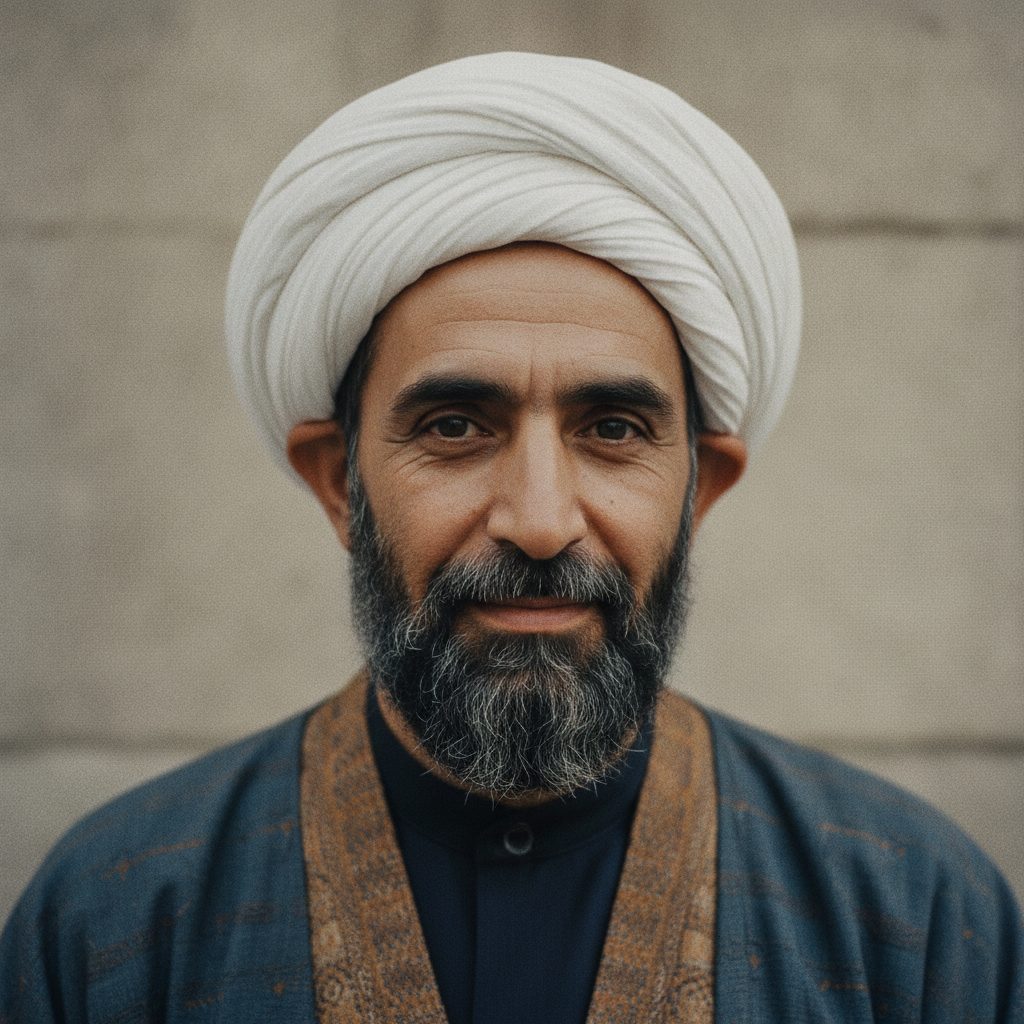
Facial tones and hair: Khayyam was probably typical of Khorasan’s urban Persian population — dark hair and dark brown eyes with an olive to medium complexion. Portraits and regional descriptions favor a sober, strong face rather than exotic or highly stylized features. Beard and hairstyle: He is usually imagined with a neatly trimmed beard and mustache, the kind of controlled facial hair associated with learned men of his day; hair would likely be dark and either clipped short under a turban or wrapped beneath it. Clothing and bearing: Visual tradition places him in a plain but well-cut scholar’s robe and a wrapped turban, garments that convey learning more than extravagance—simple fabrics in muted, dignified colours, sometimes with a narrow decorative trim. He would present a composed, thoughtful posture rather than a showy appearance.
Height / build
Likely average height · Likely average to slender
Hair
Likely dark to graying · Likely straight to slightly wavy · Likely mature/receding with graying at temples in later life
Eyes
Likely dark
Complexion
Likely Mediterranean / olive to medium
Face
Likely oval to long · Likely straight to slightly aquiline
Notable features
Dark eyes, prominent brow and nose, turban, trimmed full beard
Grooming
Likely full beard with mustache (well-kept, scholarly style) · Typically clean and groomed for a court scholar: trimmed beard, hair covered by a turban, scholarly robes.
Dress / presentation
Likely scholar's robes and a turban — elegant, practical, court-appropriate garments
hair
Hair color
Likely dark to graying
Later portraits consistently show dark hair that is often depicted with gray at temples; textual references describe him as an older scholar in later life.
eyes
Eye color
Likely dark
West Asian (Persian/Khorasanian) populations overwhelmingly have dark eyes; miniature portraits emphasize dark eyes.
other
Beard
Likely full beard with mustache
Medieval Persian scholarly dress standards and later artistic depictions show Khayyam with a trimmed full beard and mustache.
clothing
Typical attire
Scholar's robes and turban
As a court astronomer and respected scholar he would wear fine robes and a turban, consistent with Persian courtly/scholarly dress of the Seljuk era and later depictions.
skin
Complexion
Likely Mediterranean / olive to medium
Regional population characteristics of Khorasan and Persian miniatures indicate a medium/olive complexion rather than Northern European pale or South Asian brown.
height build
In Khayyam's world, appearance communicated learning and status: neatly trimmed beards, turbans, and plain but fine robes signaled piety and scholarship. Excessive ornament was less typical for serious intellectuals than calm dignity and reserved dress.
Khayyam came from Nishapur in Khorasan, an ethnically Persian and cosmopolitan region. People there typically had West Asian (Greater Iranian) features — olive to medium skin tones, dark hair and eyes — shaped by long-standing local population continuity.
Modern images often exoticize him (Westernized facial features or romanticized long flowing hair); historically he would look like a sober Persian scholar in contemporary dress.
Modern portrayals sometimes give Khayyam romanticized long flowing hair or Eurocentric features. Historically he would most often appear as a turbaned, bearded Persian scholar — understated, not glamorized — and later miniature art amplified scholarly iconography rather than photographic likeness.
Likely average height for a medieval Khorasanian man.
Likely dark.
Likely dark, turning to gray in later life.
Probably — a trimmed full beard with mustache typical of Persian scholars.
Scholar's robes and a turban — court-appropriate, neat, and restrained attire.
They are posthumous, stylized images that reflect a scholarly iconography more than a contemporary likeness.
Persian and Mughal miniature portraits of Omar Khayyam
Various illustrated manuscripts (14th–18th century) · 14th–18th century (posthumous)
Multiple posthumous manuscripts depict Khayyam as a turbaned, bearded man with dark hair and eyes, wearing robes — a standardized scholarly image rather than a contemporary likeness.
Encyclopaedia Iranica: entry 'Khayyām, ʿUmar'
Encyclopaedia Iranica · Online reference (modern)
Authoritative modern scholarly summary of Khayyam's life and later representations; explains that surviving portraits are later and summarizes biographical tradition.
A Literary History of Persia (E. G. Browne) — biographical discussion
E. G. Browne · 20th century compilation (original early 20th c.)
Classic Western scholarship surveying Persian literary history and biographical traditions about Khayyam, useful for contextualizing how later tradition portrayed him.
Court and scholarly dress in Seljuk Persia (scholarly summaries)
Modern scholarship on medieval Persian dress · modern
Studies of medieval Persian court costume and scholar presentation indicate turbans, robes, and trimmed beards as standard markers of learned status.
Population/demographic context for Khorasan
Historical demography and regional studies · modern synthesis
Provides typical phenotype expectations for medieval Khorasan: West Asian/Persian features, dark hair and eyes, olive to medium complexions.
Height
Likely average height
Nothing in textual tradition suggests exceptional height; average is the responsible default for urban Persian men then.
height build
Build
Likely average to slender
A scholarly, court-based lifestyle implies a non-physical-labor build; artistic portrayals do not depict heavy musculature.
face
Face and nose
Likely oval to long face with straight to slightly aquiline nose
Portraits and broader Persian physiognomic depictions show refined noses and elongated faces for scholars; consistent with regional traits.
grooming
Grooming style
Neat and restrained — trimmed beard, turbaned head
Court scholars maintained neat grooming to signify status and piety; later miniatures show tidy presentation.
other
What would stand out
Intellectual bearing and turbaned scholar look more than physical flamboyance
Descriptions and images emphasize his learned role; his appearance signaled scholar-status rather than warrior prestige.