hair
Hair color
Likely dark (black)
Andean populations and chronicler descriptions indicate black or very dark hair; indigenous portraits and Andean art show dark hair for rulers.
Portrait reconstruction
1418–1471 · Cusco, Tawantinsuyu (Inca Empire), Andean Peru · Mid-15th century (pre‑Hispanic Andes)
Pachacuti likely looked like a dark‑haired, brown‑skinned Andean leader wearing the mascapaicha crown, a finely woven unku, and gold earspools—probably clean‑shaven with a strong, athletic build.
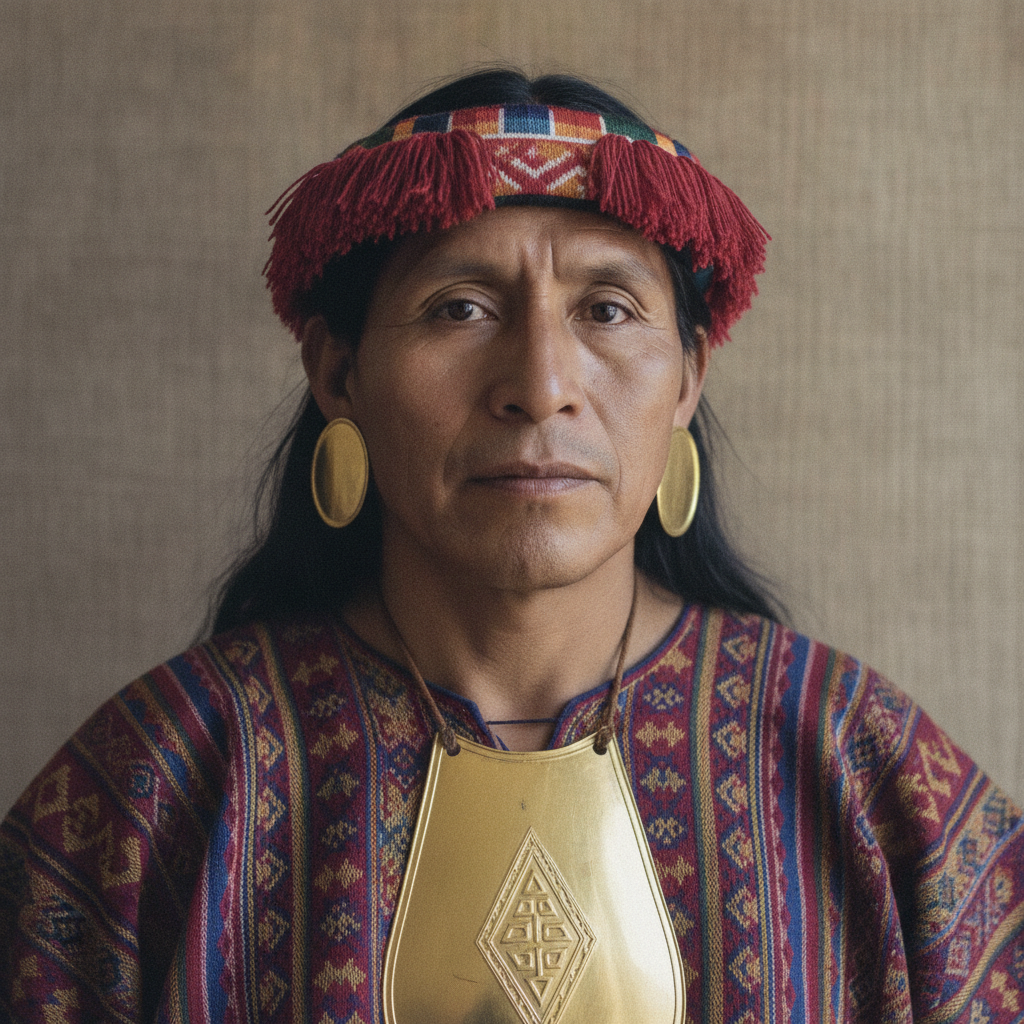
Face and hair: Pachacuti probably had straight, dark hair and deep brown eyes framed by a broad face and high cheekbones typical of Andean highland peoples. He was likely clean‑shaven or had only sparse facial hair, giving his face a clear, angular look that read as both youthful vigor and authority. Body and bearing: As a warrior‑ruler who led campaigns and oversaw state projects, he would have had a sturdy, muscular build—robust and capable rather than slender. His posture would have been erect and purposeful, projecting the combination of military strength and ritual command expected of a Sapa Inca. Clothing and jewelry: For public and ceremonial occasions he would have worn the mascapaicha (the red fringe headband of the Sapa Inca) across the forehead, a finely woven unku tunic patterned with geometric designs and bright colors reserved for elites, and a cloak fastened with a precious metal ornament. Large gold or silver earspools and chest ornaments would have signaled his status, and he likely carried a small staff or emblem of office while wearing simple sandals or woven footwear.
Height / build
Likely average to slightly above average height for 15th‑century Andeans · Likely muscular/athletic build
Hair
Likely dark (black) · Likely straight to coarse · Likely full; hair usually worn long and arranged or bound under headgear
Eyes
Likely dark (brown)
Complexion
Likely medium‑brown
Face
Likely oval to broad face · Likely straight to slightly broad nose
Notable features
Wore mascapaicha crown, gold ear ornaments and chest jewelry; strong posture and warrior bearing would stand out.
Grooming
Probably minimal or clean‑shaven · Likely well‑groomed with hair carefully arranged; as Sapa Inca he would wear the mascapaicha (royal headband) and other formal accoutrements.
Dress / presentation
Elaborate royal Inca garments: finely woven uncu (tunic), richly patterned textiles, mascapaicha headband, and gold or silver jewelry
hair
Hair color
Likely dark (black)
Andean populations and chronicler descriptions indicate black or very dark hair; indigenous portraits and Andean art show dark hair for rulers.
skin
Complexion/skin tone
Likely medium‑brown
Cusco highland Quechua populations were medium to darker brown; royal status did not significantly change basal complexion.
eyes
Eye color
Likely dark (brown)
Dark brown eyes dominate indigenous Andean populations and are consistently implied in descriptions.
grooming
Facial hair
Probably minimal or clean‑shaven
Spanish chroniclers noted limited facial hair among many Andean men; elite men often presented a smooth face.
clothing
Royal headgear
Wore mascapaicha (striped royal headband)
Multiple sources and indigenous illustrations show the mascapaicha as the primary insignia of the Sapa Inca.
clothing
Clothing
Finely woven uncu and richly patterned textiles with gold/silver jewelry
Inca rulers signaled authority through precise, ritualized dress more than through individual facial flamboyance: the mascapaicha (striped headband), exquisitely woven textiles, and gold or silver insignia established rank at a glance. Grooming emphasized cleanliness, controlled hair, and visible symbols of office—creating a controlled, dignified look that reinforced political power.
Pachacuti was a Quechua noble from the Cusco Valley; his phenotype would align with highland Andean features—medium‑brown skin, dark eyes, and dark hair—rather than Mediterranean or European traits. His noble status would be visible primarily through clothing and jewelry rather than markedly different body type at birth.
Modern paintings and statues often Europeanize facial features, add heavy beards, or dress him like a generic 'ancient king' rather than showing Inca textile patterns, mascapaicha, and Andean physiognomy.
Modern paintings and statues often Europeanize Pachacuti—lighter skin, European facial proportions, or heavy beards—and dress him in generic 'kingly' robes. The real visual markers of Inca rulership were textile patterns, the mascapaicha, and metalwork; facial features would have been recognizably Andean.
Likely average to slightly above average height for a 15th‑century Andean man—stately but not towering.
Likely dark brown.
Likely black and straight to coarse, worn long and arranged under the mascapaicha.
Probably minimal or clean‑shaven; heavy beards were uncommon among highland Andean men in contemporary accounts.
His mascapaicha crown, richly patterned tunic and metal jewelry—symbols of sovereignty that made him immediately recognizable as the Sapa Inca.
By combining early written descriptions, indigenous illustrations of royal dress, and archaeological evidence for textiles and metalwork to form the most plausible visual profile.
Comentarios Reales de los Incas
Garcilaso de la Vega · 1609 (published)
A mestizo chronicler describes Inca rulers' regalia, stature, and ceremonial presentation; used widely to reconstruct court dress and the mascapaicha crown.
Chronicles of Peru
Pedro Cieza de León · 1553
Sixteenth‑century Spanish chronicle with observations on Andean appearance, grooming, and social dress; notes limited facial hair and distinctive garments among elites.
Nueva corónica y buen gobierno (drawings)
Felipe Guamán Poma de Ayala · c.1615
Detailed indigenous illustrations of Andean clothing, rulers, and insignia; shows mascapaicha, tunics, and jewelry that inform visual reconstructions.
Narrative of Juan de Betanzos
Juan de Betanzos · 1551
Court‑informant‑based chronicle describing Inca court life, rituals, and priestly/royal presentation; used to identify dress and ceremonial posture.
Archaeological textiles and tunics (uncu)
Museum textile collections (various) · various (archaeological)
Surviving Inca textiles show complex patterns, weaving quality, and colors reserved for elites—central to understanding how a Sapa Inca like Pachacuti would have been clothed.
Archaeological metalwork (gold/silver earspools, chest ornaments)
Museum and archaeological reports · various
Metal insignia recovered from elite contexts show the kinds of jewelry worn by rulers and noble classes.
Colonial and post‑colonial statues/paintings of Pachacuti
Various later artists and modern monuments · 17th century to modern
Archaeological textiles and chronicler descriptions emphasize elite woven garments and metalwork as royal signs.
height build
Height and build
Likely muscular/athletic and average to slightly above average height
Ruler‑warrior role, chronicler praise of imposing presence, and the physical demands of Andean warfare suggest a sturdy, fit body.
other
Jewelry and insignia
Gold earspools, chest ornaments, and possibly nose ornaments as status markers
Royal metalwork is documented in chronicles and archaeological finds; images depict elite ear and chest jewelry.
face
Face shape and nose
Likely oval to broad face with straight to slightly broad nose
General Andean craniofacial patterns and stylized depictions in iconography point to these proportions.
cultural
Presence
Commanding and ceremonially polished — built to project authority
As Sapa Inca he would wear highly symbolic regalia and be presented in rituals to maximize authority and presence.
Many representations are post‑contact artistic imaginings that emphasize regal iconography but often Europeanize facial features; useful for study of later memory but not direct likeness.
Pedro Sarmiento de Gamboa: History of the Incas
Pedro Sarmiento de Gamboa · c.1572 (published later)
Contains descriptions of Inca rulers and court appearance assembled from informants and earlier reports.