height build
Height
Likely average height
Population data for 1st‑century eastern Mediterranean men indicate average heights in the mid‑160s cm; nothing in sources suggests exceptional stature.
Portrait reconstruction
5–67 · Tarsus (Cilicia), Roman Near East · 1st century CE
Paul most likely appeared as a middle-aged eastern Mediterranean man with olive skin, dark (often receding) hair, a short trimmed beard, and a lean, traveling build in simple tunic and cloak.
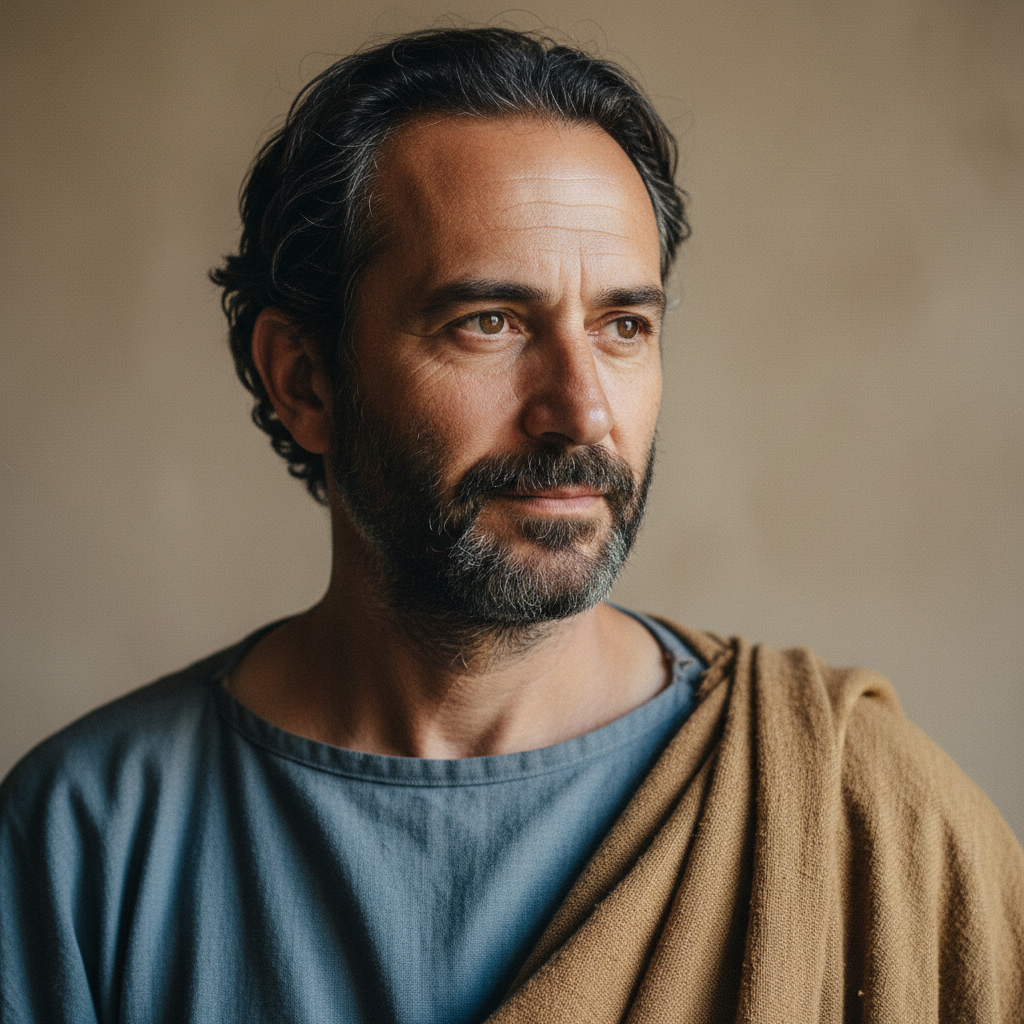
Face and hair: Think of a man with olive-toned skin and dark brown eyes; his hair was probably dark but often receding or balding at the crown, giving a high forehead. Early Christian portraits repeatedly show him with a short, neatly kept beard—so a trimmed beard, not a long flowing one, fits the picture. Build and bearing: Not a towering or heavily muscled figure—more lean, wiry, and steady. Contemporary hints describe Paul’s presence as less physically imposing than his letters, so imagine a slender frame suited to walking long distances: strong endurance rather than brute strength, with hands hardened by work and travel. Clothing and small details: He likely dressed plainly and practically: a wool or linen tunic, a travel cloak thrown over one shoulder, simple leather sandals, and a satchel or scroll-case. Grooming would be modest—beard present per Jewish custom and a short haircut consistent with Hellenistic and Jewish norms—practical, unornamented, and ready for travel or debate.
Height / build
Likely average height · Likely slender to wiry
Hair
Likely dark to graying · Likely wavy · Likely receding / slightly thinning with age
Eyes
Likely dark
Complexion
Likely Mediterranean complexion
Face
Likely oval to angular · Likely straight to slightly aquiline
Notable features
Prominent, sharp features—intense dark eyes, active facial expression, possibly a high forehead or receding hairline.
Grooming
Probably a trimmed, full beard · Practical, modest grooming: trimmed beard and relatively short hair consistent with Jewish and Hellenistic norms for adult men.
Dress / presentation
Hellenistic‑Jewish tunic (chiton) and cloak (himation) or traveler's cloak; simple, functional dress suited to missionary journeys.
height build
Height
Likely average height
Population data for 1st‑century eastern Mediterranean men indicate average heights in the mid‑160s cm; nothing in sources suggests exceptional stature.
height build
Build
Likely slender to wiry
Paul's long itinerant missionary career and work as a tentmaker imply a physically active, lean body rather than heavyset build.
eyes
Eye color
Likely dark
Eastern Mediterranean Jewish populations overwhelmingly had brown/dark eyes; textual descriptions emphasize intensity rather than light eye colors.
hair
Hair color
Likely dark to graying
Native Mediterranean pigmentation plus aging; many later portraits show darker hair turning gray with age.
hair
Hair texture
Likely wavy
Wavy hair is common in eastern Mediterranean populations and is consistent with Hellenistic portrait conventions.
grooming
Facial hair
Probably bearded
In the Jewish and Hellenistic worlds of the 1st century, authority often came from speech, age, and comportment more than ornament. Beards, modest dress, and a commanding speaking presence marked a teacher or elder; Paul would have relied on rhetoric, gestures, and a serious look to project leadership.
Tarsus was a cosmopolitan Hellenized city in Cilicia; Paul was ethnically Jewish but culturally fluent in Hellenistic settings and legally a Roman citizen. Imagine someone with eastern Mediterranean features who dressed simply but spoke and moved comfortably across Greek and Roman spaces.
Modern Europeanized or clean‑shaven images of Paul are common; historically he would more likely have been darker‑featured, bearded, and plainly dressed.
Art and film often portray Paul as a pale, European, clean‑shaven intellectual or as an idealized elder; historically he was more likely darker‑featured, bearded, and plainly dressed—his commanding quality would have come from words and presence rather than classical beauty.
Likely average height for a 1st‑century eastern Mediterranean man—probably not notably tall.
Likely dark (brown), consistent with eastern Mediterranean populations.
Likely dark in youth and dark to graying in his later years.
Probably yes—a trimmed, full beard was typical for Jewish adult men and teachers.
A simple Hellenistic‑Jewish tunic and cloak suitable for travel and work as a tentmaker; modest, functional clothes rather than luxury garments.
No verified contemporary portrait survives; our image of Paul comes from his letters, Acts, later iconography, and population context.
Pauline Epistles (letters of Paul)
New Testament / Pauline corpus · c. 50–65 CE
Paul's own letters reveal his role, age range during ministry, rhetorical style, and occasional physical remarks (e.g., opponents' comments in 2 Corinthians) that imply a serious, possibly physically unimposing speaker.
Acts of the Apostles
Luke-Acts (New Testament) · c. 80–90 CE
Provides biographical details (Tarsus origin, tentmaking, Roman citizenship, travel) that inform clothing, activity level, and cultural background—useful for imagining practical dress and build.
Early Christian and medieval iconography of Paul
Byzantine icons, medieval Western art · 4th–15th centuries CE
Consistent portrayal of Paul as bearded, balding or receding hairline, and often stern‑faced; these images reflect theological tradition rather than contemporary likeness but guide later visualization.
Population and anthropological studies of the Roman Near East
Scholarly reconstructions of 1st‑century demographics · 20th–21st century
Provide likely ranges for height, complexion, eye/hair color and common physical traits for eastern Mediterranean and Jewish populations of the period.
Cultural norms: Jewish male grooming and dress
Ancient Jewish and Greco‑Roman literature and costume studies · Classical/late antique scholarship
Shows that adult Jewish men typically wore beards and modest clothing; Hellenistic influence added regional styles—supports beard, modest haircut, and tunic/cloak attire for Paul.
2 Corinthians 10:10 (opponents' remark on bodily presence)
New Testament · c. 55–57 CE
A line indicating critics thought Paul's 'bodily presence' was weak compared to his letters—this has influenced traditional reconstructions of his physical bearing.
Jewish adult men and many Hellenistic‑Roman intellectuals commonly wore beards; Paul's role as a Pharisee and teacher reinforces this.
hair
Hairline
Likely receding or thinning with age
Paul is generally pictured as middle‑aged/older in tradition; age and portraits suggest some thinning rather than full hair.
skin
Complexion
Likely Mediterranean complexion
Born in Tarsus and of Jewish descent, his complexion would reflect the eastern Mediterranean range—olive to light brown.
clothing
Dress
Simple Hellenistic‑Jewish tunic and cloak; practical traveler's garb
Acts describes Paul as a traveling missionary and tentmaker; such work and travel required functional clothing rather than luxury garments.
face
Facial features
Sharp, intense features with a prominent nose and strong eyes
Later traditions and the way Paul's rhetorical presence is described suggest a face that conveyed intensity and seriousness.