height build
Height
Likely average height
Roman-period Levantine males clustered around a regional mean—nothing in textual tradition claims exceptional height.
Portrait reconstruction
1–64 · Galilee / Roman Judea · 1st century CE
Peter likely looked like a dark‑haired, bearded Galilean fisherman—medium height, tanned and weathered, with strong, work‑hardened hands and a face that grayed with age.
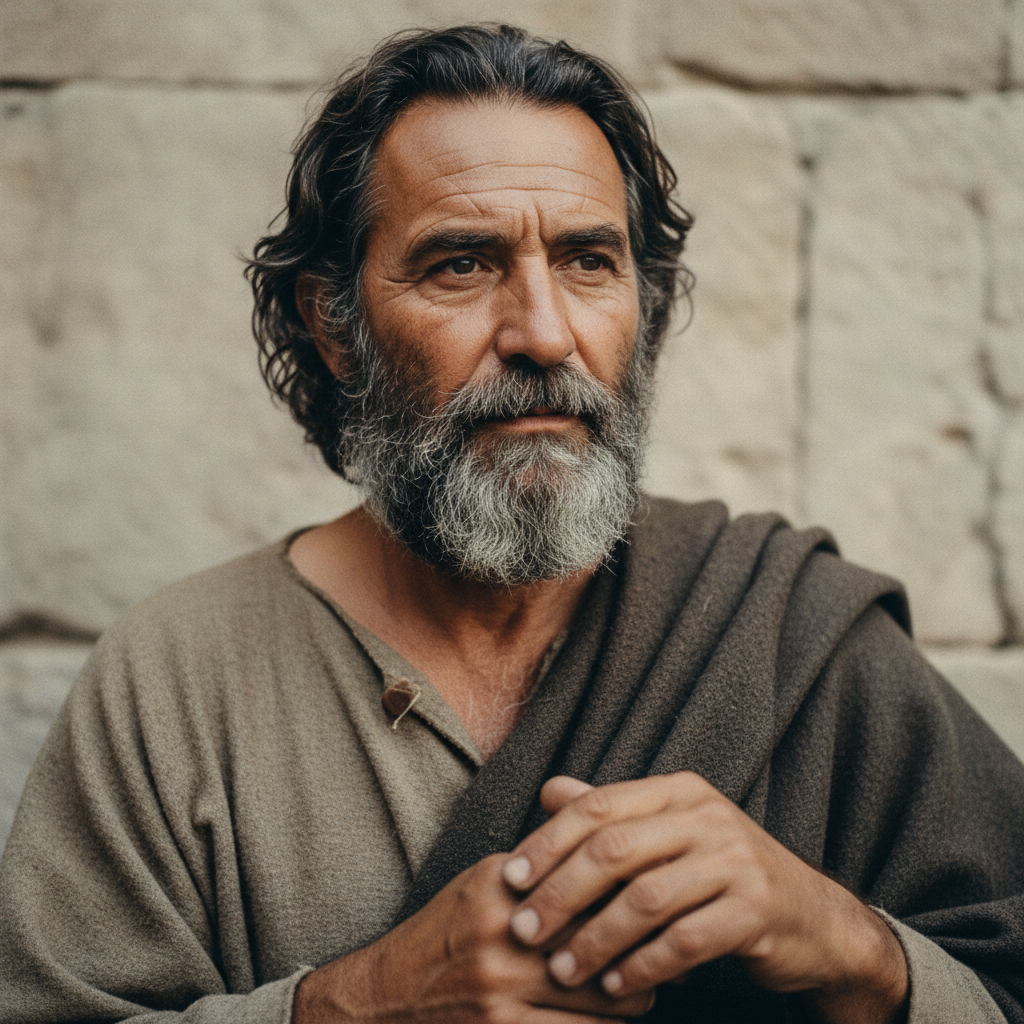
Hair and face: Most likely Peter had dark brown to black hair that began to gray with age; later images show a receding hairline or partial balding, and he would have worn a full beard in keeping with Jewish custom. His skin would have been olive to sun‑bronzed from long hours outdoors, his eyes dark and keen, and his brows sturdy and expressive. Build and stature: As a working fisherman he probably stood around the regional average for men—roughly mid‑160s to 170 cm (about 5'5"–5'7")—with a compact, strong frame: broad shoulders, thick forearms, and callused hands from hauling nets and boats. He would have carried the rounded, muscular look of manual labor rather than the leanness of scholarship or the heavy armor of a soldier. Clothing and bearing: Peter’s everyday look would be practical and simple: a plain wool or linen tunic, a coarse outer cloak for travel, and leather sandals; any jewelry or ornamentation would be minimal. His face would show lines from sun, salt, and wind—crow’s feet, a weathered forehead, and a determined mouth—giving him the appearance of a blunt, active man used to physical work and long days outdoors.
Height / build
Likely average height · Likely sturdy / stocky
Hair
Likely dark to graying · Likely wavy · Likely receding with age
Eyes
Likely dark
Complexion
Likely Mediterranean complexion
Face
Likely broad to oval face · Likely straight to slightly prominent (common Mediterranean profile)
Notable features
Weathered skin, strong hands, square jawline, prominent nose, greying beard
Grooming
Likely full beard, graying in later life · Practical grooming — beard and hair kept at a moderate length consistent with Jewish male fashion and public leadership.
Dress / presentation
Simple Galilean/Judean tunic and cloak (tunic, mantle, sandals); later depicted in fuller episcopal robes by Christian art.
height build
Height
Likely average height
Roman-period Levantine males clustered around a regional mean—nothing in textual tradition claims exceptional height.
height build
Build
Likely sturdy / stocky
Fishing was physically demanding work, favoring a muscular upper body and broad shoulders from hauling nets and rowing.
eyes
Eye color
Likely dark
Mediterranean Levantine populations overwhelmingly had brown/dark eyes in antiquity.
hair
Hair color
Likely dark to graying
Native Galilean men typically had dark hair; later-life depictions and tradition emphasize graying in elder leaders.
hair
Hair texture
Likely wavy
Wavy to slightly curly hair is common in Mediterranean populations and appears in many iconographic traditions of Galilean figures.
grooming
Facial hair
Likely full beard, graying
Jewish male practice and later Christian portrayals both present Peter with a beard; leaders were typically bearded to signal maturity and authority.
In first-century Jewish Galilee, masculinity meant visible maturity—beards, reserved dress, and a practical, unadorned appearance. Public religious leaders were expected to project authority through age and dignity rather than youthful beauty; a graying beard and weathered face conveyed trustworthiness and experience.
Peter came from the Galilee—a diverse, Mediterranean population that typically had olive skin, dark eyes and hair, and medium stature. Manual labor like fishing produced stockier, muscular bodies and weathered skin tones, so he would have looked like a sturdy local rather than a Roman aristocrat.
Modern images often show a clean-shaven, European-looking, long-haired hero; historically he was more likely a short-to-average, bearded Mediterranean fisherman whose hair and beard grayed with age.
Many films and paintings present Peter as a fair-haired, youthful European hero; historically he was almost certainly a dark-eyed, dark-haired Galilean with a beard and a weathered, practical appearance. Hollywood’s clean-shaven leading-man look is a modern invention, not a first-century Levantine reality.
Likely average height for a first-century Levantine man.
Likely dark (brown).
Likely dark in youth and dark-to-graying in later life.
Probably yes — a full beard, graying in later life.
He would have been seen as commanding and respectable rather than classically beautiful—maturity and a weathered look signaled authority.
We combine textual hints, regional population data, and long-standing iconographic tradition to form the most likely portrait.
New Testament (Gospels and Acts)
New Testament · 1st century CE (texts compiled)
Provides background on Peter’s occupation (fisherman), social role among the disciples, and hints about his age and status but no physical description.
Acts of Peter (apocryphal)
Acts of Peter · 2nd century CE (apocryphal)
Early non-canonical stories that attribute deeds and traits to Peter; these later narratives influenced how artists pictured him.
Byzantine icons and mosaics
Byzantine ecclesiastical art (5th–13th c.) · 5th–13th century
Consistent visual tradition showing Peter as dark-haired turning gray, bearded, with a prominent forehead—these images shaped Western expectations of his look.
Bronze statue of St. Peter (St. Peter's Basilica)
Vatican: Statue of St. Peter (medieval/renaissance) · Medieval / later restorations
Large devotional statue depicting Peter as an older, balding, bearded man; its wide fame influenced pilgrims and artists.
Jewish grooming and dress norms
Jewish law and social practice (Mishnah/Talmud evidence & historical studies) · Codified later, reflecting earlier customs
Context for beard wearing, hair length, and conservative dress among Jewish men—helps infer Peter’s grooming and clothing.
Bioarchaeological studies of Roman-period Levant
Regional osteological studies · 20th–21st century research
Population data on stature, robusticity, and typical phenotypes in Galilee/Judea used to estimate height, build, and complexion.
Medieval pilgrim narratives and portraits
skin
Complexion
Likely Mediterranean complexion
Galilean origin and outdoor fishing life imply olive to medium-brown skin weathered by sun and sea.
hair
Hairline
Likely receding
Later portraits and statuary commonly show a receding hairline and visible forehead among elder apostles.
clothing
Typical dress
Simple tunic and cloak; sandals
First-century Galilean peasants and fishermen wore practical tunics and mantles; later art dresses him in robes to indicate leadership.
face
Notable facial traits
Broad jaw, weathered skin, prominent nose
Artistic tradition and the stereotyped appearance of elder male leaders combine with the expected effects of life at sea to suggest these features.
Medieval devotional accounts · 7th–15th century
Pilgrim tales and artistic traditions that cemented the image of an elderly, bearded Peter in Western art.