height build
Height
Likely average height
No direct measurements; portrait tradition and social context give no strong signal for exceptional height.
Portrait reconstruction
427 BCE–347 BCE · Athens, Ancient Greece · Classical Greece (5th–4th century BCE)
Plato likely looked like a broad‑faced, bearded Athenian with a high forehead and a receding hairline.
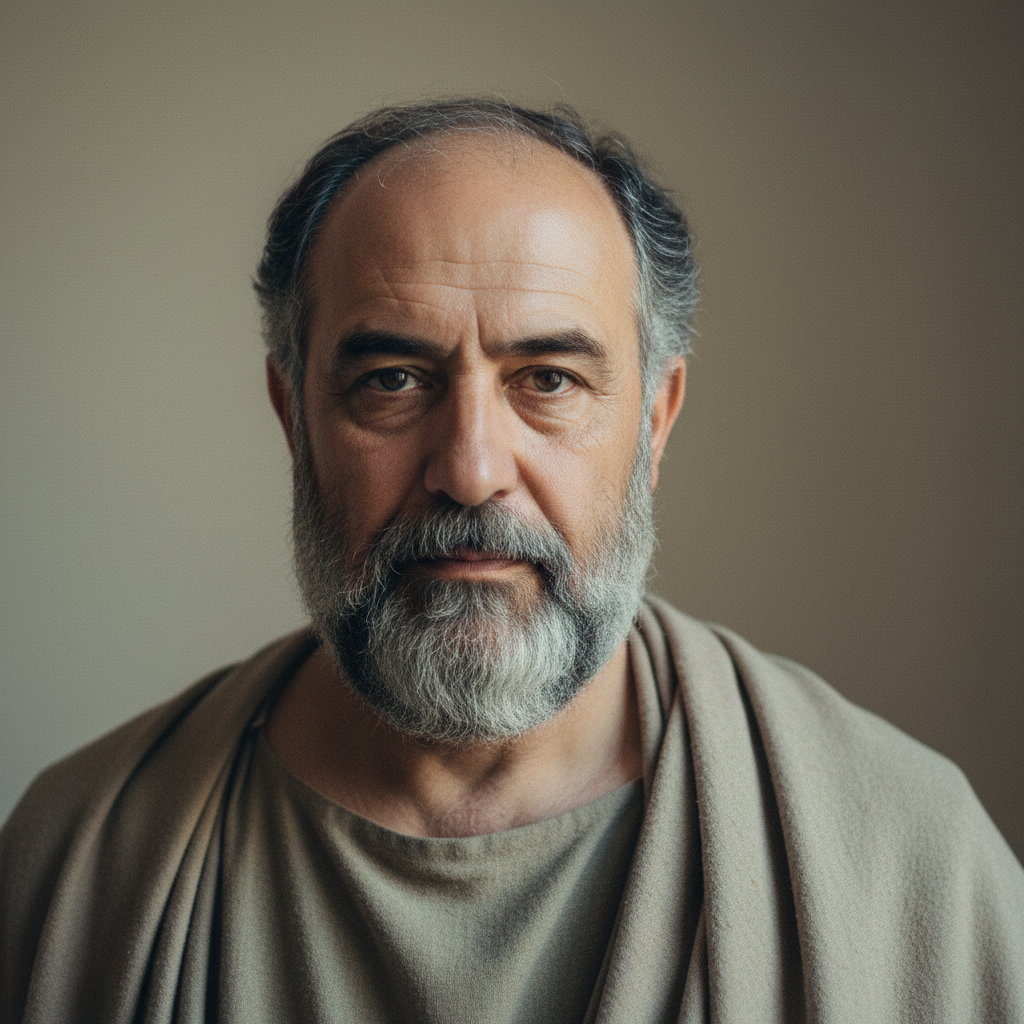
The dominant image of Plato is of a broad, rounded face framed by a short, curly beard and a hairline that retreats from a high forehead. Heavy brows and deep‑set eyes give his face a thoughtful, steady expression; his nose is pronounced and his cheeks full rather than gaunt. He likely had dark hair and brown eyes with an olive skin tone typical of Attic Greeks. Most portraits present him as middle‑aged to elderly: furrows at the temples, a lined forehead, and a compact, closely cropped hair style rather than long flowing locks. The beard is full but kept moderate in length, giving him the look of a respected elder and teacher. His overall bearing reads as robust and broad-shouldered—physically solid rather than slight. He is usually shown wrapped in the simple drapery of an Athenian gentleman or teacher—soft folds of a himation falling over one shoulder—projecting calm authority rather than flamboyance. The overall impression is of a dignified, earthy intellectual: deliberate in expression, physically substantial, and unmistakably an elder of the city.
Height / build
Likely average height · Likely broad / stocky
Hair
Likely dark to graying · Likely wavy to curly · Receding
Eyes
Likely dark
Complexion
Likely Mediterranean / olive
Face
Likely broad / square face · Likely straight to slightly hooked nose
Notable features
Broad forehead, receding hairline, heavy brow, full beard, broad neck/shoulders
Grooming
Probably a full, well‑trimmed beard · Beard and hair kept in the conventional, neat style of an educated Athenian elder: trimmed beard, ring of hair around a higher forehead.
Dress / presentation
Himation (draped cloak) over chiton — the customary philosopher’s dress
height build
Height
Likely average height
No direct measurements; portrait tradition and social context give no strong signal for exceptional height.
height build
Build
Likely broad / stocky
Nickname 'Plato' derives from 'broad' (shoulders/torso) and surviving portrait types emphasize a powerful neck and wide face.
hair
HairColor
Likely dark to graying
Typical Athenian pigmentation and busts showing darker hair with signs of graying at temples.
hair
Hairline
Receding
Most portrait heads attributed to Plato show a high forehead and receding hairline; literary tradition mentions broad head but portraiture emphasizes thinning up top.
face
FacialHair
Probably full beard
Classical Greek philosophers are routinely shown with full beards; surviving 'Plato' portraits show a full, neatly rendered beard.
eyes
EyeColor
Likely dark
In classical Athens, visible signs of age and a well‑kept beard signalled wisdom and civic standing; Plato’s beard, draped himation and broad physique would mark him as an authoritative elder and teacher more than as an aesthetic ideal of youthful beauty.
Imagine an Athenian of the 4th century BCE: olive skin, dark eyes and hair, not tall by modern standards but robust and broad. Plato would have fit the common Attic phenotype, distinguished by his posture, dress and bearing rather than exotic looks.
Modern imagery often idealizes Plato as a perfectly noble, younger-looking sage or gives him romantic curls—ancient portraits emphasize age, a receding hairline, and a broad, rugged face.
Many films and paintings smooth Plato into a youthful, romanticized sage with lush hair; historical portraits emphasize age, a receding hairline and a sturdy, broad face — traits that lend gravitas but are less glamorous.
Probably not unusually tall; most reconstructions suggest he was about average height for an Athenian male of his era.
Likely dark (brown), consistent with the typical Mediterranean pigmentation of classical Athenians.
Likely dark and wavy, often graying at the temples; many portraits show a receding hairline and a ring of hair.
Yes — he is almost always shown with a full, neatly kept beard, the conventional look for an elder philosopher.
Likely partially — portrait types show a receding hairline and a high forehead rather than complete baldness.
They reflect a consistent portrait tradition used to represent Plato — probably based on an earlier Greek likeness — so they give a plausible visual template for his face and bearing.
Roman marble portrait type identified as 'Plato' (various museum examples)
Roman copies after a Greek portrait type (various European museums) · 1st–3rd century CE (copies of earlier Greek originals)
Multiple Roman marble heads and busts consistently show a bearded man with high forehead, receding hairline, heavy brows, and broad face — the visual template usually labeled 'Plato'.
Capitoline 'Plato' (Capitoline Museums, Rome)
Musei Capitolini (traditional identification) · Roman period copy (1st–2nd c. CE) of a Greek original
One of the better‑known museum heads used to represent Plato; shows many of the standard features (beard, receding hairline, broad face).
Diogenes Laërtius — Life of Plato
Diogenes Laërtius · 3rd century CE (compilation)
Provides later biographical anecdotes about Plato, including references that support the interpretation of his sobriquet and physical reputation.
Suda entry for 'Plato' (Suda s.v. 'Plato')
Suda (Byzantine encyclopedia) · 10th century CE (compilation of earlier material)
Gives the popular explanation for Plato’s name coming from physical broadness; preserves older traditions about his appearance.
Post‑antique artistic tradition (Renaissance onward)
Renaissance and modern depictions of Plato · 15th century CE onward
Later art often idealizes Plato, but borrows elements (beard, drapery, aged face) from the classical portrait type; helpful to trace how the image evolved.
General reference — Encyclopaedia Britannica entry 'Plato'
Encyclopaedia Britannica · Modern reference
Summarizes traditional portrait evidence and textual traditions that inform reconstructions of Plato’s appearance.
Dark brown eyes were overwhelmingly typical for Athenians; portrait carving conventions often render heavy eyelids and deep sockets rather than color.
face
FaceShape
Likely broad / square face
Busts and the meaning of his sobriquet indicate a broad, heavy face and jawline.
face
Nose
Likely straight to slightly hooked
Common classical portrait detail shows a strong, prominent nose on the Plato type rather than a small or delicate nose.
clothing
ClothingStyle
Himation over chiton (philosopher’s drapery)
Philosophers and intellectuals in Athens are almost always depicted wearing the himation; textual and sculptural evidence supports this.
other
Age at typical depiction
Older (50s–70s)
Most surviving portraits present an aged, mature man with lines, full beard, and receding hairline associated with elder philosophers.