height build
Height
Likely average height (about 5'0"–5'3")
Typical female stature for Eastern Woodlands Indigenous populations in the early 1600s and English observer impressions of her as modest in size.
Portrait reconstruction
1595–1617 · Tsenacommacah (Powhatan Confederacy), Virginia; later England · Early 17th century
Pocahontas likely had dark hair, warm brown skin, dark eyes, and the bearing of a Powhatan chief's daughter who later wore English court dress.
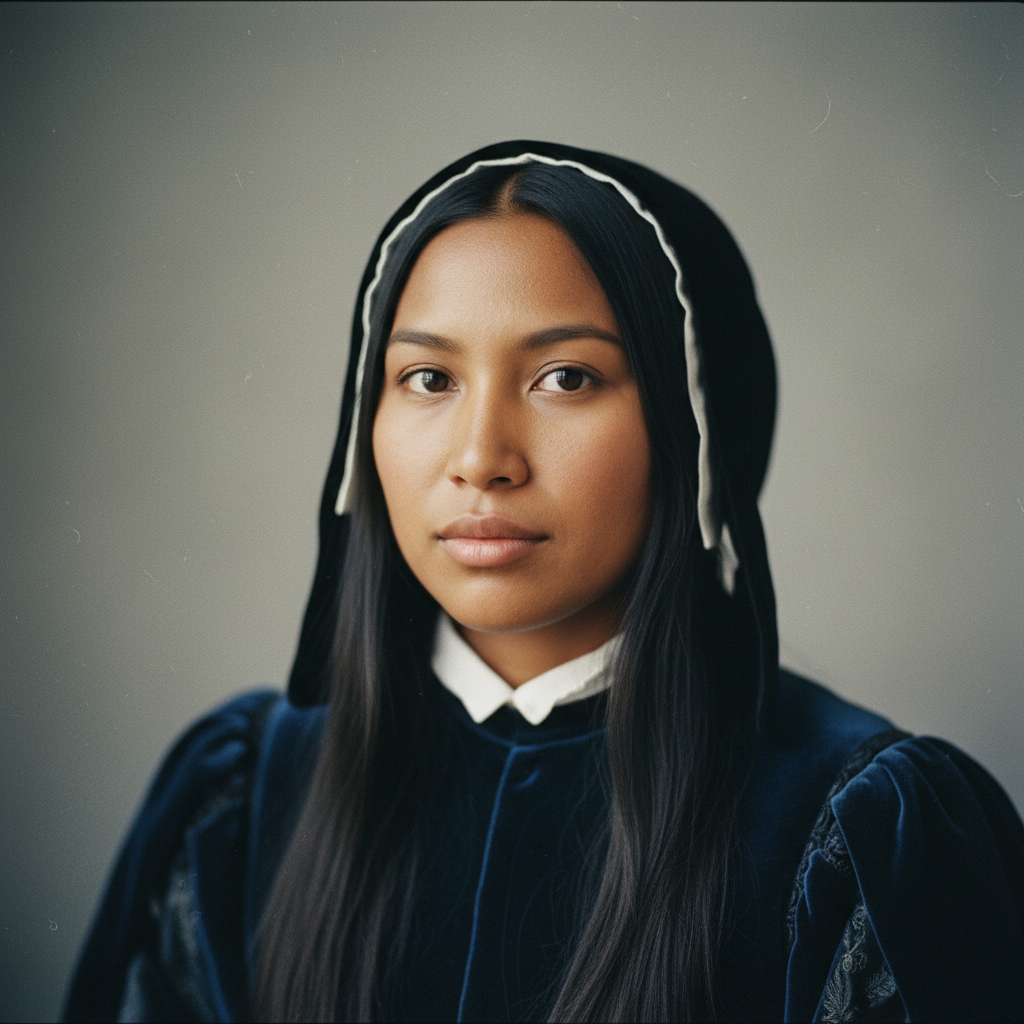
Face and hair: Pocahontas most likely had dark brown to black hair — worn long in her native setting and styled or pinned up in England — and dark brown eyes. Her skin tone would have been a warm brown typical of the Indigenous peoples of the Virginia tidewater. Facial features were probably those common in the Eastern Woodlands: softly rounded cheeks, a straight to gently broad nose, and a youthful, balanced face. Build and carriage: She was described as young and striking; she likely had a medium, agile build suited to the active life of her community. As a daughter of a chief she would have carried herself with confidence and poise, a composed presence that English visitors noticed and recorded. Native dress and ornament: In Tsenacommacah she would most often have worn deerskin garments, shell and bead necklaces, and hair arranged in the styles of Powhatan women—often long and either loose or bound with cords and ornaments. Beads, shell pendants, and small feather accents signaled status and identity and would have added visual detail to her appearance. English dress and styling: During her visit to England she adopted English court clothing and a European hairstyle, appearing in gowns, a ruff or high collar, and jewelry; contemporary engravings and oil portraits show her with hair partly drawn back and wearing formal dress that made her look like an English gentlewoman while retaining her dark hair and brown complexion.
Height / build
Likely average height (about 5'0"–5'3") · Likely slender to athletic
Hair
Likely dark, black to dark brown · Likely straight to slightly wavy · Likely normal; traditionally worn long and often braided or plaited
Eyes
Likely dark (brown)
Complexion
Likely medium-brown (warm)
Face
Oval to slightly rounded · Straight to slightly broad
Notable features
Long dark hair, dark eyes, warm brown skin, graceful bearing and modest stature.
Grooming
None (female) · In Virginia she likely wore long hair, often plaited with ornaments; in England she adopted European styling and covered hair under a coif or hat.
Dress / presentation
In Virginia: deerskin garments and shell/bead ornaments; in England: contemporary English gown, ruff and cap as shown in 1616 portrayals.
height build
Height
Likely average height (about 5'0"–5'3")
Typical female stature for Eastern Woodlands Indigenous populations in the early 1600s and English observer impressions of her as modest in size.
height build
Build
Likely slender to athletic
Daily life and subsistence activities of Powhatan women favored a lean, capable physique rather than heavy build.
hair
Hair color
Likely dark (black to dark brown)
Powhatan peoples and contemporary images/engravings show dark hair; English accounts note long, dark hair.
hair
Hair texture
Likely straight to slightly wavy
Regional Indigenous hair texture is commonly straight or slightly wavy; period descriptions and portraits show smooth long hair.
eyes
Eye color
Likely dark (brown)
Brown eyes are overwhelmingly common in Eastern North American Indigenous populations; no credible source describes light eyes.
skin
Complexion
Among Powhatan peoples, a woman's appearance included well-kept long hair, decorative shell and beadwork, and a dignified bearing—especially for women of rank. Jewelry, tattoos or body paint, and tidy plaited hair signaled status and beauty as much as face shape or height.
Pocahontas belonged to Eastern Algonquian-speaking Powhatan peoples whose physical traits commonly included dark hair, brown eyes and warm medium-brown skin. This regional profile helps visualize her in a way consistent with both Indigenous appearance and the Anglicized images made in England.
Modern portrayals often whiten, Europeanize, or fantasy-idealize Pocahontas (blonde hair, Euro facial types); surviving contemporary images show her dark-haired and dressed in English fashions for public presentation in 1616.
Popular films and illustrations often whiten or Europeanize Pocahontas—lightening skin, altering facial proportions, or dressing her in invented 'native' costumes. Contemporary 1616 portraits, colonial notes, and Powhatan cultural practices point to a darker-haired, brown-skinned woman whose famous appearances in England were deliberately Anglicized.
Probably not; she was likely average or modest in height for an early 17th-century Eastern Woodlands woman (roughly 5'0"–5'3").
Likely dark brown.
Likely dark—black to dark brown—and worn long.
Yes—English contemporaries described her as attractive, graceful and striking when presented in England.
In Virginia: deerskin garments and Powhatan ornaments; in England she wore contemporary English gowns, ruffs and caps as shown in 1616 images.
They show a contemporary, Anglicized public likeness—useful for facial cues but styled to English fashions and ideals.
Engraving of Pocahontas by Simon de Passe
Simon de Passe (engraving) · 1616
A widely circulated 1616 engraving that depicts Pocahontas in English dress and became the model for many later images; shows dark hair and a Europeanized face and costume.
Oil portrait copy associated with Pocahontas (National Portrait Gallery type)
Oil portrait (early 17th c., copies linked to 1616 likeness) · c.1616–1617
Oil portraits derived from the de Passe likeness show Pocahontas in English court dress and provide a face widely used in historical reference, though with Anglicized styling.
John Smith's accounts and later colonial narratives
John Smith and Jamestown writings · early 17th century (various editions)
English narratives describe Pocahontas as young, notable, and attractive; these texts shaped early English impressions of her appearance and demeanor.
Colonial letters and reports from Jamestown and 1616 England visit
Various Jamestown colonists and visitors (1607–1616) · 1607–1616
Letters and reports recorded her presence, clothing changes, and how English society received her; they note her conversion, English dress, and dignified bearing.
Ethnographic and historical studies of Powhatan peoples
Scholarly works (e.g., Helen C. Rountree) · 20th century scholarship summarizing 17th c. context
Provides regional population traits, clothing, grooming and status markers useful for reconstructing likely appearance and dress of a Powhatan chief's daughter.
Modern portrayals (film, illustration)
20th–21st century films and art (e.g., Disney) · 20th–21st century
Popular images often romanticize or Europeanize Pocahontas—useful for understanding modern misconceptions but not reliable for historical appearance.
Likely medium-brown (warm)
Powhatan peoples typically had warm medium-brown skin; English observers contrasted her complexion with Englishwomen but called her fair-looking by their standards.
clothing
Virginia clothing
Deerskin garments and traditional Powhatan adornment
Powhatan women commonly wore deerskin clothing and bead/shell ornaments; status influenced decorative elements.
clothing
England clothing
Contemporary English gown, ruff and cap (as in 1616 portraits)
Portraits and written records document her presentation in English dress during the 1616 visit.
grooming
Hairstyle
Long, often plaited or ornamented in Virginia; covered or styled in England
Powhatan women wore long hair with ornaments; English court customs led to European hair coverings and styling in 1616.
face
Facial hair
None
Female grooming norms and portrait evidence show no facial hair; English accounts describe feminine appearance.
other
Distinctive presence
Graceful, composed, and striking for English visitors
Multiple English observers noted her composure and attractiveness when she met colonists and when presented in England.