height build
Height
Likely average height for his time
Typical male height in the Roman Empire and the status of an equestrian official make average height the most plausible estimate.
Portrait reconstruction
0–0 · Judea (Roman province), Roman Empire · Early Roman Empire (1st century CE)
Pontius Pilate most likely looked like a middle‑aged Roman prefect: short dark hair, probably clean‑shaven, olive skin, and the formal dress and bearing of an equestrian official.
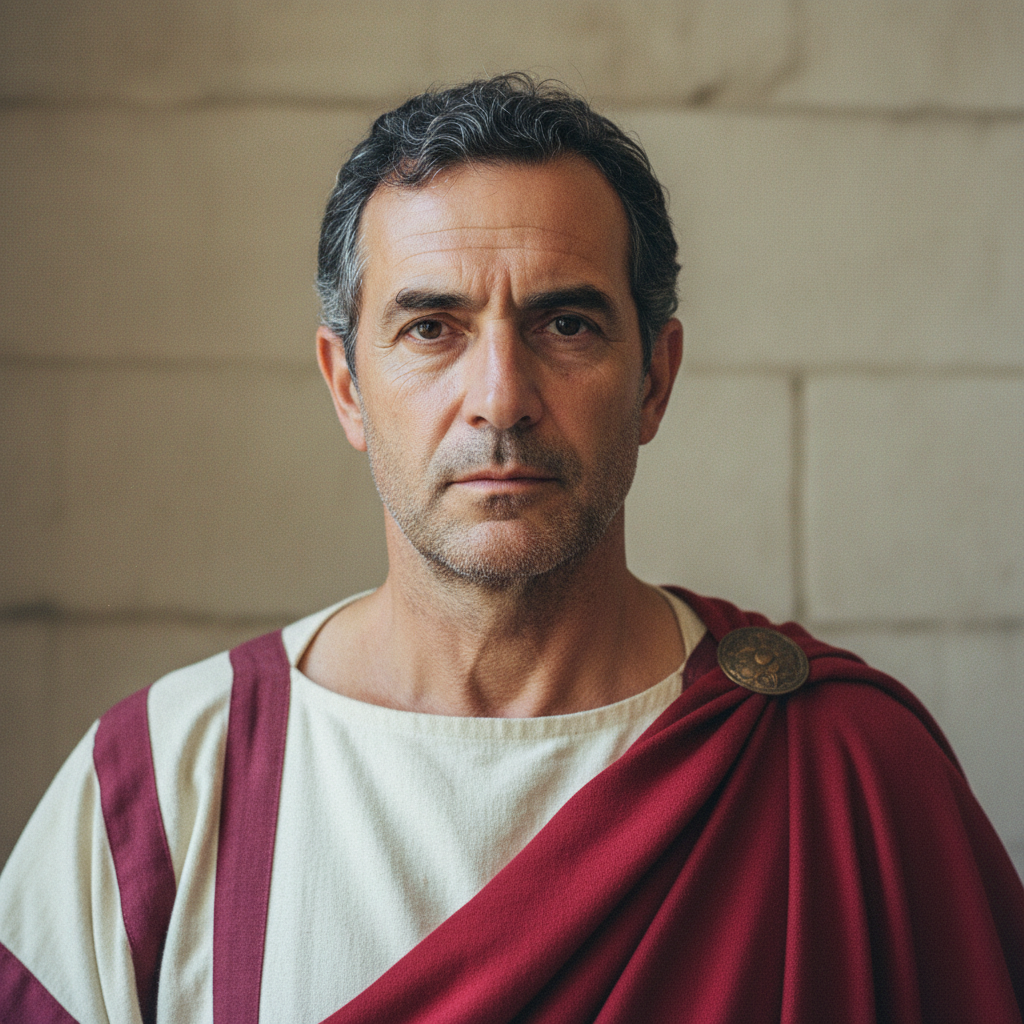
Hair and face: He probably wore his hair short and neatly trimmed in the Roman fashion of the early empire—likely dark in color—with a clean‑shaven face or only a closely clipped moustache. His features were likely Mediterranean: a straight or slightly aquiline nose, steady brown eyes, and a firm jaw set into an austere, official expression. Build and age: As a provincial prefect appointed to rule Judea, he would have presented as a middle‑aged man with a straighter, disciplined posture—solid, well‑muscled from military life or administrative duties rather than slender. Expect average Roman height for the period, a compact, durable build, and a bearing that projected control and authority. Clothing and grooming: Pilate would have worn formal Roman attire appropriate to an equestrian officer—clean, fitted tunic with a narrow stripe, a cloak or military mantle fastened with a fibula, leather belt and boots, and possibly a simple brooch or insignia of rank. Grooming would have been meticulous: trimmed nails, neat hair, and clean skin to display Roman civility and command.
Height / build
Likely average height for a Roman male of his class · Likely average to slightly lean
Hair
Likely dark to graying · Likely wavy · Likely mature/receding hairline
Eyes
Likely dark
Complexion
Likely Mediterranean complexion
Face
Likely oval to slightly angular · Likely straight to slightly aquiline
Notable features
Commanding official bearing; likely a strong brow and prominent nose; presence of graying hair by middle age.
Grooming
Probably clean-shaven · Short, trimmed hair and clean shave in keeping with early Imperial Roman elite fashion.
Dress / presentation
Roman official dress—tunic with broad stripe (laticlavus/clavi as appropriate), cloak or military paludamentum on duty; garments marked his rank as prefect.
height build
Height
Likely average height for his time
Typical male height in the Roman Empire and the status of an equestrian official make average height the most plausible estimate.
height build
Build
Likely average to slightly lean
An administrative governor who rode and supervised troops would be fit but not heavily muscled.
hair
Hair color
Likely dark to graying
Mediterranean ancestry and middle age point to dark hair tending to gray.
hair
Hair texture
Likely wavy
Wavy hair was common in Mediterranean populations and frequently depicted in contemporary portraits.
hair
Hairline
Likely mature / slightly receding
As a middle‑aged man in a high post, portraits of contemporaries often show a mature hairline and some thinning.
grooming
Facial hair
Probably clean-shaven
Early imperial Roman elite fashion (Augustan–Tiberian era) favored the clean-shaven look for administrators.
In Pilate’s world, authority was shown through sober grooming, formal dress, and a composed bearing. Early imperial Roman elites emphasized a clean-shaven face, short trimmed hair, and garments that signaled rank—the toga or tunic with a broad stripe and a cloak for official duties—so a prefect would project dignitas and control rather than flamboyance.
Pontius Pilate likely belonged to the Roman equestrian class with origins in Italy or an Italic family branch; imagine a Mediterranean‑featured man—olive skin, dark eyes and hair—whose appearance fit the central Roman provincial elite rather than the local Judean population.
Modern images often make him either dramatically exotic (long hair/beard) or overtly villainous; historically he would have looked like a typical Roman official—clean-shaven, short-haired, and formally dressed.
Art and film frequently portray Pilate as long‑haired, bearded, or theatrically sinister. These are largely later Christian or theatrical conventions. Historically he would have appeared as a short‑haired, clean‑shaven Roman official—more bureaucrat than exotic villain.
Likely average height for a Roman male of his class.
Likely dark.
Likely dark, probably graying by middle age.
Probably clean-shaven, following early Imperial Roman elite fashion.
Roman official attire: a tunic marked for rank and a cloak; on duty he might wear a military-style cloak to show authority.
Contemporary writers describe Pilate’s actions and character but provide no detailed physical portrait; appearance is inferred from rank, culture, and comparative portraits.
Pilate Stone (Inscription)
Pilate Stone (Caesarea inscription) · c. 1961 (discovery)
An inscription that names Pontius Pilate as prefect of Judea—confirms his historical office and rank, which informs likely dress and public presentation but contains no image.
Josephus, Antiquities and The Jewish War
Flavius Josephus · late 1st century CE
Describes Pilate’s actions, character, and role as prefect; supplies behavioral context that implies an authoritative, official demeanor.
Philo, Embassy to Gaius / On the Embassy to Gaius
Philo of Alexandria · early 1st century CE
Reports Pilate’s harsh governance and conflicts with locals—adds to an impression of a forceful provincial governor rather than physical descriptors.
Canonical Gospels (trial narratives)
Gospels (Matthew, Mark, Luke, John) · late 1st century CE
Portray Pilate as the Roman official who judged Jesus; focus on office and actions rather than physical appearance, but imply formal Roman dress and courtroom presence.
Roman imperial portraiture (Augustan–Tiberian era)
Contemporary Roman portrait corpus · late 1st century BCE – early 1st century CE
Surviving busts and portraits show grooming norms (short hair, clean-shaven in early Empire), hair textures, and physiognomic conventions useful for modelling likely appearance of an equestrian prefect.
Medieval and Renaissance depictions of Pilate
Christian iconography · medieval – modern
Later images often show long hair/beard or dramatic features; useful to note common modern misconceptions though not reliable for historical appearance.
skin
Complexion
Likely Mediterranean complexion
Likely Italian/Italo‑Roman background and life in the eastern Mediterranean suggest olive to light-brown skin tone.
face
Nose / profile
Likely straight to slightly aquiline
Roman portrait tradition and elite physiognomic ideals often show a pronounced nose; judaeo‑local variation doesn't contradict this.
clothing
Public dress
Roman official tunic and cloak (ceremonial stripe), military cloak on duty
As prefect he would display rank through Roman official garments rather than local costume.
other
Presence
Authoritative, formal bearing
Contemporary texts depict Pilate acting as an often forceful official; such roles were expressed through posture and dress.
Onomastic and regional studies of the nomen 'Pontius'
Onomastic / prosopography research · modern scholarly work
Links Pilate’s family name to Italic/Samnite origins, supporting an Italic/Roman provincial ancestry for physical-context inference.