height build
Height
Likely average height
No contemporary measurements; regional averages for Greek males of the period suggest typical stature rather than exceptional height.
Portrait reconstruction
570 BCE–495 BCE · Samos; later Croton (Magna Graecia) · Archaic / early Classical Greece
Pythagoras likely looked like a lean, dark-haired Mediterranean man with a short, tidy beard, a prominent forehead and nose, and the plain cloak of a philosopher-priest.
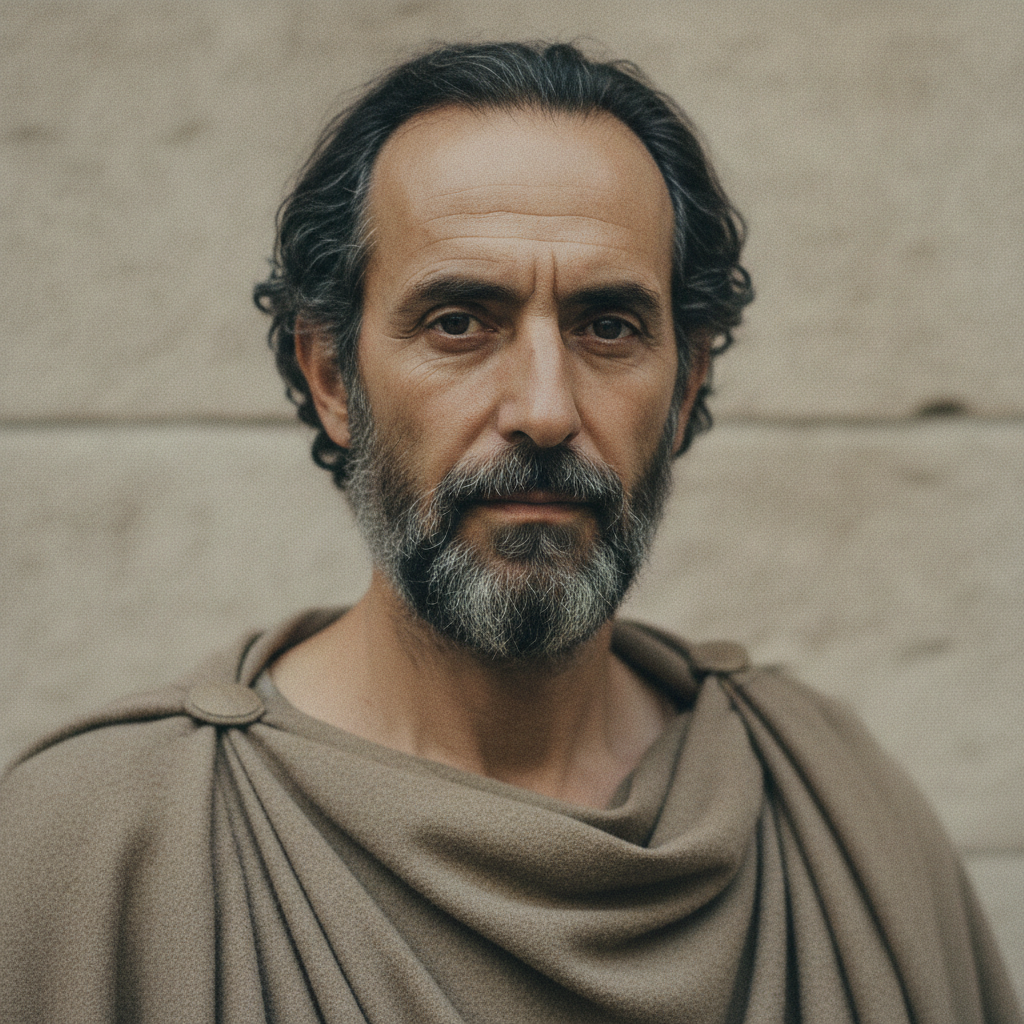
Face and head: He would have had a narrow, oval face with a high forehead and a slightly aquiline nose—features repeated in the traditional marble heads labeled as Pythagoras. His skin tone would have been Mediterranean olive, his eyes dark and steady. Hair was probably dark brown or black and may have thinned at the temples, giving a taller forehead. Beard and grooming: Rather than a long, flowing beard, imagine a short, well-kept beard that conveyed maturity and authority without extravagance; grooming would be neat and understated, matching the ascetic image of a philosophical leader. His hair and beard would emphasize seriousness more than fashion. Build and dress: Slight to medium height and lean in build—fit from walking and a simple daily life—he wore plain garments: a simple linen tunic beneath a heavier wool cloak (himation) draped for dignity and warmth. Accessories were minimal: possibly a simple headband or fillet used in ritual contexts and sturdy sandals or bare feet when appropriate to his community’s customs.
Height / build
Likely average height · Likely slender
Hair
Likely dark to graying · Likely wavy · Likely receding / high forehead
Eyes
Likely dark
Complexion
Likely Mediterranean complexion
Face
Likely oval to long · Likely prominent, straight to slightly aquiline
Notable features
High forehead, prominent nose, penetrating gaze, beard
Grooming
Likely bearded (trimmed or medium-length) · Groomed but austere: beard and hair kept neat rather than ornate, reflecting philosophical decorum and clerical/initiatory dress.
Dress / presentation
Himation or long cloak typical of Ionian Greek philosophers and initiates
height build
Height
Likely average height
No contemporary measurements; regional averages for Greek males of the period suggest typical stature rather than exceptional height.
height build
Build
Likely slender
Pythagorean communities emphasized moderation and ascetic practices that correlate with a leaner physique in textual traditions.
hair
Hair color
Likely dark to graying
Ionian Greek populations were typically dark‑haired; later portraits and descriptions often show philosophers with dark hair that grays with age.
hair
Hairline
Likely receding / high forehead
Many later depictions and busts emphasize a high forehead; literary emphasis on a contemplative look supports this image.
hair
Hair texture
Likely wavy
Aegean populations commonly have wavy to curly hair; surviving ancient portraits of Greek intellectuals depict wavy hair.
grooming
Facial hair
Likely bearded
In Pythagoras’s Greece, a beard and simple cloak signaled adulthood, seriousness, and moral authority — the visible uniform of teachers, sages, and initiates. People read philosophical identity from grooming: a neat—but not luxurious—beard, clean lines, and a reserved expression conveyed wisdom more than youth or handsome features.
Pythagoras was born in Samos (Aegean) and later active in Croton (southern Italy). His genetic and phenotypic context would be that of Ionic Greeks — Mediterranean complexion, dark hair and eyes, and features typical of eastern Aegean populations rather than northern European types.
Modern images tend to either classicize him into an idealized, clean-shaven classical hero or turn him into a mystical, exotic priest; historically he was more austere, bearded, and recognizably Ionian Greek.
Popular modern art often turns Pythagoras into a sanitized, classical idol (smooth face, idealized features) or an exotic mystical guru. Historically he would be more recognizably Greek and austere — bearded, practical, and marked by the modesty of a communal religious leader.
Probably not notably tall — likely average height for an Ionian Greek male of his era.
Likely dark (brown), consistent with Mediterranean Greek populations.
Likely dark and wavy, probably going gray with age.
Yes — most traditions and portraits show him bearded, the standard look for Greek philosophers.
Not bald, but likely had a receding hairline and a high forehead.
No contemporary portrait survives; our image is built from later ancient biographies and Roman-era portraits traditionally identified as Pythagoras.
Life of Pythagoras — Diogenes Laertius
Diogenes Laertius, Lives and Opinions of Eminent Philosophers · 3rd century CE (compilation)
Contains later biographical anecdotes about Pythagoras’s habits, dress, and moral character that inform traditional portraits (beard, ascetic lifestyle, leadership).
Life of Pythagoras — Iamblichus
Iamblichus, Life of Pythagoras · 3rd–4th century CE
A detailed Neoplatonic biography that emphasizes Pythagoras’s religious authority, communal dress and behaviors; influential on the visual tradition of Pythagoras.
Life of Pythagoras — Porphyry
Porphyry, Life of Pythagoras · 3rd century CE
Ancient biography that contributed to later characterizations of Pythagoras as a philosopher-priest; used by later artists and writers to shape his image.
Roman-era marble busts traditionally identified as Pythagoras
Various museum collections (Roman copies of Greek portraits) · Roman Imperial period (copies of earlier Greek prototypes)
Several Roman marble heads and busts in European collections are labeled 'Pythagoras' and show an older bearded man with high forehead and prominent nose; they inform the later visual canon.
Medieval and Renaissance portraits and engravings
Renaissance and later European art · 15th–18th centuries
Artists translated textual biographies into images that blend classical motifs and contemporary fashions, propagating a standard look (beard, cloak, high forehead) across Europe.
Regional population and burial data
Archaeological and osteological syntheses of ancient Greek populations · Modern scholarship (20th–21st c.)
Provides context on typical height, complexion, and average physical types for Ionian and southern Italian Greek communities, used to infer plausible traits.
Classical Greek philosophical and male civic norms favored beards as a mark of maturity and wisdom; later biographies and portraits show him bearded.
eyes
Eye color
Likely dark
Mediterranean Greek populations overwhelmingly had brown/dark eyes; artistic convention for Greeks often shows dark eyes.
face
Nose and forehead
High forehead, prominent straight to aquiline nose
Later portraits and literary descriptions emphasize intellect (high forehead) and many traditional busts show a prominent nose.
clothing
Typical dress
Himation / philosopher's cloak
Greek philosophers and religious initiates wore the himation or cloak; Pythagoreans had distinctive communal dress in later sources.
other
Overall bearing
Austere, disciplined, and authoritative
Ancient sources stress Pythagoras’s moral rigor and leadership of a community, which would project a controlled, commanding presence.