height build
Height
Likely tall for her time
Oral and local chronicles emphasize her imposing presence and leadership on the battlefield; later depictions present her as taller than peers.
Portrait reconstruction
0–0 · Zazzau (present-day Zaria, northern Nigeria) · Traditionally 16th century (Hausa city-state period)
Queen Amina likely looked like a dark-skinned, athletic Hausa warrior-queen: dark hair tucked or plaited beneath a helmet or scarf, riding in leather or metal-trimmed armor with sword, shield, and distinctive elite cloth and jewelry.
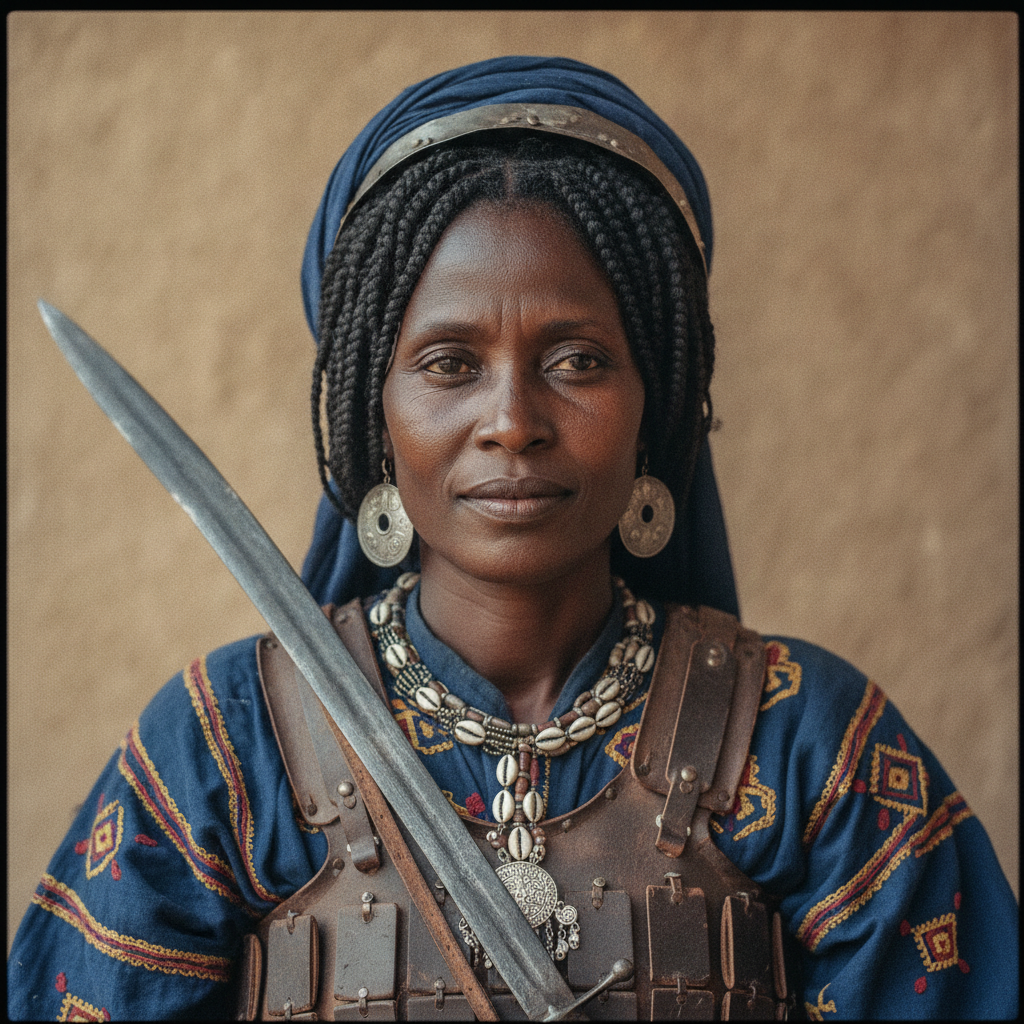
Her skin was likely dark brown, matching the Sahelian Hausa population of Zazzau; her eyes and hair were probably dark, with hair commonly plaited, braided, or wrapped beneath a headscarf or helmet. Facial features would reflect West African Sahelian proportions—strong cheekbones and a determined expression shaped by life as a rider and leader. Her build was probably athletic and sturdy from years of riding and campaigning: broad-shouldered, lean legs, and a confident, upright carriage suited to commanding cavalry. She would have carried herself with the authority of a ruler—compact and powerful rather than delicate. In battle and public display she likely wore practical protective gear: a close-fitting leather or boiled-leather cuirass, layered cloth garments for mobility, and a helmet or hardened cap; a curved sword or sabre, spear, and a round shield would have been her standard accoutrements. Over this martial kit she would wear markers of rank—embroidered wrappers, a richly dyed riding cloak, and visible jewelry such as metal bracelets, necklaces, or earrings that signaled elite status.
Height / build
Likely tall for her time · Likely athletic / strong
Hair
Likely dark · Likely tightly coiled / afro-textured; often plaited or covered · Likely natural hairline, typically kept covered by wraps or headgear
Eyes
Likely dark (brown)
Complexion
Likely dark (Sahelian West African skin tone)
Face
Likely strong jaw, high cheekbones · Likely broad, straight to slightly aquiline Sahelian nose
Notable features
Imposing stature, warrior accoutrements (sword, possibly helmet/metalwork), ornate Hausa jewelry and embroidered robes
Grooming
Probably none · Likely kept hair braided or wrapped; as a ruler she would wear jewelry and well‑maintained dress, with practical grooming for a mounted warrior.
Dress / presentation
Likely a mix of Hausa elite dress (embroidered robes, wrappers, jewelry) and practical warrior gear (leather or metal protection, helmet, sword/scabbard)
height build
Height
Likely tall for her time
Oral and local chronicles emphasize her imposing presence and leadership on the battlefield; later depictions present her as taller than peers.
other
Build
Likely athletic / strong
Described across traditions as a mounted warrior and commander, implying stamina and muscular conditioning from riding and warfare.
eyes
Eye color
Likely dark (brown)
Typical West African phenotype and later visual representations show dark eyes; no contrary evidence.
hair
Hair color
Likely dark
Regional ancestry and traditional depictions point to dark hair, usually arranged in braids or hidden under wraps/helmets.
hair
Hair texture & style
Likely tightly coiled (plaited or wrapped)
Hausa grooming practices historically favor braiding and headwraps for elite women; military practicality suggests covered hair under helmets or wraps.
skin
Complexion
Among Hausa elites, status and authority were shown through richly embroidered robes, layered wrappers, distinctive headgear and beaded or metal jewelry. For a ruler such as Amina, martial symbols (swords, well‑crafted riding gear, and helmets) would be combined with luxurious textiles to communicate both nobility and combat leadership.
Amina belonged to the Sahelian/Hausa cultural zone—people with deep brown to dark complexions, dark eyes, and tightly coiled hair. Visualizing her as a northern Nigerian ruler helps anchor her look in local physiognomy and the practical needs of cavalry warfare.
Modern paintings and films often westernize or romanticize her (European facial features, classical armor, pale skin) or show fantasy armour; historical reality was Sahelian in look and gear.
Modern paintings, films and school illustrations often either Europeanize her features or clothe her in anachronistic ‘fantasy’ armor (chainmail like a medieval European knight). Historically, her appearance would have been Sahelian and folded into local textile and armor traditions rather than medieval European plate armor.
Likely tall for her time—tradition emphasizes an imposing, commanding stature.
Likely dark brown, consistent with Sahelian West African populations.
Likely dark and tightly coiled—commonly plaited or kept under wraps or helmets.
She was celebrated more for commanding presence, strength and authority than conventional prettiness—described as formidable and striking.
Likely a mix of Hausa elite textiles (embroidered robes, beads) and practical warrior gear—sword, riding equipment, and possible leather or metal protection and helmet.
By combining oral traditions, later chronicles, regional dress and cavalry customs, and how successive generations pictured her—then synthesizing a likely visual profile.
Zazzau oral tradition (local songs and epics)
Zazzau oral tradition · oral / transmitted over centuries
Oral histories depict Amina as a warrior-queen who built walls, led cavalry, and carried arms—emphasizing her martial stature and leadership rather than physical minutiae.
Local chronicle references (Zaria Chronicle and related Hausa chronicles)
Zaria Chronicle (local chronicle) · compiled/later written form (18th–19th c.)
Later written chronicles of northern Nigeria include accounts of Amina’s campaigns and deeds; these texts contribute to descriptions of her as a commanding martial leader.
Statue of Queen Amina in Zaria and modern public monuments
Statue in Zaria (20th century) · 20th century
Public monuments and statues present Amina as an armed mounted warrior, often with helmet and sword—these shaped popular mental images and schoolbook illustrations.
Modern illustrations, schoolbooks, and films
Modern schoolbook images & films · 20th–21st century
Contemporary media repeatedly depict Amina with a dramatic warrior aesthetic; useful for showing how public perception formed but not direct evidence for original appearance.
Colonial-era and early ethnographic descriptions of Hausa elites
Colonial-era histories and ethnographies · 19th–early 20th century
Travelers' and colonial accounts document Hausa dress, jewelry, and cavalry traditions; useful to reconstruct likely clothing and accoutrements associated with a ruler/warrior in that region.
Scholarly syntheses on Hausa history and gender roles
Modern scholarly studies (summaries) · 20th–21st century
Academic works synthesize oral traditions and regional history to present Amina as a martial leader; they provide contextual evidence for likely appearance and public presentation.
Likely dark (deep brown)
Hausa/Sahelian ancestry and regional population characteristics indicate a dark skin tone; later images concur.
clothing
Typical dress
Elite Hausa robes combined with warrior gear (sword, helmet, leather/metal protection)
Oral tradition highlights her role as both ruler and campaign leader; later statues and paintings show a mix of regal textiles and arms.
grooming
Facial hair
Probably none
Hausa women of elite status customarily did not have visible facial hair; images and descriptions do not note beards.
face
Notable facial features
Likely strong jaw and high cheekbones, an authoritative expression
Later descriptions and portrayals stress her command and stern leadership; Sahelian facial traits often include prominent cheekbones.
other
Weapons / accoutrements
Often shown with sword and helmet; likely carried sword and cavalry equipment
Oral epics and later art repeatedly link Amina with a sword, town gates she built, and cavalry campaigns—visual shorthand for her martial role.
cultural
Jewelry & ornament
Likely adorned with Hausa elite jewelry and embroidered textiles
As a monarch she would display status through beads, metal jewelry and fine textiles customary among Hausa elites.