height build
Height
Likely average height
Women in ancient South Arabia/Horn are generally estimated around 150–160 cm; nothing indicates exceptional tallness.
Portrait reconstruction
0–0 · Saba (South Arabia, modern Yemen) or Aksum (Horn of Africa — Ethiopia/Eritrea) · Antiquity (tradition places her c. 10th–1st millennium BCE)
She would have presented as a dark‑skinned South Arabian or Ethiopian queen, crowned, swathed in fine textiles, and lavishly adorned with gold and gemstones.
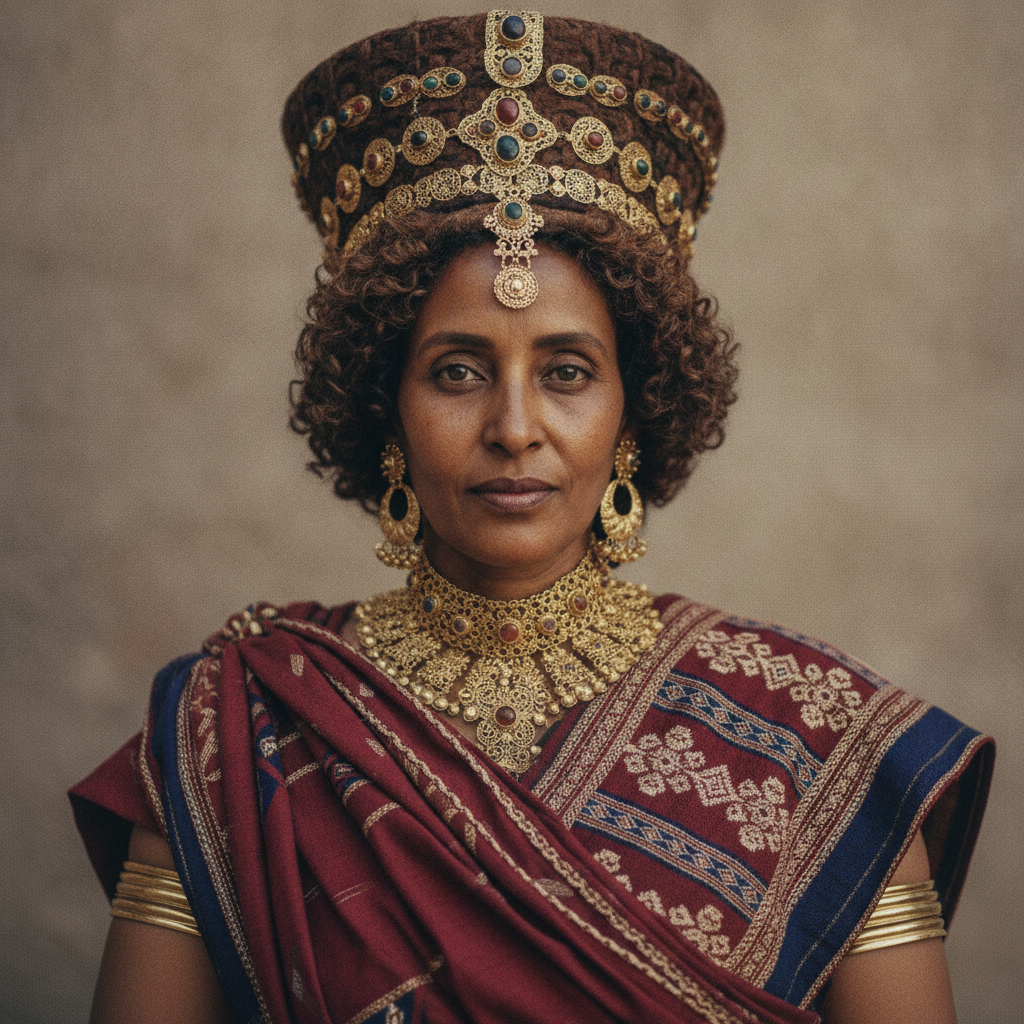
Skin tone: likely in the range of deep olive to rich brown typical of South Arabian and Horn of Africa populations — warm, sun‑tanned, and luminous under jewelry and dyes. Hair and face: dark hair, probably worn in thick braids, coils, or an updo ornamented with gold threads and beads; brows and lashes emphasized with kohl to make large, dark eyes the focal point of her face. Facial features would read as strong and dignified — high cheekbones, a straight or slightly rounded nose, and a composed jawline. Clothing and textiles: layered, finely woven robes with geometric Sabaean or Aksumite patterns and bright natural dyes (deep indigo, saffron, crimson). She likely wore a long outer mantle when appearing at court and richly embroidered tunics beneath. Jewelry and regal accoutrements: abundant gold — wide collars and pectoral necklaces, stacked bracelets, filigree earrings, and a distinct crown or diadem set with precious stones; a ceremonial staff or scepter and containers of incense or spices would underscore her status.
Height / build
Likely average height · Likely average to slender
Hair
Likely black to very dark brown · Likely wavy to tightly curled; often plaited or styled · Likely full
Eyes
Likely dark (brown)
Complexion
Likely olive to dark brown
Face
Likely oval · Likely straight to slightly aquiline
Notable features
Regal bearing, heavy gold jewelry, jewel‑studded headdress, patterned royal textiles
Grooming
None · Likely elaborately groomed: plaited or coiled hair, gold ornamentation, cosmetics such as kohl around the eyes and scented oils
Dress / presentation
South Arabian / Aksumite royal dress: finely woven robes, layered shawls, gold collars and bracelets, a tall or broad headdress
height build
Height
Likely average height
Women in ancient South Arabia/Horn are generally estimated around 150–160 cm; nothing indicates exceptional tallness.
height build
Build
Likely average to slender
Elite status suggests adequate nutrition but not labor-intensive musculature; royal garments would emphasize a dignified, elongated silhouette.
eyes
Eye color
Likely dark (brown)
Populations of South Arabia and the Horn overwhelmingly have brown eyes; later iconography of the Ethiopian tradition also shows dark eyes.
hair
Hair color
Likely black to very dark brown
Regionally typical pigmentation in South Arabia and the Horn is dark hair; later portraits and narratives describe her with dark hair in Ethiopian tradition.
hair
Hair texture & style
Likely wavy to curly, often plaited and ornamented
Archaeological finds and later depictions show elaborate plaiting and gold hair ornaments among South Arabian and Aksumite elites.
skin
Complexion
In South Arabian and Aksumite court culture, visible wealth signaled authority: gold collars, stacked bracelets, and tall or broad headdresses broadcasted status at a distance. Scent (incense, myrrh), polished skin, and elaborate hairwork were part of a royal presentation that combined beauty with economic and religious power.
Tradition places the queen in Saba (modern Yemen) or in the Horn (Aksum). Both regions were connected by Red Sea trade and feature populations with olive to dark brown skin tones, dark hair and dark eyes. Mixed coastal genetics and cultural exchange make a blend of South Arabian and Horn African appearance plausible.
Modern images swing between an African black queen and a Eurocentric pale beauty; the historically likeliest appearance is South Arabian / Horn African — dark/olive skin with generally Sub‑Saharan or Near Eastern features, richly attired.
Modern portrayals often polarize her as either a sub‑Saharan African queen or as a white European beauty. Both extremes oversimplify: the historically likeliest image is a South Arabian/Horn figure — dark‑to‑olive skin, dark eyes and hair — with royal dress rather than any European court fashion.
Likely average height — comparable to other women in South Arabia or the Horn, roughly 150–160 cm by modern estimates.
Likely dark brown.
Likely black to very dark brown, wavy to curly, often plaited and decorated with gold or gems.
Probably striking and regal — sources emphasize her charisma, wealth and commanding presence.
Fine woven robes, layered shawls, heavy gold collars and bracelets, and a ceremonial headdress — all richly ornamented.
No contemporary portrait survives; the visual image is assembled from textual tradition, archaeological finds from Saba/Aksum, and later artistic traditions.
1 Kings 10 (Hebrew Bible) — account of Sheba's visit
Hebrew Bible, 1 Kings 10 · traditionally 10th–6th century BCE (text composed later)
Describes a wealthy queen visiting Solomon with gifts (gold, spices, precious stones), emphasizing wealth and status rather than physical detail; supports a richly attired, high-status presentation.
Qur'anic reference to Bilqis (the Queen of Sheba)
Qur'an, Sura 27 (An-Naml) · 7th century CE
Names the queen Bilqis and tells of her audience with Solomon; emphasizes her kingship and gifts, contributing to later Islamic visual traditions.
Kebra Nagast (Ethiopian epic)
Kebra Nagast · compiled c. 14th century CE (based on earlier traditions)
Presents Makeda, Queen of Sheba, in detail as Solomon's equal and mother of a dynastic line; heavily influenced Ethiopian portrayals that show dark‑skinned royal women in rich robes and crowns.
Sabaean inscriptions and South Arabian archaeology
Archaeology of Saba (Marib, Yemen) · 1st millennium BCE finds
Material culture (temple reliefs, jewelry, inscriptions) shows wealthy elites with gold ornaments and distinctive textile patterns, supporting the idea of elaborate royal costume and jewelry.
Aksumite and Ethiopian royal art and icons
Aksumite reliefs and medieval Ethiopian icons · c. 1st millennium BCE–medieval
Depicts elite women with crowns, large necklaces, and dark skin in Ethiopian tradition; these later images shaped how the Queen of Sheba is visualized in the Horn.
Medieval and Renaissance European paintings
European biblical art collections · 12th–17th centuries CE
Often portray the queen according to local beauty ideals (European features), demonstrating how later art projected contemporary ideals onto the figure.
Likely olive to dark brown
Geographic placement (Yemen or Horn) and later Ethiopian tradition both support an olive–dark complexion for a royal of that region.
clothing
Royal dress
Gold jewelry, fine woven robes, ceremonial headdress
Written sources emphasize gifts and wealth; archaeological finds from Saba and Aksum show gold collar necklaces, bracelets and patterned textiles for elites.
grooming
Cosmetics and grooming
Probably used kohl, oils and scented resins; hair and skin carefully maintained
Cosmetics and scented oils were common elite practices in the ancient Near East and South Arabia; incense and spices are central to Sheba tradition.
face
Facial profile
Likely oval face with straight to slightly aquiline nose
Art from both South Arabia and Aksum shows a range of straight-to-pronounced noses and generally oval faces among elite women.
cultural
Regal bearing
Striking, authoritative presence
Sources emphasize her wealth, intelligence and status; as queen she would be presented purposefully and impressively.