face
Jawline
Broad, strong jaw
Colossal statues and busts emphasize a square, powerful jaw; reconstructions based on the mummy echo a robust lower face.
Portrait reconstruction
1303 BCE–1213 BCE · Ancient Egypt (Nile Valley) · New Kingdom, 19th Dynasty (Late Bronze Age Egypt)
Ramses II likely appeared as a broad‑faced, powerfully built man with dark hair, brown eyes, a straight prominent nose, and the unmistakable crowns and wig of pharaonic authority.
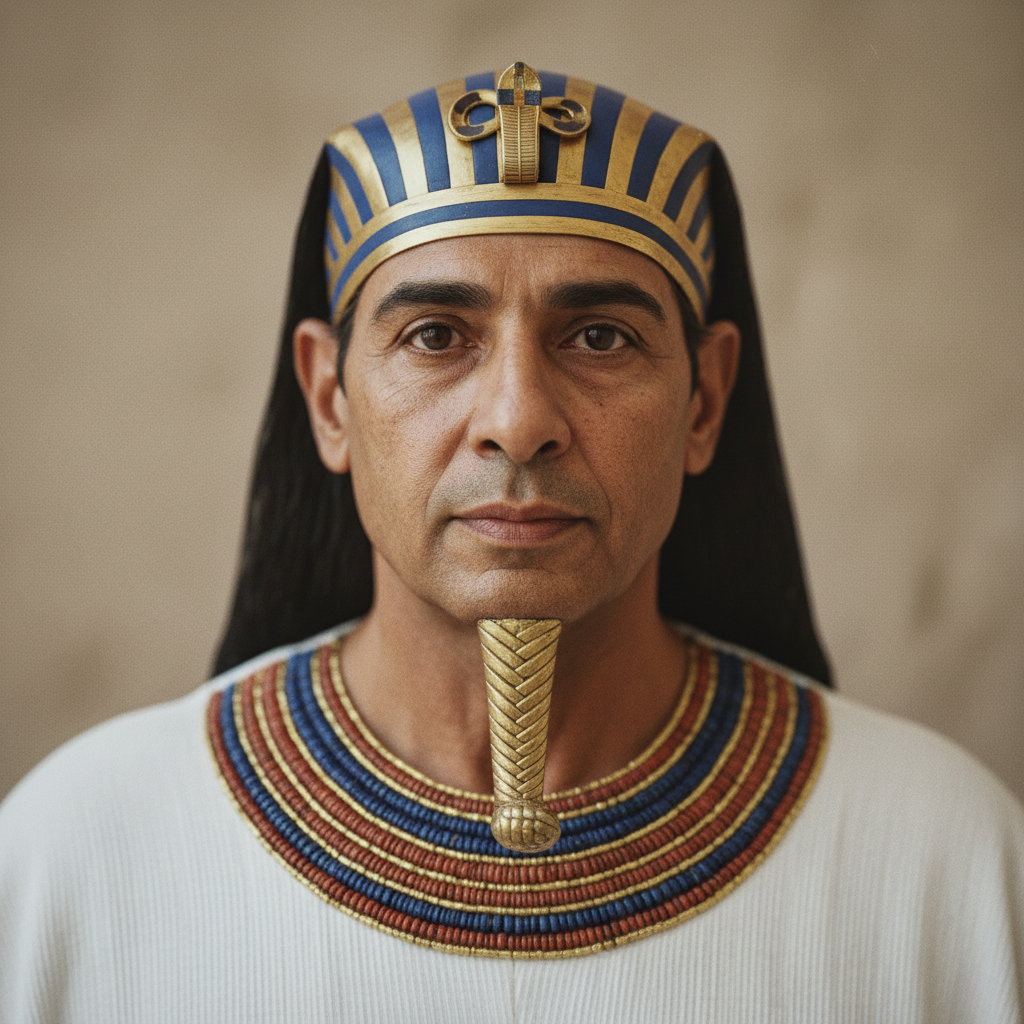
His face is best imagined with a wide, square jaw, full lips and a straight, prominent nose—features repeated across his giant colossi and relief portraits. The overall plane of the face is strong rather than delicate, with a sense of solidity that reads as authority and endurance. Skin tone would have been a warm olive to medium‑brown typical of the Nile Valley; hair was likely dark and thick, usually covered by a royal wig or the striped nemes headdress in public imagery. Reconstructions guided by the royal mummy present brown eyes and proportions that match the monumental portraits. Ramses projected physical power: broad shoulders, a muscular chest, and an upright, commanding posture. In ceremonial and public contexts he wore the shendyt (pleated kilt), broad collar, and the crowns or nemes with the uraeus; statues often add the stylized false beard and idealized musculature to emphasize kingship.
Height / build
Likely average to slightly tall for his time · Likely robust / medium to stocky build
Hair
Likely dark (black to dark brown) · Likely straight to slightly wavy · Likely full in adulthood; possibly receding or thinner in later life
Eyes
Likely dark (brown)
Complexion
Likely Mediterranean / olive to light brown
Face
Broad, square face with strong jaw · Straight, prominent nose
Notable features
Strong jawline, prominent straight nose, deep-set dark eyes, regal posture and the iconic nemes wig/royal crowns
Grooming
Probably clean‑shaven in daily life; wore a stylized false ceremonial beard as pharaoh · Often portrayed with the royal wig (nemes), shaved head or wig in formal images, and the false beard and elaborate jewelry of kingship.
Dress / presentation
Pharaonic regalia: shendyt kilt, nemes wig or crowns (white crown, red crown, double crown), wide collars and ceremonial apparel
face
Jawline
Broad, strong jaw
Colossal statues and busts emphasize a square, powerful jaw; reconstructions based on the mummy echo a robust lower face.
face
Nose
Straight and prominent
Temple reliefs and statues consistently show a strong, straight nose; reconstructions based on skeletal data support a prominent nose.
eyes
Eye color
Likely dark (brown)
Population context for Nile Valley Egyptians and pigment choices in painted portraits point to brown/dark eyes; mummy soft tissues and reconstructions assume dark irises.
hair
Hair color
Likely dark (black to dark brown)
Ancient Egyptian depictions and hair preserved in some royal mummies indicate dark hair; wigs and painted portraits also show black hair.
hair
Hair style / wig
Often shown wearing the nemes wig or crowns; probably shaved or cropped in private life
Pharaonic convention: nemes headcloth, crowns and ceremonial wigs are standard in royal imagery; many elite mummies show trimming/shaving of natural hair.
skin
In New Kingdom Egypt, a king's appearance on monuments was a visual program: youthfulness, symmetry, and divine attributes mattered more than realistic aging. That’s why Ramses is repeatedly shown with an idealized face, perfect proportions and the accoutrements of divinity — nemes wigs, crowns, collars and the ceremonial beard — creating a timeless, commanding image.
Ramses II belonged to the native Nile Valley population and ruled an empire interacting with Nubia, the Levant and Mediterranean polities. His features — dark hair, brown eyes, olive‑brown skin tones — fit the broader Eastern Mediterranean/North African phenotypes common among Egyptian elites of the Ramesside period.
Modern films and illustrations often impose European features or dramatic hair/skin color; surviving Egyptian art and his mummy point to darker hair, brown eyes, and Nile‑Valley complexion.
Movies and cartoons often recast Ramses as either a pale, Europeanized tyrant or a flamboyantly exotic figure with wildly different skin or hair color. In reality, surviving Egyptian art and his mummy point to dark hair, brown eyes and a Nile‑Valley complexion — not the extremes of modern fantasy.
Probably around average to slightly above average height for a New Kingdom Egyptian man — monuments make him appear much taller for effect.
Likely dark brown — consistent with Nile‑Valley populations and forensic reconstructions from his remains.
Likely dark (black to dark brown); royal portraits and surviving hair on royal mummies support dark hair.
He was probably clean‑shaven in daily life but is routinely shown wearing the stylized false ceremonial beard of pharaohs.
He was portrayed as idealized and commanding — meant to be impressive and divine rather than a private portrait of beauty.
Monuments present an idealized, heroic version of Ramses; the mummy and forensic reconstructions confirm many matching facial proportions, so statues capture key features but amplify youth and scale.
Colossal statues at Abu Simbel
Abu Simbel Temples (reliefs & colossi) · c. 1264–1244 BCE (reign of Ramses II)
Four immense seated colossi and numerous reliefs present a standardized, idealized royal face: broad jaw, full lips, straight prominent nose and the nemes or crown; the scale accentuates presence and authority.
Ramesseum statues and Luxor/Luxor colossi
Ramesseum (memorial temple) and Luxor statues · 13th century BCE
Multiple large statues reinforce the same facial template and body type: broad‑shouldered, square face, strong nose and regal pose used repeatedly across royal monuments.
Ramses II mummy (modern study)
The Royal Mummy (Cairo Museum) — Ramses II · Mummy rewrapped and identified in 19th century; modern CT studies 20th–21st c.
The preserved remains provide skeletal and some soft‑tissue data used in forensic reconstructions, confirming robust cranial features and giving direct anatomical input for face shape and stature estimates.
Forensic reconstructions based on the mummy
Forensic facial reconstructions (Egyptian antiquities teams / CT studies) · Late 20th–early 21st century
CT-guided models and reconstructions translate the mummy's cranial anatomy into lifelike faces showing dark hair, brown eyes, and the overall proportions consistent with monumental portraits.
Temple relief portraits and painted scenes
Reliefs from temples across Egypt (Karnak, Abydos, etc.) · 13th century BCE
Painted and carved reliefs show consistent iconography: royal wig/headgear, stylized features and color palettes that reflect contemporary aesthetic norms for skin and hair tones.
Contemporary inscriptions and titulary
Royal inscriptions and titulary of Ramses II · 13th century BCE
Complexion
Likely Mediterranean / olive to light brown
Artistic palettes and regional population context place Nile Valley elites in this complexion range; reconstructions use olive tones consistent with New Kingdom Egyptians.
height build
Height
Likely average to slightly tall for his time
Monumental sculpture exaggerates height, but measurements and assessments of royal mummies place him near or a bit above period male averages.
height build
Build
Likely robust / solid
Royal statuary and military scenes depict a broad‑shouldered, muscular figure; life as a warrior-king favors a strong build.
grooming
Facial hair
Probably clean‑shaven in life; wore ceremonial false beard
Egyptian kings are shown with stylized false beards in art; everyday grooming for elites tended toward shaving.
clothing
Regalia
Pharaonic regalia: nemes/headcloth, crowns, shendyt kilt, wide collar; often shown with royal scepter
Iconography across temples consistently depicts Ramses in full royal costume and insignia of kingship.
other
Facial expression/pose
Stoic, commanding, idealized
Royal portraits aim to convey divinity and authority rather than candid expression; statues show composed, timeless features.
Inscriptions describe his deeds and emphasize kingship and divinity; while they do not detail color or hair, they contextualize the visual program that shaped how he was represented.