height build
Height
Likely about 5'8" (average to slightly tall for his time)
Skeletal measurements from the recovered skeleton give an estimated stature of roughly 5'8" (≈173 cm).
Portrait reconstruction
1452–1485 · England (House of York) · Late medieval — Wars of the Roses
Richard III probably had dark hair, brown eyes, a long narrow face and a slight asymmetry in his posture from spinal curvature, and he wore the rich livery and armor of a Yorkist noble.
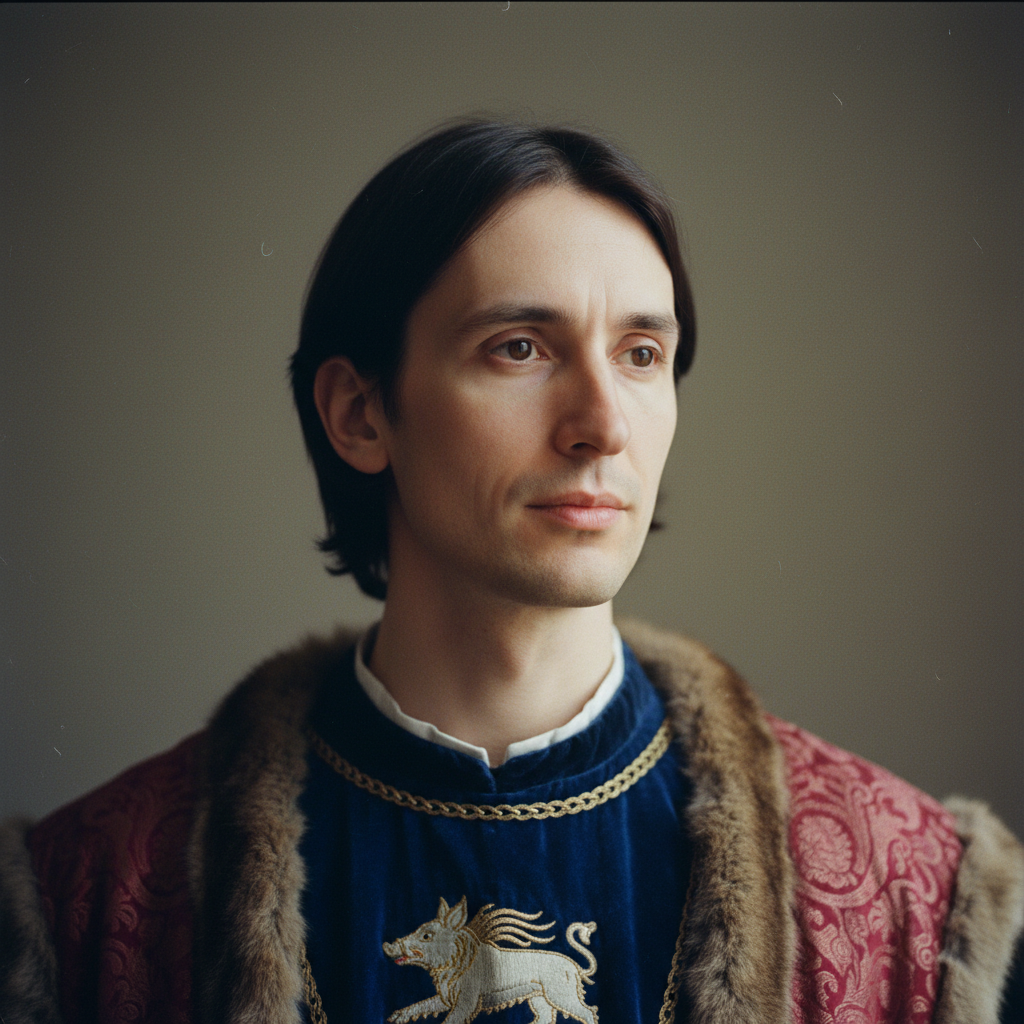
Face and head: He most likely had a long, narrow face with a relatively straight to slightly prominent nose and a firm jawline. Forensic reconstructions suggest brown eyes and dark hair, worn short by the standards of late medieval noblemen; he was probably clean-shaven or closely trimmed rather than sporting a full beard. Body and posture: He stood around 5'8" (about 173 cm) and was muscular from years of military service. A noticeable spinal curvature gave him a mild tilt or asymmetry—one shoulder sitting a little higher—which would have been visible in posture but not an extreme hunch. Marks and dress: Campaign life and personal combat left him with battle scars and the stance of a seasoned soldier. Off the battlefield he dressed in sumptuous Yorkist finery—embroidered gowns, furs and the white boar badge—while in action he wore articulated plate armor appropriate to a late medieval prince and commander.
Height / build
Likely about 5'8" (average to slightly tall for his time) · Likely lean and athletic
Hair
Likely dark brown · Likely straight to slightly wavy · Likely a normal (medial) hairline — not markedly receding
Eyes
Likely dark (brown)
Complexion
Likely fair to pale
Face
Likely long and narrow · Likely straight to slightly prominent
Notable features
Pronounced spinal curvature (scoliosis) producing asymmetric shoulders, long narrow face, and a distinctive profile often shown in reconstructions.
Grooming
Probably clean‑shaven or with very short trimmed facial hair · Typical late‑medieval noble grooming: short, well‑kept hair, clean shave or minimal facial hair, and carefully dressed court appearance.
Dress / presentation
Late medieval English royal court dress — rich fabrics, fur trims, embroidered doublets and robes, and Yorkist heraldic motifs (notably the white boar livery).
height build
Height
Likely about 5'8" (average to slightly tall for his time)
Skeletal measurements from the recovered skeleton give an estimated stature of roughly 5'8" (≈173 cm).
height build
Build
Likely lean and athletic
As a medieval soldier and nobleman the skeleton indicates a wiry, well‑muscled frame consistent with active military life.
face
Face shape
Likely long and narrow
Forensic facial reconstruction based on the skull produced a relatively long, narrow facial form in multiple reconstructions.
other
Spinal/asymmetry
Scoliosis producing asymmetric shoulders
The skeleton shows pronounced scoliosis of the spine that would have tilted his shoulders and given a distinctive asymmetry in posture.
hair
Hair color
Likely dark brown
No genetic phenotype markers published for hair color; regional, family and portrait tradition favor a dark brown head of hair.
eyes
Eye color
Late medieval English elites prized a martial, authoritative look: a soldierly bearing, controlled grooming, pale skin that signaled noble status, and clothing that displayed rank through rich fabrics and emblematic badges. Public image mixed the ideals of chivalry with visual signs of lineage.
Richard belonged to the English Plantagenet dynasty with Norman/Anglo‑French ancestry; physiognomy would tend toward the north‑western European range — fairer skin, dark hair and brown eyes were common among the nobility of his region and lineage.
Modern portrayals often exaggerate deformity (hunched posture and caricatured facial features); skeletal and forensic evidence show a man with scoliosis but not the grotesque deformities in later propaganda.
Shakespeare and later Tudor writers amplified Richard’s scoliosis into monstrous deformities and a villainous appearance; modern films often double down, making him grotesquely hunched or facially distorted — the skeleton shows an asymmetry from scoliosis but not the exaggerated hunch or facial mutilation of many portrayals.
He was about 5'8", which was average to slightly tall for late 15th‑century England.
Likely dark (brown).
Likely dark brown.
Probably clean‑shaven or with very short trimmed facial hair.
He had pronounced scoliosis that made one shoulder higher than the other, but not the grotesque hunch often depicted in Tudor propaganda.
In sumptuous late‑medieval royal court clothes: embroidered doublets and robes, fur trims, and Yorkist heraldic badges such as the white boar.
Skeletal remains identified as Richard III
University of Leicester — Archaeological Services / Genetic and osteological analysis team · 2013
Directed excavation under Leicester Greyfriars found a male skeleton with battle injuries and scoliosis; radiocarbon, radiographic and DNA analyses matched known maternal-line descendants, supporting identification and providing measurements (age at death ~32, stature ~5'8").
Forensic facial reconstructions of Richard III
University of Leicester forensic team (collaborations with facial reconstruction specialists) · 2013–2014
Reconstructions using skull morphology and soft‑tissue profiling produced consistent images showing a long narrow face, straight-to-prominent nose, dark hair and brown eyes; used in public exhibitions and documentaries.
Portraits traditionally identified as Richard III (Royal and civic images)
National Portrait Gallery and Royal Collection · 16th–17th century (posthumous portraits)
Several posthumous portraits established an iconic visage of Richard — long face, hooked nose in some images — but these are later, idealized images that influenced how he was pictured for centuries.
Contemporary / near‑contemporary chronicles and descriptions
Various chronicles (e.g., Croyland/Polydore Vergil accounts and later Tudor-era narratives) · 15th–16th centuries
Chronicles and later writings shape Richard's historical image — including descriptions emphasizing haughtiness or deformity — but are colored by politics; they do provide context for his public appearance and reputation.
Heraldic and material culture (white boar badge, clothing depictions)
Heraldic records and surviving livery badges · 15th century
Material culture associated with Richard (white boar badge, robes depicted on effigies and in accounts) indicate his wardrobe was richly embroidered and emblematic of Yorkist identity.
Likely dark (brown)
No direct genetic phenotype published; brown/dark eyes were common in the English population and are consistent with period portraits.
grooming
Facial hair
Probably clean‑shaven
Late 15th‑century English nobles commonly wore little or no facial hair; contemporaneous images normally show a clean face or minimal stubble.
skin
Complexion
Likely fair to pale
Noble status, northern English ancestry and court life made a fair complexion likely; reconstructions portray relatively pale skin.
clothing
Clothing style
Late medieval royal court dress with Yorkist heraldry (white boar)
As king and Yorkist noble, he would have worn rich fabrics, fur trims and livery heraldry; the white boar was his personal badge.
hair
Hair texture
Likely straight to slightly wavy
Forensic reconstruction and regional trait patterns favor straight or gently wavy hair rather than tightly curled.
face
Nose
Likely straight to slightly prominent
Skeletal nasal structure and reconstructions indicate a straight, somewhat pronounced nose rather than a flattened or hook form.
comparison
Overall impression in a room
Commanding, soldierly, and lean rather than corpulent or grotesquely deformed
Combining stature, military bearing, clothing and the visual effect of scoliosis gives a commanding but not monstrous presence.