height build
Height
Likely average height
No reliable measurement survives; medieval Scottish nobles commonly averaged heights similar to contemporary British men, with no strong textual claim of exceptional stature.
Portrait reconstruction
1274–1329 · Scotland · Medieval (Late 13th–early 14th century)
Robert the Bruce likely looked like a broad‑faced, dark‑haired, bearded warrior‑king with a sturdy, compact build, usually clad in mail and a kingly mantle.
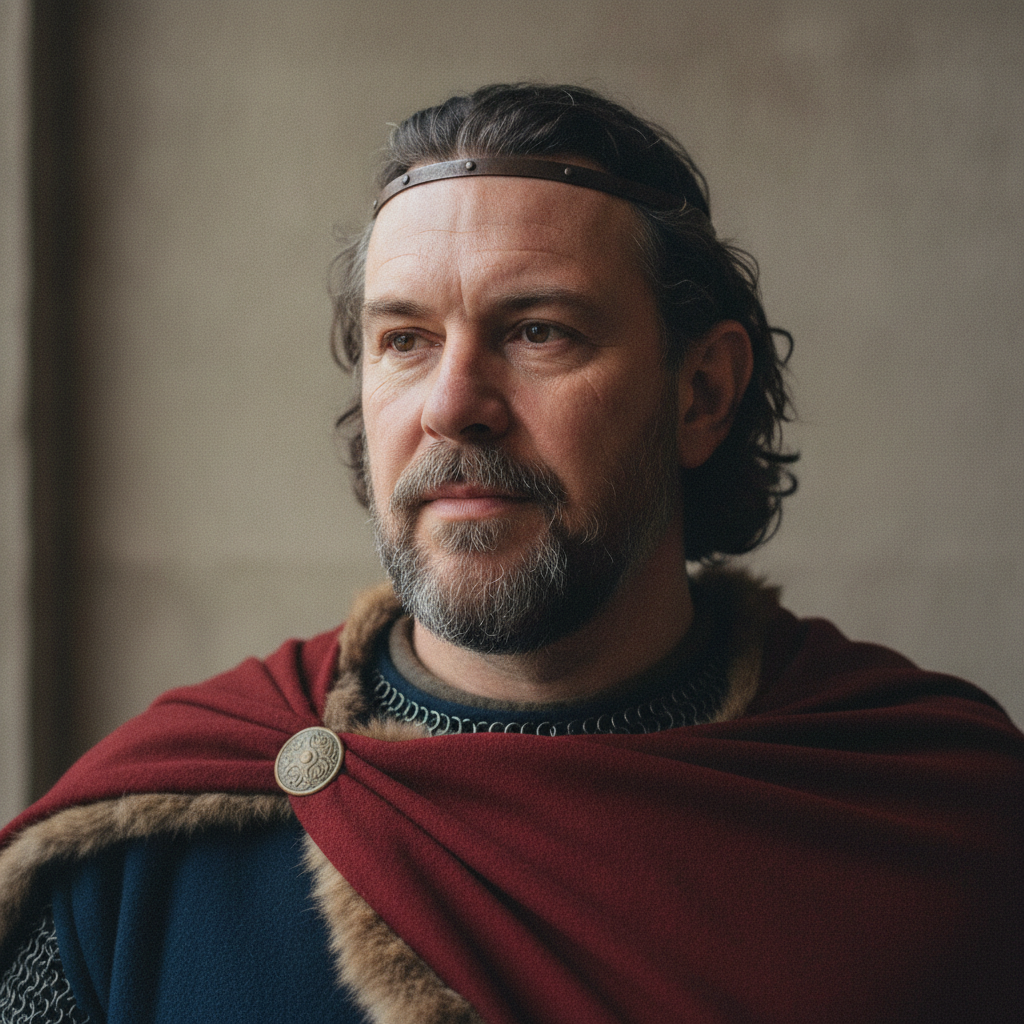
Face and hair: He likely had a broad, square face common to many carved effigies and seal profiles associated with him—strong jaw, full cheeks and a prominent brow. Hair was probably dark and cut to practical medieval lengths rather than long flowing locks; later romantic images lengthen it for effect. A beard is the clearest visual trait: medieval stone effigies and later portraits consistently show him with a substantial beard, probably trimmed rather than wildly unkempt. Physique and bearing: Think compact and powerful rather than gaunt or lanky—built for riding and combat. Contemporary descriptions emphasize a commanding presence, and his likely body type would have been solidly muscular from armour and horseback campaigning. He would have stood with the posture of a leader: broad‑shouldered, upright, and physically resilient rather than lithe. Dress and accoutrements: On official seals and the Dunfermline effigy he appears in regalia—circlet or small crown, a mantle or cloak fastened at the shoulder, and the practical layers of a medieval noble: a padded gambeson and mail for battle, a surcoat bearing arms for public and ceremonial occasions. Weapons and a sword were part of his image; helmets and mail coifs were worn in the field, but portraits more often show him in kingly outer dress to signal authority.
Height / build
Likely average height · Likely solid/muscular
Hair
Likely dark to graying · Likely wavy to straight · Likely receding/thinning later in life
Eyes
Likely dark (brown)
Complexion
Likely fair to ruddy (northern British complexion)
Face
Likely broad/oval · Likely prominent/strong (perhaps aquiline)
Notable features
Commanding jawline, prominent nose, weathered skin from campaigning, possible scars from battle
Grooming
Probably a trimmed full beard or moustache (typical noble grooming) · Short, practical hair and a well-kept beard; not the long unkempt hair of later romantic images.
Dress / presentation
Anglo‑Norman/Scottish noble dress: mail and surcoat in war; fur-lined cloak, embroidered tunic and crown or circlet at court
height build
Height
Likely average height
No reliable measurement survives; medieval Scottish nobles commonly averaged heights similar to contemporary British men, with no strong textual claim of exceptional stature.
height build
Build
Likely solid / muscular
A lifetime of campaigning and mounted warfare suggests a robust, muscular physique rather than slenderness.
hair
Hair color
Likely dark to graying
Typical northern French/Scots elite pigmentation and later-life graying seen in effigial and later portrait conventions.
hair
Hair texture
Likely wavy to straight
Regional ancestry (Norman/Scots) and medieval depictions favor a wavy/straight texture over tightly curled hair.
hair
Hairline
Likely receding/thinning later in life
Many medieval and later depictions show a mature king with shorter hair and some thinning; aging by his 50s would commonly include recession.
other
Facial hair
In Robert’s world, a king’s appearance signaled martial competence and authority more than courtly prettiness—sturdy physicality, visible readiness for war, and sober, high-quality clothing flagged legitimacy. Furs, a cloak, and an emblematic circlet or crown signaled rank; clean grooming and a trimmed beard expressed discipline.
The de Brus family was of Norman origin but long integrated into Scotland’s nobility; visually Robert would likely fit the varied northern French / British Isles phenotype common among the Scottish elite — darker hair and eyes, fair northern skin, and robust build from riding and fighting.
Modern films often show him with long wild hair and movie-hero musculature; reality was likely shorter hair, practical grooming, and a solid, battle-hardened build.
Films often show Robert with long unkempt hair, extreme bulk, or a Hollywood 'wild man' look. More plausibly he kept his hair short for fighting, wore practical armor on campaign, and presented a dignified, controlled appearance at court.
Likely average height for a medieval Scottish noble—nothing in contemporary sources claims exceptional height.
Likely dark (brown), the common eye color among northern French and British populations of the era.
Likely dark, turning to gray in later life; hair probably wavy to straight and cropped short for military practicality.
Probably yes—a trimmed full beard or at least a moustache, in line with noble and martial grooming of the period.
In battle: mail shirt, surcoat and helm; at court: embroidered tunic, fur-lined cloak and circlet or crown—Anglo‑Norman/Scottish noble dress.
From a mix of medieval effigies and seal imagery, near‑contemporary literary descriptions emphasizing presence, and later portraits shaped by those images.
Recumbent effigy at Dunfermline Abbey (traditionally associated with Robert the Bruce)
Dunfermline Abbey effigy · 14th century (post-1329)
Stone effigy traditionally linked to Robert I shows a broad-faced, bearded king in medieval dress; has strongly influenced later images of his appearance.
Seal impressions and royal iconography
Great Seal of Robert I and charter seals · Early 14th century
Seal impressions show stylized profile and royal insignia—useful for dress and iconographic cues (crown, mantle) though faces are schematic.
The Brus by John Barbour
John Barbour, The Brus · c. 1375 (poem)
A near‑contemporary epic poem praising Robert’s deeds and presence; literary descriptions convey a majestic, commanding figure and provide cultural context for his bearing.
Post‑medieval portraits (17th–19th centuries)
Various later painted portraits held in Scottish collections · 17th–19th centuries
Imaginative portraits created centuries after his death that depict him as a bearded, often long‑haired warrior; useful for reception history but low value as direct likenesses.
Contemporary chronicles and charter records
Various chronicles (e.g., Scalacronica, English and Scottish chronicles) · 14th century
Chronicles focus on deeds and leadership; when they mention appearance they stress commanding presence rather than fine detail.
Probably a trimmed full beard or moustache
Medieval noble and warrior grooming typically favored beards; seals and effigies often show facial hair on kings and knights.
eyes
Eye color
Likely dark (brown)
Brown/dark eyes were common among northern French and British populations of the period; no direct evidence suggests light eyes.
skin
Complexion
Likely fair to ruddy
Northern British complexion combined with outdoor campaigning would yield fair skin with weathered, ruddy tones.
other
Notable facial features
Likely a strong jaw and prominent nose
Effigial representations and the iconography of kings emphasize a strong profile; contemporary descriptors praise his presence.
clothing
Clothing style
Anglo‑Norman/Scottish noble dress: mail in war; fur-lined cloak and embroidered tunic at court
As king he combined martial kit (mail, surcoat) with courtly Anglo-Norman dress; Scottish noble dress included furs and distinctive cloaks.
grooming
Grooming
Practical and well-kept (short hair, trimmed beard)
Military leaders favored manageable hair and trimmed beards for helmet use and hygiene; later romantic portrayals exaggerate length.