clothing
Tunic / Hood
Likely a hooded green tunic (Lincoln green)
Medieval ballads repeatedly link Robin Hood and his band with green clothing and hoods used for woodland camouflage and identification.
Portrait reconstruction
0–0 · Sherwood Forest / Nottinghamshire, England (legendary) · Late medieval England (legendary figure associated with 13th–15th century ballads)
Robin Hood likely looked like a fit, weather-tanned yeoman with dark hair, a hooded green tunic, and the strong arms and callused hands of a longbowman.
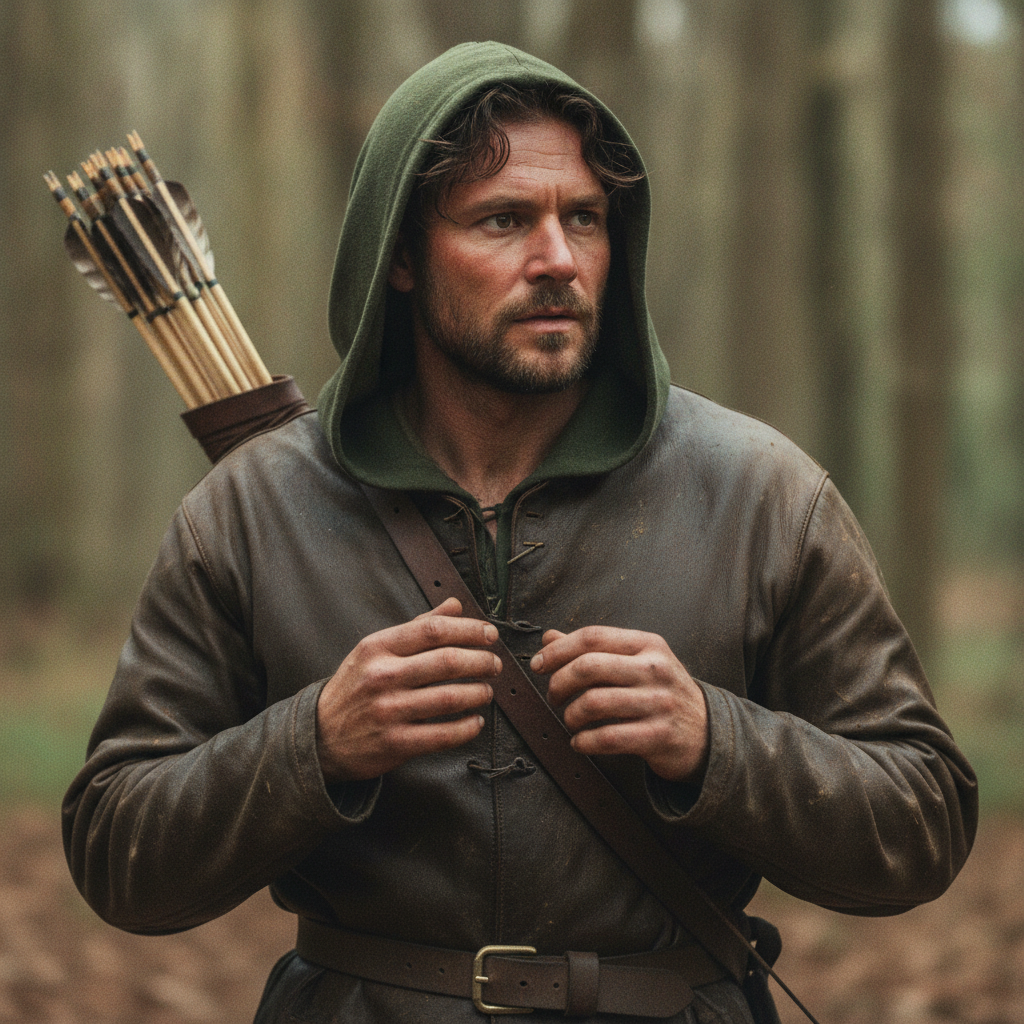
Face and hair: Probably dark-haired—brown to black—kept short or tied back to avoid snagging branches, with brown eyes and a lean, sun-darkened complexion from hours outdoors. His face would read more hard-earned surface than ornament: a straight nose, weathered cheeks, and a jaw often kept clean-shaven or with only a short, practical stubble rather than an elaborate beard. Build and bearing: Broad-shouldered and compact rather than gaunt, built for explosive strength and endurance: thick forearms, strong back and shoulders from drawing a longbow, and callused fingertips. He would move with the low, quick grace of someone used to the trees—balanced, quick-stepping, and ready at a moment’s notice to draw a bow or climb a slope. Clothing and kit: A close-fitting woolen or mixed-fabric tunic dyed in shades of green (the traditional “Lincoln green”), a hood or cowl to blend into the woodland, a leather jerkin or patches for extra protection, sturdy hose and rough-soled leather boots, and a wide belt carrying a quiver, knife and possibly a short sword. Practical details—patched sleeves, mud-dark hems, and a hood often pulled up—would dominate over decoration.
Height / build
Likely average height · Likely athletic / muscular
Hair
Likely dark brown to brown · Likely wavy to straight · Likely full hairline
Eyes
Likely dark (brown)
Complexion
Likely tanned / ruddy
Face
Likely square to oval face with pronounced jaw · Likely straight or slightly aquiline
Notable features
Weathered, sun-darkened skin, strong jaw and forearms, possible calluses on draw-hand, keen alert eyes, clothing stains from outdoors
Grooming
Probably short beard or trimmed stubble · Practical and maintained — trimmed facial hair, hair kept to practical length under a hood.
Dress / presentation
Hooded tunic (Lincoln green), leather belt and boots, quiver and longbow; pragmatic leather or wool rather than fine silk
clothing
Tunic / Hood
Likely a hooded green tunic (Lincoln green)
Medieval ballads repeatedly link Robin Hood and his band with green clothing and hoods used for woodland camouflage and identification.
height build
Height
Likely average height
No claims of extraordinary height appear in the tradition; practical woodland fighters were typically average-stature men for medieval England.
height build
Build
Likely athletic / muscular
His role as a longbow archer and active outlaw implies strong upper body and lean, muscular frame from constant physical activity.
hair
Hair color
Likely dark brown
Medieval English population norms and ballad imagery favor darker hair; later romantic blond portrayals are modern inventions.
hair
Hair style / texture
Likely wavy to straight, kept practical length under a hood
Practical woodland living and hooded dress encourage shorter, manageable hair; regional phenotypes favor wavy/straight textures.
eyes
Eye color
Late medieval English rural culture prized physical skill, self-reliance, and martial competence—especially proficiency with the longbow—over courtly beauty. For a popular outlaw-leader, charisma, reliability in the field, and visible competence (a strong draw-arm, steady gaze) mattered more than fashionable clothes.
Robin Hood should be pictured as an English rural man of the late medieval period—an Anglo-Saxon/Anglo-Norman mixed population with predominantly dark hair and brown eyes, medium stature, and a sun-darkened complexion from outdoor work.
Modern movies often show long flowing blonde hair, polished nobility, or fanciful costumes; the ballad tradition and social reality point to a darker-haired, practical yeoman in rough green garments.
Film and TV favor romanticized images—long flowing hair, aristocratic refinement, or gaudy green costumes—whereas the ballads and social reality point to a practical, darker-haired, rugged yeoman in a simple hooded tunic suited to woodland life.
Likely average height—nothing in the ballads marks him as unusually tall.
Likely dark (brown).
Likely dark brown, wavy to straight, kept at a practical length under a hood.
Probably a short beard or trimmed stubble.
A practical hooded green tunic (Lincoln green), leather belt, boots, and bow and quiver.
No exact contemporary portrait exists; his look is reconstructed from ballads, later art, and period context.
A Gest of Robyn Hode
A Gest of Robyn Hode (late 15th century ballad) · late 15th century (compiled)
Major composite ballad that repeatedly situates Robin and his men in the greenwood, emphasizes archery and yeoman status, and supplies much of the traditional clothing imagery.
Robin Hood and the Monk
Middle English ballad (early–mid 15th century) · 15th century
One of the earliest surviving Robin Hood narratives; includes references to hoods, woodland action, and outlaw life that inform assumptions about dress and activity.
Robin Hood and Guy of Gisborne
Middle English ballad (15th century) · 15th century
Ballad describing violent encounters and archery skill; supports image of a dangerous, physically capable outlaw-leader.
Child Ballads (compilation)
Francis James Child, The English and Scottish Popular Ballads (late 19th century) · 1882–98 (compilation of medieval texts)
Comprehensive 19th-century collection and commentary that preserves multiple medieval variants, perpetuating descriptions like Lincoln green clothing and the yeoman status of Robin Hood.
Records of May games and 'Robin Hood' plays
Municipal and church records (13th–15th centuries references) · 13th–15th century (various records)
References to popular plays and games invoking Robin Hood during festivals indicate a widely recognised popular figure with set costume conventions (often green and hooded) used in public performance.
Victorian and later illustrations and theatrical costumes
19th–20th century artistic tradition (e.g., woodcuts, stage costumes) · 1800s–1900s
Later images cemented the green-hooded look and introduced romantic variations (e.g., fair hair, aristocratic bearing) that shaped modern expectations though they deviate from medieval textual hints.
Likely dark (brown)
Brown eyes were predominant in medieval England; ballads do not highlight unusual eye color, which later romances might.
grooming
Facial hair
Probably short beard or trimmed stubble
Medieval adult men commonly wore some facial hair, and a practical trimmed beard fits an outdoor leader's image.
skin
Complexion
Likely tanned / ruddy
Sustained outdoor life (hunting, campaigning) darkened skin relative to indoor, courtly figures.
other
Distinctive marks
Weathered face and strong hands (archer’s calluses)
A skilled longbowman would develop physical marks like callused fingers and a sun-weathered visage from outdoor life.
cultural
Social presentation
Yeoman / practical leader rather than noble in fine clothes
Ballads depict Robin Hood as a yeoman or outlaw leader who prizes skill over courtly appearance; his clothing and behavior align with commoner/forester roles.
Archery practice and material culture
Studies of medieval longbowmen and clothing · modern scholarship (various)
Archaeological and experimental studies show longbowmen developed specific musculature, calluses, and preferred practical clothing that informs likely physical attributes for an active archer like Robin Hood.