height build
Height
Likely average height
No direct metric evidence; typical urban Persian men of his class were not notably tall or short.
Portrait reconstruction
1207–1273 · Born in Balkh (now Afghanistan); lived and died in Konya (now Turkey) · Medieval Islamic world (13th century)
Rumi most likely looked like a dignified, bearded Persian scholar with dark hair, an oval face, and a turbaned, robed presence.
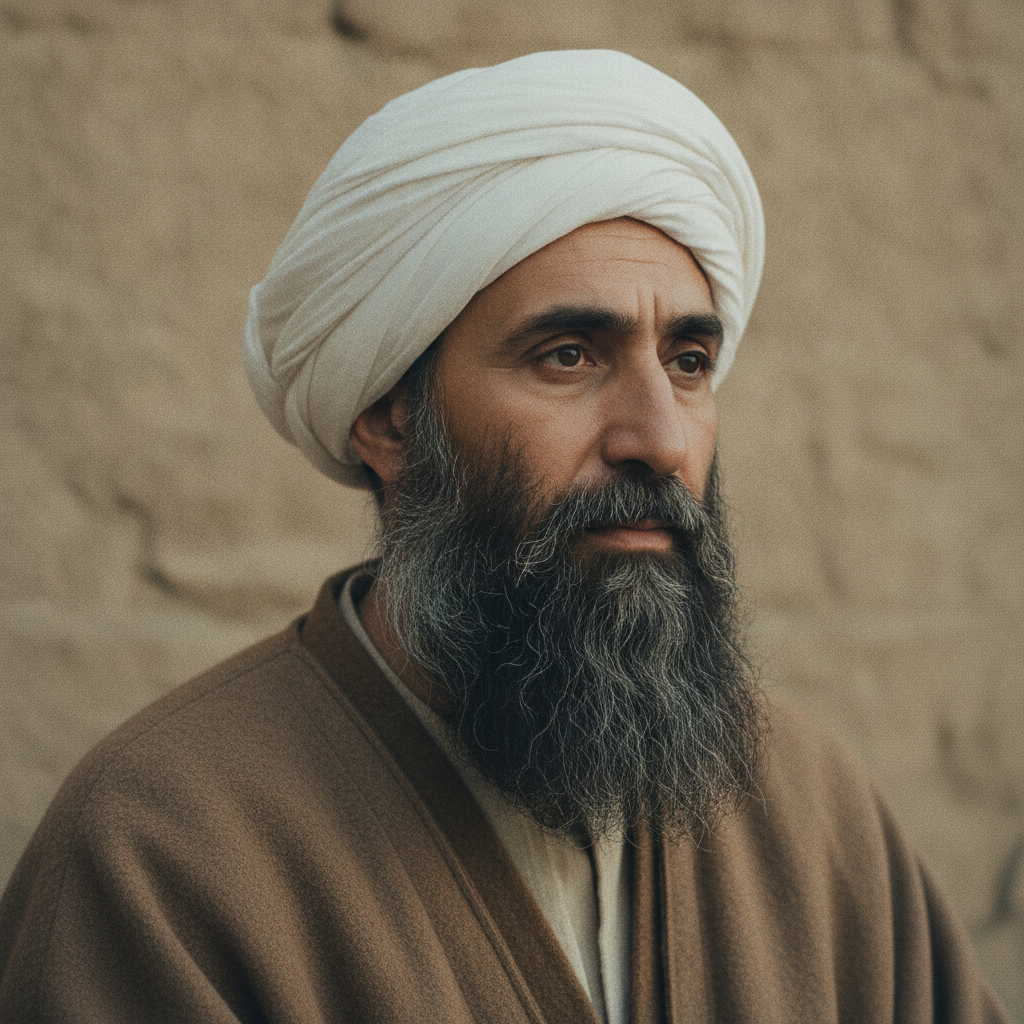
Faces in the manuscript tradition and later shrine images show an oval face framed by dark hair and a full beard; Rumi is commonly portrayed as a mature man with steady, inward‑focused eyes and a calm expression. A full beard was the norm for learned men of his rank, so a beard rather than a clean shave is the best visual guess. He is almost always pictured wearing a wrapped turban and long scholarly robe—simple, dignified garments rather than ornate court finery. Think wool or cotton robes in muted tones, a wrapped turban sitting low on the brow, and a loose outer cloak or sash that marks him as a teacher and spiritual guide. Overall he would have read and taught in a composed, seated posture—often shown with a book or rosary—projecting the quiet authority of a teacher. His complexion was probably in the medium olive range typical of the eastern Iranian/Persian cultural world he came from, and the images favor the look of a thoughtful, elder scholar rather than a flamboyant mystic.
Height / build
Likely average height · Likely slender to average build
Hair
Likely dark to graying · Likely straight to slightly wavy · Likely receding a little with age
Eyes
Likely dark (brown)
Complexion
Likely olive to light brown (Mediterranean / West Asian)
Face
Likely oval to long face · Likely straight to slightly aquiline
Notable features
Expressive dark eyes, long beard, prominent nose, dignified scholar's bearing
Grooming
Probably full beard (dark, later graying) · Typically worn a full, well‑kept beard and kept hair under a turban; overall neat, scholarly grooming rather than ascetic shabbiness.
Dress / presentation
Likely long scholar’s robe (khirqa‑style when depicted as a Sufi) and turban; later Mevlevi iconography shows him with a double‑layered cloak and simple, dignified garments.
height build
Height
Likely average height
No direct metric evidence; typical urban Persian men of his class were not notably tall or short.
height build
Build
Likely slender to average build
Life as a scholar and spiritual teacher suggests a non‑manual, moderate physique shown in manuscript images.
eyes
Eye color
Likely dark (brown)
Dark eyes were dominant in his region and appear in later portrait traditions.
hair
Hair color
Likely dark to graying
Contemporary portraits and textual references to aging show dark hair that gray with age.
hair
Hair texture
Likely straight to slightly wavy
Most Persian‑Anatolian male hair types are straight to wavy and later portraits show smooth hair under turbans.
hair
Hairline
Likely modestly receding with age
Later portraits and the pattern of aging suggest some recession rather than total baldness.
In the 13th‑century Persianate world, authority and learning were signaled by sober, high‑quality dress (long robes and turbans), a well‑kept beard, and calm, composed bearing. Rumi’s clothing and grooming would announce his role as a scholar‑shaykh more than physical ornamentation or courtly finery.
Rumi was born into the eastern Iranian/Persian cultural world (Balkh) and spent his adult life in Konya, a Turko‑Persian urban center. That places him within a population blend where olive to light brown complexions, dark hair and eyes, and straight to slightly wavy hair textures were common — a look typical of many Persian scholars illustrated in later manuscripts.
Modern images often romanticize him as an exotic, ethereal figure or use Ottoman‑era costume; the best-supported image is more sober: a Persian scholar‑mystic in contemporary Sufi dress with ordinary, dignified features.
Modern depictions often exoticize Rumi — showing him as saintly, otherworldly, or borrowing later Ottoman fashions that post‑date him. The more historically consistent image is of a sober Persian scholar in contemporary Sufi dress: human, commanding, and culturally rooted rather than ethereal or heavily Orientalist.
Likely average height — nothing in surviving sources marks him as particularly tall or short.
Likely dark (brown).
Likely dark when younger, turning to dark‑gray with age.
Probably — he is almost always shown with a full beard in manuscript portraits and Mevlevi tradition.
Long scholar’s robes and a turban; when shown as a Sufi shaykh he wears a cloak (khirqa) and simple, dignified garments.
By combining early written notices, the Mevlevi visual tradition, later illuminated manuscripts, and regional dress norms to produce a consistent, sober image of a scholar‑mystic.
Persian and Ottoman manuscript portraits of Rumi
Various illustrated Mathnawī and Diwans (15th–18th centuries) · 15th–18th century (posthumous)
Numerous later Persian and Ottoman miniatures consistently show Rumi as a bearded, turbaned man with an oval face, dark hair, and dignified bearing; they form the main visual tradition used to imagine his look.
Biographical notices by his son and early Mevlevi sources
Sultan Walad and Mevlevi records (early post‑Rumi sources) · 13th century (son) and 14th century (early Mevlevi records)
Early written references by his son and later Mevlevi records describe Rumi's teaching, personality and status; they support a dignified, scholarly presentation (robes, shaykhly bearing) rather than physical details beyond beard and presence.
Aflākī’s Mevlevi hagiography
Aflākī, Manāqib al‑ʿārifīn (collector of Mevlevi biographies) · 14th century
Aflākī’s accounts contribute to the later visual and narrative tradition surrounding Rumi; while hagiographic, they shaped how artists depicted him in manuscripts.
Mevlana Museum iconography and shrine tradition (Konya)
Mevlana Museum, Konya (collection and shrine images) · Ottoman to modern era
The Mevlana Museum preserves devotional portraits and clothing associated with Rumi; these items reflect later, institutionalized images (beard, turban, robe) that inform modern views.
Modern scholarship summarizing appearance and iconography
Franklin D. Lewis, Annemarie Schimmel (modern Rumi biographies and studies) · 20th–21st century
Modern scholars synthesize textual records and manuscript imagery, describing Rumi as a Persian scholar‑mystic whose traditional depiction includes a turban, robe and beard; they provide the contextual basis for appearance claims.
grooming
Facial hair
Probably full beard (dark, later graying)
Sufi and scholarly portraits and textual tradition depict him with a full beard; Mevlevi imagery consistently shows a beard.
skin
Complexion
Likely olive to light brown
Born in eastern Iran and living in Anatolia, he would share the common West‑Asian complexion of Persianate elites shown in regional art.
face
Face shape
Likely oval to long face with prominent nose
Later portraits and textual descriptions emphasize a dignified, somewhat long face and distinct nose.
clothing
Clothing style
Scholarly Sufi robe and turban (khirqa‑style cloak)
As a prominent shaykh, he would wear the long robe and turban of learned men; Mevlevi tradition preserves this dress in portraits and funerary objects.
other
Overall bearing
Dignified, learned, spiritually authoritative
Contemporary accounts and later portrayals emphasize his teaching presence more than physical flamboyance.