height build
Height
Likely average height (~5'0"/152 cm)
Fits measurements and stature norms for Northern Plains/Shoshone women of the period and contemporary descriptions that portray her as a normal-sized young woman.
Portrait reconstruction
1788–1812 · Lemhi Shoshone / Northwestern Plains (present-day Idaho/Montana) · Early 19th century (Lewis & Clark Expedition)
Sacagawea was likely a slim, teenage Lemhi Shoshone woman with straight dark hair, warm-brown skin, dark eyes, and practical Plains-style clothing.
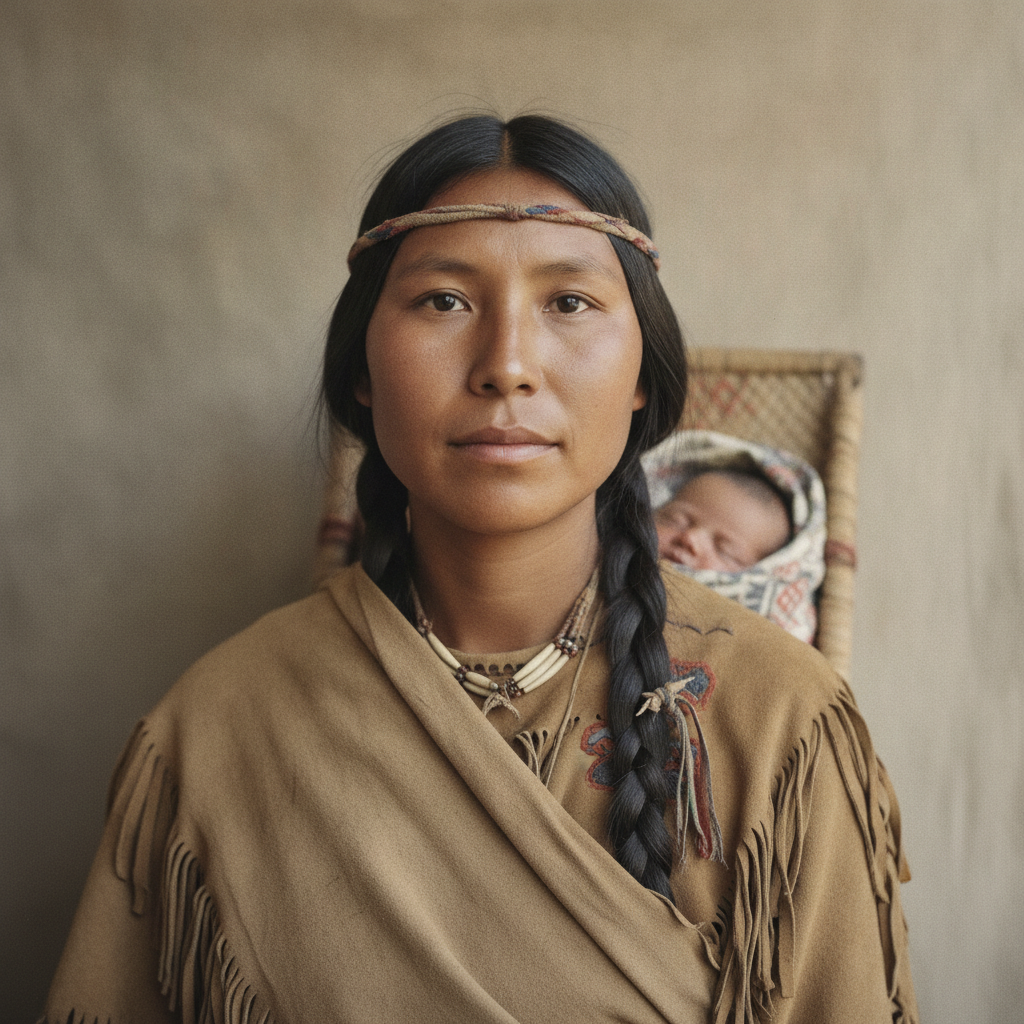
She was probably young and slight — in her mid-teens and lithe from long travel and daily work. Her skin would have been a warm brown tone common to Northern Plains Indigenous people; sunlight from months on the trail would have given her a healthy, weathered glow rather than a pale complexion. Her hair was almost certainly straight and dark, worn for practicality: braided or tied back to keep it out of the way while paddling, packing, and caring for her infant. Faces described by those familiar with Shoshone communities suggest high cheekbones, a straight or gently rounded nose, and dark, almond-shaped eyes that were observant and alert. Clothing was functional and regionally typical: a deerskin or hide dress with leggings and moccasins, often softened and decorated with simple beadwork, fringe, or trade-cloth trim. She likely carried her baby in a cradleboard or wrapped on her back, and may have had small personal ornaments—beads, shell, or hair ties—consistent with Lemhi Shoshone customs.
Height / build
Likely average height (around 5'0"/152 cm) · Likely slender/lean
Hair
Likely very dark brown to black · Likely straight and coarse · Likely full – hair worn long and often braided
Eyes
Likely dark (brown)
Complexion
Likely warm medium-brown (copper-toned)
Face
Likely oval with high cheekbones · Likely straight to medium-width nose
Notable features
High cheekbones, clear dark eyes, youthfully rounded features, and typically compact frame carrying an infant
Grooming
Likely none · Hair likely kept long and braided; wear of simple beadwork or trade ornaments was probable and practical.
Dress / presentation
Plains/Shoshone clothing: buckskin dress and leggings, practical footwear, sometimes trade-cloth accents and a cradleboard for her child
height build
Height
Likely average height (~5'0"/152 cm)
Fits measurements and stature norms for Northern Plains/Shoshone women of the period and contemporary descriptions that portray her as a normal-sized young woman.
height build
Build
Likely slender/lean and muscular
Endurance travel, frequent walking, and childcare would produce a wiry, fit physique rather than heavy build.
eyes
Eye color
Likely dark brown
Dark brown eyes were overwhelmingly common among Shoshone and neighboring Indigenous groups.
hair
Hair color
Likely very dark brown to black
Consistent with Northern Plains Indigenous populations and later descriptions and depictions.
hair
Hair texture & style
Likely straight, coarse; worn long and often braided
Ethnographic records of Shoshone hair habits show long straight hair commonly worn in braids or loose for practical reasons.
skin
Complexion
Likely warm medium-brown (copper-toned)
Shoshone values emphasized health, utility, and family roles rather than ornate display—long strong hair, clean and functional clothing, and evidence of good child-rearing were signs of stature. Ornamentation existed but prioritized meaningful beadwork and practical gear over European fashion.
As a Lemhi (Northern) Shoshone woman she belonged to Great Basin/Plains populations whose typical features include dark hair and eyes, medium-brown skin, and lean bodies adapted to an outdoor, mobile lifestyle—traits that make a dark-haired, copper-toned, fit young woman the most plausible image.
Modern images often Euro-idealize her (lighter skin, refined European facial types, or romanticized costume); true contemporary appearance was more plainly functional and distinctly Indigenous.
Coins, statues, and movie images often smooth or Europeanize Sacagawea—lightening her skin, softening Indigenous bone structure, or dressing her in romanticized fringe and feather clichés—whereas contemporary life would have favored practical clothing and distinct Indigenous features.
Likely average height—around 5'0" (152 cm), typical for Northern Plains/Shoshone women of her time.
Likely dark brown, consistent with Shoshone population traits.
Likely very dark brown to black, straight and coarse, typically worn long and often braided.
Probably yes—descriptions and cultural context point to a healthy, striking young woman valued for vitality and good child-rearing.
Practical Plains/Shoshone clothing: a buckskin dress and leggings, sometimes trade-cloth additions, and a cradleboard or sling for her infant.
Researchers combine expedition journals, Shoshone oral histories, and ethnographic records of regional dress and traits to form the most likely visual portrait.
Lewis & Clark Journals
Meriwether Lewis & William Clark (Corps of Discovery Journals) · 1804–1806
Multiple journal entries note Sacagawea's presence, age, language ability, and travel with her infant; they provide context for clothing and role but offer few direct physical measurements.
Fort Manuel record of death (John Luttig entry)
Fort Manuel (Fort Manuel record reported by John Luttig) · 1812
An early American post record sometimes cited as reporting Sacagawea's death in 1812; useful for dating but not for appearance details.
Shoshone oral traditions and tribal histories
Teton/Lemhi Shoshone oral history · 20th century (oral tradition transmitted earlier)
Tribal accounts preserve memories and descriptions of Sacagawea's role, dress, and features in ways that align with Plains/Shoshone physical traits and her status as a young mother and guide.
U.S. Mint Sacagawea dollar depiction
United States Mint (Sacagawea dollar coin) · 2000
Contemporary, stylized image used on the U.S. dollar coin (design by Glenna Goodacre) that influenced modern iconography but is an artist's interpretation rather than a likeness based on contemporary portraiture.
20th-century and later statues and paintings of Sacagawea
Various sculptors and painters (e.g., Glenna Goodacre sculpture for coin) · Late 19th–21st century
Multiple commemorative artworks shape the popular visual image; they reflect contemporary tastes and often idealize or Euro-ensemble features rather than providing historical likenesses.
Plains and Shoshone ethnographic studies
Smithsonian, Handbook of North American Indians; regional ethnographies · 20th century (compilation of earlier records)
Northern Shoshone ancestry and outdoor life give a medium to warm brown skin tone typical of Great Basin/Plains peoples.
grooming
Facial hair
Likely none
Adult Shoshone women did not typically wear facial hair; journals and later accounts do not mention it.
clothing
Typical clothing
Buckskin dress/Plains attire with trade-cloth additions; used cradleboard
Journals and ethnographic evidence describe Indigenous women wearing buckskin, leggings, and using cradleboards for infants.
face
Facial features
Likely high cheekbones and a clear, youthful face
Common facial characteristics in Shoshone depictions and oral descriptions emphasize cheekbone structure and a healthy, youthful look.
other
Age appearance
Likely late-teens appearance
Contemporary records and expedition journals note her age as a teenager at the time of the Corps of Discovery.
grooming
Ornaments & accessories
Likely simple beadwork, utility ornaments, and a cradleboard for her child
Plains/Shoshone women commonly used beadwork and practical items; Sacagawea is regularly shown and described traveling with her infant.
Provides population-level descriptions of clothing, grooming, complexion, hair, and lifestyle that inform the most likely visual traits for a Lemhi Shoshone woman of Sacagawea's age and era.