hair
Hair length
Very long (waist to floor length)
Heian court women prized and grew long hair (suberakashi); literary sources repeatedly praise floor-length hair among aristocratic ladies.
Portrait reconstruction
966–1017 · Heian-kyō (Kyoto), Japan · Heian period (Japan)
Sei Shonagon most likely appeared as a pale-faced Heian court lady with long black hair, painted eyebrows, a small rouged mouth, and many layers of silk.
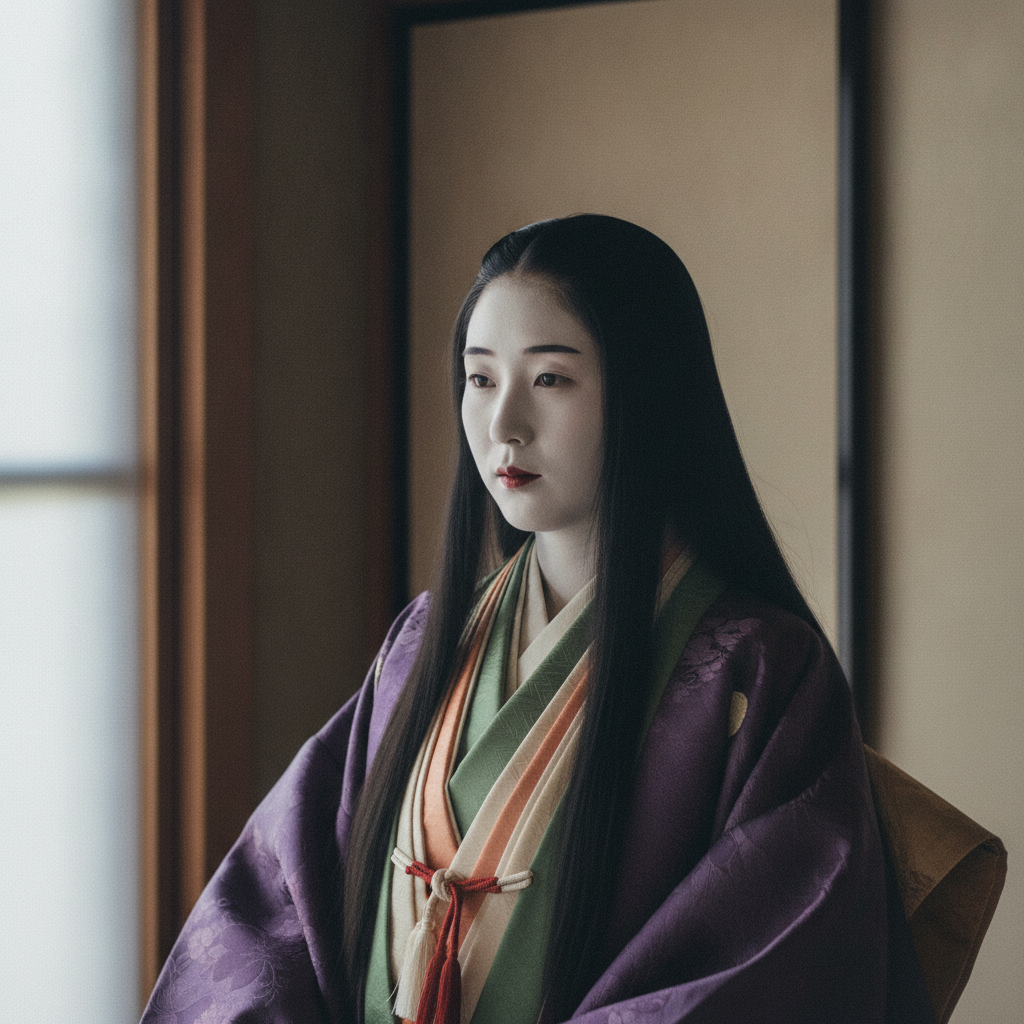
Her hair was probably the most striking single feature: long, straight, glossy black tresses worn loose or gathered so they could hang nearly to the floor, a hallmark of elite Heian women. The hair would have been smooth and dark, framing a face prepared to the era’s taste. Her face would have been coated with white powder (oshiroi) to create a porcelain pale canvas; natural eyebrows were plucked and repainted higher on the forehead (hikimayu), and her lips were shaped into a small, vividly red mouth with beni. On formal occasions she may have darkened her teeth (ohaguro); otherwise, the look emphasized delicate, deliberately small features and refined grooming. Clothing gave her a tall, composed silhouette: multiple layers of flowing silk robes (the jūnihitoe) in carefully chosen color combinations, long sleeves and trailing hems, and subtle hair accessories rather than heavy jewelry. Movement was measured and graceful, the layered robes and long sleeves creating an elegant, column-like presence rather than a fitted shape.
Height / build
Likely short by modern standards · Likely slender
Hair
Likely black · Likely straight · Likely normal, with hair grown long (no special recession)
Eyes
Likely dark (brown to very dark brown/black)
Complexion
Likely very pale (white-powdered face typical of court fashion)
Face
Likely small, oval to rounded · Likely small, straight and refined
Notable features
Very long floor- or sleeve-length black hair, white powdered face, high painted eyebrows, elaborate layered silk robes (jūnihitoe).
Grooming
None · Highly stylized: long loose or coiffed hair, painted eyebrows (hikimayu), white facial powder, possible blackened teeth (ohaguro) if married or in certain court phases.
Dress / presentation
Ceremonial multi-layered Heian court robes (jūnihitoe) with careful color combinations; inner silk garments and decorative cords.
hair
Hair length
Very long (waist to floor length)
Heian court women prized and grew long hair (suberakashi); literary sources repeatedly praise floor-length hair among aristocratic ladies.
hair
Hair color
Likely black
Native Japanese women of the Heian period typically had black hair; poems and descriptions emphasize glossy black hair as an ideal.
skin
Complexion
Likely very pale (white powdered)
Court cosmetics (oshiroi) produced a highly whitened face, a defining Heian aristocratic aesthetic described in contemporary sources.
grooming
Eyebrows
Painted high eyebrows (hikimayu)
Heian practice removed or plucked natural brows and painted new ones higher on the forehead for aristocratic women.
grooming
Teeth
Possibly blackened (ohaguro) at some life stages
Ohaguro was practiced by many aristocratic women (especially married/older); whether Sei Shonagon did so is not recorded but was a courtly possibility.
eyes
Eye color
In Sei Shonagon's world, beauty was a cultural composition: heavily whitened skin, extremely long straight black hair, and painted high eyebrows signaled refinement and rank. Makeup and layered robes were not mere decoration but a visible grammar of taste—color, texture and subtlety mattered more than bold physical features.
Sei Shonagon belonged to the Yamato aristocracy centred in Heian-kyō; her ancestry, diet and lifestyle match the East Asian phenotypes of medieval Japan. Imagine narrow, delicate facial features, dark eyes and black hair—a look shaped as much by convention and cosmetics as by biology.
Modern images often show her without Heian makeup, with modern clothing, or as a contemporary Japanese figure; they usually understate the extreme whitened makeup, painted eyebrows, layered robes and the cultural meaning of long hair.
Modern depictions often strip away Heian makeup and costume or dress Sei Shonagon in contemporary fashions; they also tend to underplay painted eyebrows and the ritual whitened face. Anime or simplified portraits may show a bare-faced young woman, but her actual court look was highly artificial and ritualized.
Likely short by modern standards—Heian aristocratic women were generally petite (roughly mid-140s to mid-150s cm).
Likely dark brown to black.
Likely long, straight black hair worn loose or in court styles, often grown to floor or sleeve length.
Yes—likely used white facial powder (oshiroi) and painted high eyebrows (hikimayu) as part of court fashion.
Possibly—ohaguro was common among aristocratic women at certain life stages, though direct evidence for Sei Shonagon specifically is not recorded.
No securely contemporary portrait of Sei Shonagon survives; our picture is reconstructed from her writing, contemporary descriptions and Heian visual conventions.
The Pillow Book (Makura no Sōshi)
Sei Shonagon · c. 1002 (composition period)
A first-person collection of observations from a Heian court lady; provides rich context for court life, aesthetics and the kinds of appearance details valued and noticed at court.
The Tale of Genji (Genji Monogatari)
Murasaki Shikibu · early 11th century
A near-contemporary novel offering many descriptions of courtly appearance, makeup, hair, and clothing that reflect Heian beauty ideals shared by court ladies like Sei Shonagon.
Heian cosmetics and grooming practices (scholarly studies)
Histories of Japanese cosmetics (oshirōi, hikimayu, ohaguro) · modern scholarship summarizing Heian practices
Summaries of cosmetic rites explain the heavy white powder, painted eyebrows, and teeth-blackening that were part of elite women's appearance.
Heian court dress descriptions (jūnihitoe)
Court costume studies and imperial records · Heian period records and modern reconstruction studies
Documentary and modern reconstruction evidence for the multi-layered silk robes of court ladies clarifies the silhouette and visual presence of an aristocratic woman.
Medieval and later portraits/emaki of Heian court ladies
Tale of Genji emaki and later portrait traditions · 12th–14th centuries (later visual traditions)
Later illustrated handscrolls and portrait conventions show white faces, painted brows and long hair; while produced after Sei Shonagon, they reflect enduring visual conventions for Heian aristocratic women.
Diaries and court records (e.g., Murasaki Shikibu's diary)
Diaries of contemporaries · early 11th century
Contemporary diaries record daily court life, fashion and cosmetic usage, providing corroborating context for how a lady like Sei Shonagon would present herself.
Likely dark brown to black
Native East Asian pigmentation makes dark eyes overwhelmingly likely.
height build
Stature
Likely petite / short by modern standards
Skeletal and historical estimates for medieval Japan and descriptions of court women point to modest stature (roughly mid-140s to mid-150s cm).
other
Body build
Likely slender and delicate
Aristocratic lifestyle, diet, and sedentary court life favored a slender, delicate appearance in descriptions and aesthetics.
clothing
Clothing
Multi-layered silk robes (jūnihitoe)
Sei Shonagon was a court lady; the jūnihitoe was the formal, highly layered dress of elite Heian women, noted in contemporaneous literature.
face
Facial hair
None
Heian court women did not display facial hair; grooming and cosmetics emphasized hairless, smooth faces.
cultural
Overall style
Refined, highly stylized aristocratic presentation
Literary sources emphasize layered dress, powdered skin, and long hair as markers of courtly refinement—traits likely embodied by Sei Shonagon.
comparison
How she stood out
Seen for wit and style rather than imposing physical stature
Her fame rests on literary sharpness and refined taste; in court settings her beauty would be typical of elite women, with individuality in robes, colors and manners.