hair
Hair color
Likely dark (black to dark brown)
Assyrian population and surviving art depict dark hair; classical descriptions assume Near Eastern complexion.
Portrait reconstruction
0–0 · Assyria (northern Mesopotamia) / Near East · Neo-Assyrian / legendary (traditions centered on 9th–7th century BCE)
Semiramis likely appeared as an imposing Neo‑Assyrian royal woman: dark hair in braids or a wig, kohl‑rimmed eyes, layered robes and rich jewelry.
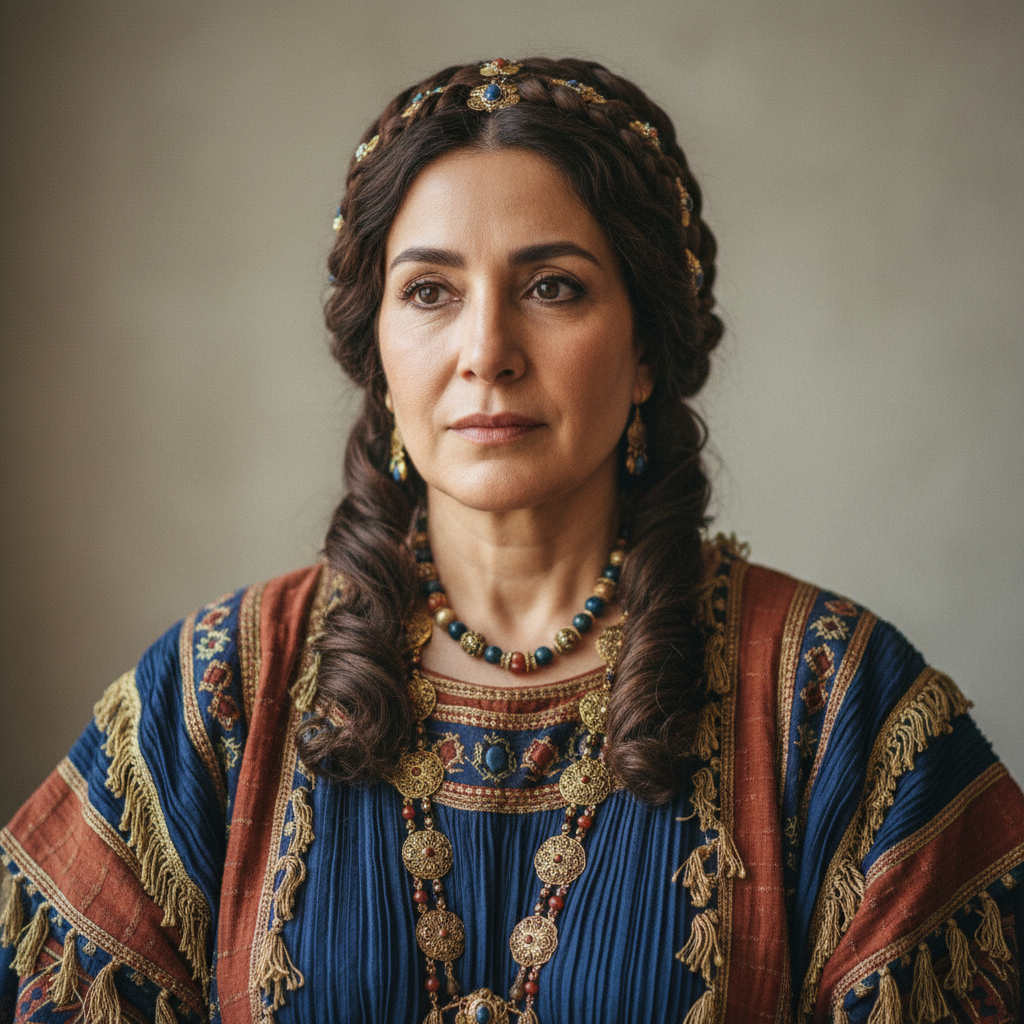
Her hair was likely dark—black or deep brown—often arranged in heavy, formal braids or worn with a high, styled wig; reliefs show majestic, thick hair as a clear courtly signal. She probably wore a diadem, beaded hairnets, or veils to mark her rank, with pins and devices that caught the light. Her face would have been smoothed and clean‑shaven—no facial hair—and framed by pronounced eyes darkened with kohl, giving a dramatic, long‑lidded look that Neo‑Assyrian art exaggerates. A straight or gently aquiline nose and full lips would sit on a strong, composed profile, presented in reliefs with the reserved dignity expected of royalty. Clothing layered the body: a close‑fitting tunic beneath a long, patterned robe with fringed hems or a heavy, pleated outer mantle. Jewelry was abundant—wide collars of beads and metal, multiple bracelets, large disc or hoop earrings, and ornate belts and pins—so she would have flashed gold, carnelian and silver as visible signs of power. In posture and bearing she would have seemed authoritative: upright, measured, and commanding. The court’s stylized imagery emphasizes steadiness and control—qualities that would have translated into a poised presence in life, even if reliefs render features more formal than a candid portrait.
Height / build
Likely average height · Likely average to sturdy build
Hair
Likely dark (black to dark brown) · Likely wavy to curly · Likely full hairline, often covered by wigs or braids
Eyes
Likely dark
Complexion
Likely Mediterranean to West Asian (olive/tawny)
Face
Oval to broad with strong cheekbones · Prominent, slightly aquiline/straight
Notable features
Large expressive eyes, strong brows, prominent nose, diadem or crown, heavy jewelry
Grooming
None · Wore elaborate coiffures or wigs, heavy braids, cosmetics around the eyes, and rich jewelry as markers of royal status.
Dress / presentation
Assyrian royal dress: layered pleated/fringed robes, decorated borders, beaded ornaments and a diadem or tiara
hair
Hair color
Likely dark (black to dark brown)
Assyrian population and surviving art depict dark hair; classical descriptions assume Near Eastern complexion.
hair
Hair style
Elaborate braids or formal wig, often adorned
Royal Assyrian women are repeatedly shown in reliefs with heavy braids or wigs and jewelry — a visual court norm.
eyes
Eye color
Likely dark
Ethno‑regional expectation and emphasis on large, dark eyes in Near Eastern portraiture and descriptions.
face
Prominent facial features
Large eyes, strong brows, prominent nose
Assyrian art emphasizes large eyes and defined noses on elite female figures; classical praise highlights striking features.
skin
Complexion
Likely Mediterranean / West Asian (olive/tawny)
Assyrian population and artistic conventions indicate an olive/tawny skin tone for elite women of the region.
height build
Build
Likely average to sturdy
Assyrian royal culture prized a composed, solemn beauty: large, kohl‑accented eyes, strong brows, and carefully arranged hair or wigs. Jewelry, patterned robes and a diadem signaled rank; visible grooming was less about flirtation and more about power and ritual status.
Semiramis traditions come from the Neo‑Assyrian world — a West Asian, Semitic cultural sphere. Physically she would resemble other elite Northern Mesopotamian women: dark hair and eyes, olive‑tawny skin tones, and facial proportions common in the region.
Modern art often Europeanizes or sexualizes Semiramis (blonde hair, skimpy dress, exotic fantasy garb); historically she would have worn full, heavily decorated Near Eastern royal garments and dark hair.
Popular art and film often recast Semiramis as a European blonde or an eroticized 'Eastern temptress.' Historically, representations would have shown dark‑haired, fully dressed royal women — the fantasy imagery reflects later exoticism rather than ancient reality.
Likely average height for a Near Eastern woman of her period.
Likely dark.
Likely dark (black/dark brown), worn in heavy braids or a formal wig and adorned with jewelry.
Probably considered striking and commanding — her beauty is emphasized in classical texts as part of her authority.
Layered, pleated/fringed Assyrian royal robes with decorative borders, heavy jewelry and a diadem or head ornament.
No securely identified portrait labeled 'Semiramis' survives; reconstructions rely on the historical queen Shammuramat, Assyrian royal imagery and classical descriptions.
Royal inscription references to Shammuramat
Assyrian royal inscriptions (Shammuramat references) · c. 9th century BCE
The historical figure Shammuramat, often identified with Semiramis, appears in Assyrian inscriptions as queen/regent — providing the most direct historical anchor for Semiramis traditions.
Assyrian palace reliefs showing royal women
Reliefs from Nineveh, Nimrud and Khorsabad · 9th–7th century BCE
Stone reliefs depict elite women with layered garments, heavy braids or wigs, large stylized eyes, and jewelry — a direct model for royal female appearance in the Neo‑Assyrian court.
Ctesias' fragments and summaries
Ctesias (Persica fragments, 5th c. BCE tradition) · 5th century BCE (tradition)
Ctesias provided early Greek accounts of Semiramis, describing her beauty, status and deeds — important for later image formation though written centuries after the events.
Diodorus Siculus’ account
Diodorus Siculus (Bibliotheca historica) · 1st century BCE
Diodorus narrates a dramatic, larger‑than‑life Semiramis with emphasis on commanding beauty and regal bearing — influential for classical and medieval imagery.
Medieval and Renaissance portraits of Semiramis
European paintings and prints · 12th–19th centuries
Later art often Europeanizes her (lighter skin/hair, contemporary dress) and exaggerates erotic elements — useful for tracking modern myths but not for historical appearance.
Assyrian material culture (jewelry, textiles)
Archaeological finds from royal contexts · 9th–7th century BCE
Recovered jewelry, textile fragments, and small art objects indicate the types of ornaments and garments used by Assyrian elites — informing reconstructions of Semiramis' dress and accessories.
Elite status, resources and art portrayals suggest a well‑nourished, solid physique rather than extreme slenderness.
grooming
Grooming and cosmetics
Used cosmetics (especially around eyes) and wore visible jewelry
Archaeological and iconographic evidence shows eye makeup, earrings, necklaces and decorative attire among royal women.
clothing
Typical dress
Layered, pleated/fringed Assyrian royal robes with diadem
Reliefs and textile fragments indicate richly decorated, full‑coverage garments and head ornaments as royal insignia.
cultural
Regal bearing
Commanding, dignified posture and bearing
Classical stories and Assyrian portrayals emphasize authority and a stately public presence for queens.
comparison
Compared to contemporaries
Looked similar to elite Assyrian women but more elaborately dressed
Shared regional features but greater ornamentation, formal coiffure and insignia of power distinguish a queen.