height build
Height
Likely average to slightly below average for his time
Classical Athenian male averages and literary hints place him at typical or slightly shorter stature.
Portrait reconstruction
470–399 · Athens, Ancient Greece · Classical Greece (5th century BCE)
Socrates was a compact, broad-faced Athenian with a snub nose, receding hairline and a full, untidy beard.
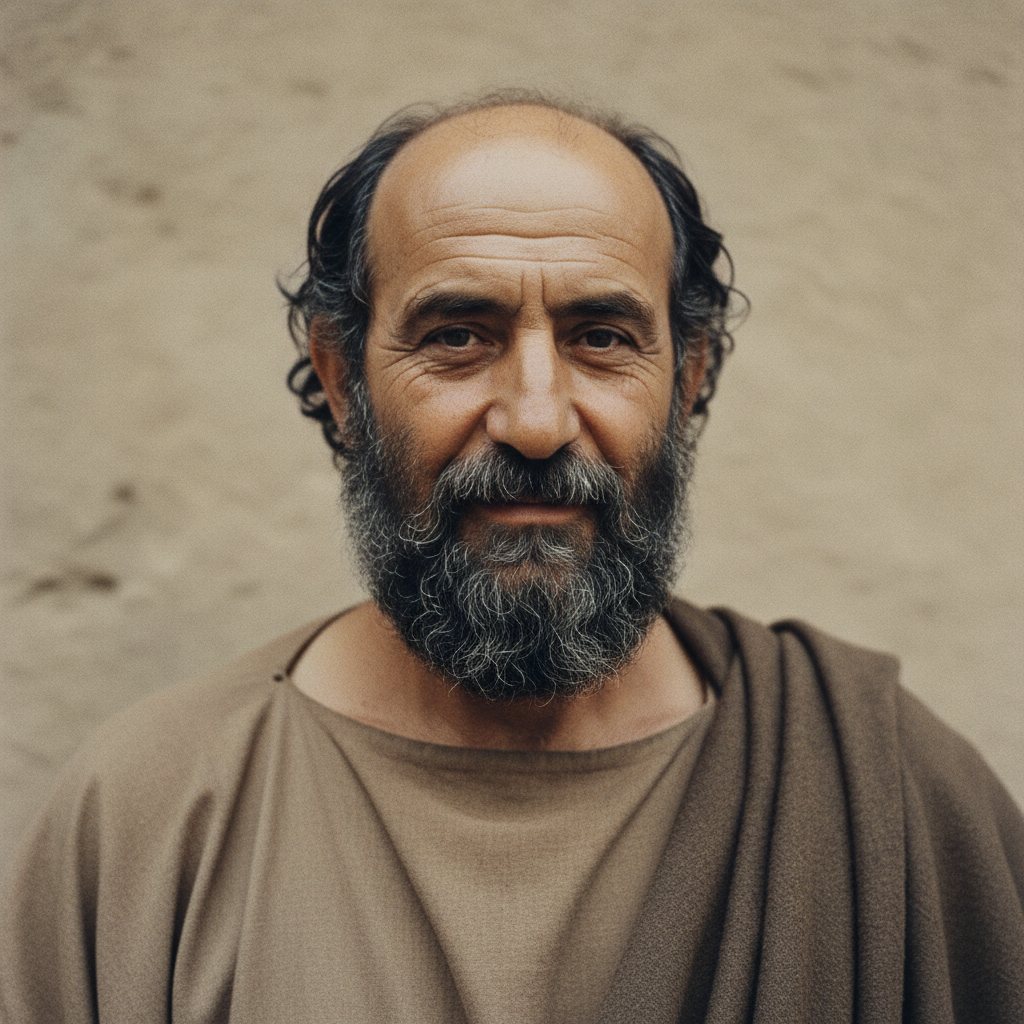
Face and head: He likely had a broad, flattened face with a short, snub nose and prominent, slightly bulging eyes. The crown of his head receded early, leaving a balding top with short, dark, curly hair around the sides. Hair and beard: Most portrayals show him with a thick, full beard rather than clean-shaven; it would have been roughly kept, matching his plain, unsentimental style. Hair color was almost certainly dark—typical of Attic Greeks. Build and posture: Descriptions portray him as squat and sturdy rather than gaunt—muscular and solid from an active public life in Athens, not a fragile scholar. He moved with a direct, energetic gait, often barefoot or in simple sandals, wearing a plain cloak or himation. Skin and features: His skin tone was Mediterranean—olive-tanned from outdoor life—and his overall look leaned toward the ungainly: plain, memorable rather than classically handsome, with a wide mouth and strong jaw that carried a forceful expression.
Height / build
Likely average to slightly below average for his time · Likely stocky / robust
Hair
Likely dark to graying · Likely wavy to curly · Likely receding / partially bald
Eyes
Likely dark
Complexion
Likely Mediterranean / olive
Face
Likely broad, round face · Likely snub / flattened nose
Notable features
Snub/flattened nose, prominent brow and eyes, receding hairline, broad jaw and cheeks
Grooming
Likely full beard (typical for adult Athenian males) · Plain and practical grooming—beard maintained but not fashionably trimmed, simple haircut when present.
Dress / presentation
Plain Athenian citizen dress (simple chiton and himation), often worn simply and roughly
height build
Height
Likely average to slightly below average for his time
Classical Athenian male averages and literary hints place him at typical or slightly shorter stature.
height build
Build
Likely stocky / robust
Ancient writers and portrait types emphasize a sturdy, muscular frame rather than slenderness.
face
Nose
Likely snub / flattened
Multiple literary descriptions and portrait heads show a short, rounded nasal profile.
face
Face shape
Likely broad, fleshy face
Busts and textual remarks note broad cheeks and a full face rather than a narrow classical profile.
hair
Hairline
Likely receding / balding
Ancient comic and biographical sources and portrait tradition show a receded hairline and bald crown.
hair
Hair color
Likely dark to graying
Typical Athenian pigmentation and accounts of him aging point to dark hair that grayed with age.
Classical Athens prized physical fitness and beauty in some contexts (e.g., athletes, rulers), but intellectual authority, moral character, and plain civic modesty carried great weight. A figure like Socrates—intellectually dominant and deliberately plain—could convert ungainly looks into a public trademark: his unadorned appearance underscored his focus on philosophy over vanity.
As an Attic Greek, Socrates most likely had olive skin, dark eyes, and dark hair that could be wavy or curly—traits common in mainland Greece. These baseline features help visualize him even where direct color evidence is absent.
Modern portraits often soften or idealize Socrates (showing a handsome, Hellenized philosopher) while ancient evidence emphasizes his ungainly, distinctive features and baldness.
Modern portraits often smooth or Hellenize Socrates into an idealized, classically handsome sage or stage a romanticized beard-and-flowing-hair look. Ancient testimony and portrait types instead record a distinctly ungainly, balding man—his odd features were part of his philosophy's public persona.
Likely average to slightly below average for his time.
Probably yes—a full beard, as was typical for adult Athenian men.
Likely receding / partially bald on the crown.
Likely dark eyes and dark hair that grayed with age.
Generally regarded as plain or ungainly rather than handsome, though intellectually magnetic.
Probably similar—the consistent Roman portrait type (balding, broad face, snub nose) reflects an ancient visual tradition of Socrates’ likeness.
Plato — Various Dialogues (e.g., Apology, Symposium)
Plato · c. 4th century BCE
Plato depicts Socrates as plain-featured and extremely persuasive by intellect rather than physical charm; passes along anecdotes about his appearance and manner.
Xenophon — Memorabilia, Symposium, Apology
Xenophon · early 4th century BCE
Xenophon gives practical descriptions of Socrates’ physical presence—sturdy, muscular, and plain—and recounts his everyday dress and deportment.
Aristophanes — Clouds (comic portrayal)
Aristophanes · 423 BCE
A contemporary comic caricature that emphasizes grotesque, snub-nosed, balding features—an important early impression of Socrates' look in Athenian public life.
Diogenes Laertius — Lives of Eminent Philosophers (bio summaries)
Diogenes Laertius · 3rd century CE
Later compiled descriptions that collect earlier accounts about Socrates’ ugliness, snub nose, and baldness; preserves traditional portrait details.
Capitoline type 'Socrates' bust (Roman copy)
Capitoline Museums (traditional Socratic portrait) · Roman copy of a 4th–3rd century BCE Greek portrait (dating varies)
Marble portrait type showing broad face, snub nose, protruding eyes, receding hairline and full beard—illustrates the standardized Socratic image used by Romans to represent him.
Other Roman-era portrait heads labeled 'Socrates' (various museums)
Multiple museum collections (Louvre, British Museum, Naples, etc.) · Roman copies after Greek originals (2nd–1st c. BCE to 2nd c. CE)
A group of similar portrait heads share traits—balding crown, full beard, broad face—indicating a recognizable Socratic type circulating in antiquity.
eyes
Eye color
Likely dark
Dark brown eyes were common in mainland Greece; portrait types show strong, prominent eyes rather than light irises.
other
Beard
Likely full beard
Adult Athenian males normally wore beards; busts and texts describe Socrates with a beard.
skin
Complexion
Likely Mediterranean / olive
Native Attic Greek ancestry points to an olive Mediterranean complexion.
grooming
Grooming
Plain, practical grooming
Socratic lifestyle and Athenian male norms favor simple grooming, not fashion-conscious trimming.
clothing
Typical clothing
Simple chiton and himation (plain, roughly worn)
As an Athenian citizen and ascetic public figure, he is typically described and depicted in ordinary citizen garments, unadorned.
other
Striking presence
More memorable for expression and manner than for classical good looks
Ancient sources repeatedly stress his conversational presence and odd features making him notable.
Aristophanic and later literary echoes shaping imagery
Classical and later literary tradition · 5th century BCE onward
Comedic and biographical writings reinforced an image of Socrates as ungainly and bald; later Roman-era sculptors reproduced that type.