height build
Height
Likely tall for his time
Thracian warriors and frontline gladiators who succeeded as field commanders were usually at or above average stature; ancient descriptions emphasize his physical presence.
Portrait reconstruction
0–0 · Thrace (Balkans) and Italy · Late Roman Republic (1st century BCE)
Spartacus likely looked like a compact, heavily muscled Thracian warrior with dark hair, a weathered, scarred body, and a fierce, determined stare.
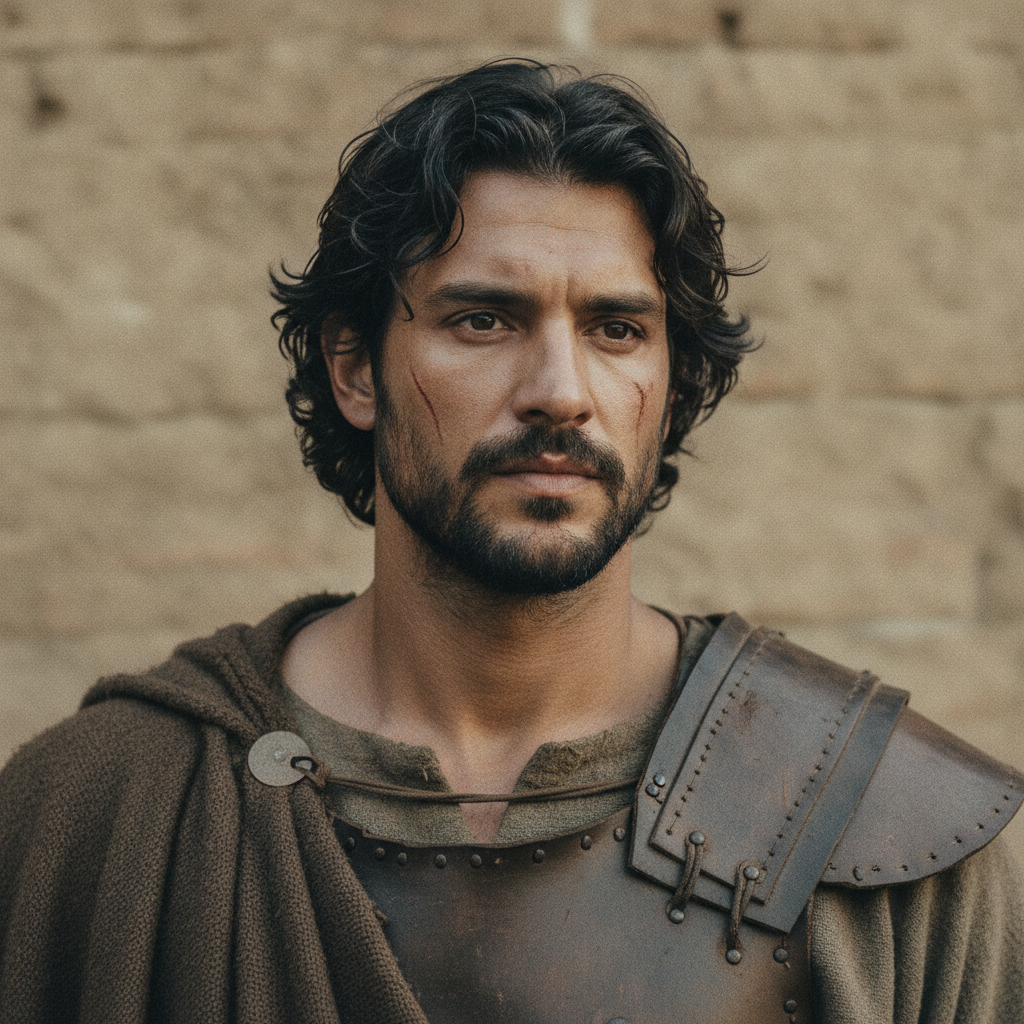
Build and stance: Spartacus was probably short to medium in height but powerfully built — thick shoulders, strong back and legs, and a low, compact center of gravity suited to grappling and close combat. His movement would have been agile and explosive rather than the long‑limbed stride of a hoplite. Scars, callused hands and a hard, weathered skin tone from campaigning and fighting would have been obvious at a glance. Face and hair: He most likely had dark hair, worn short or closely cropped for practical fighting; modern accounts suggest he was probably clean‑shaven or only lightly stubbled rather than bearing a long, stylized beard. His face would have been lean and angular from hardship: a strong jaw, high cheekbones, a straight or somewhat prominent nose, and intense, alert dark eyes that read as forceful and decisive. Clothing and bearing: As a Thracian and a former gladiator, his gear would have been pragmatic — rough leather, a simple cloak, and stripped‑down protective pieces rather than parade armor. He likely carried a short sword or curved blade and a small shield or spear, with fast, practical boots or sandals. Overall his look announced readiness for hand‑to‑hand fighting, leadership in rough conditions, and relentless physical toughness.
Height / build
Likely tall for his time · Likely muscular and compact
Hair
Likely dark to brown · Likely wavy · Likely full, worn short or cropped
Eyes
Likely dark
Complexion
Likely Mediterranean (olive to light-olive)
Face
Likely square/strong-jawed · Likely straight and prominent
Notable features
Strong jaw, pronounced neck and shoulders, likely battle scars and a weathered complexion
Grooming
Probably short beard or trimmed stubble · Practical, military-style grooming: short hair and trimmed facial hair common among fighters and non-elite soldiers.
Dress / presentation
Gladiatorial armor mixed with improvised military gear and simple cloaks/tunics
height build
Height
Likely tall for his time
Thracian warriors and frontline gladiators who succeeded as field commanders were usually at or above average stature; ancient descriptions emphasize his physical presence.
height build
Build
Likely muscular and compact
Gladiatorial training and active battlefield leadership require a heavily built, powerful physique rather than slenderness.
hair
Hair color
Likely dark to brown
Thracian/Balkan origin and Mediterranean population norms make dark-brown hair the most plausible.
hair
Hair texture
Likely wavy
Wavy-to-curly hair is common in the Balkans and Mediterranean; practical soldier grooming would keep it short.
grooming
Facial hair
Probably short beard or stubble
Non-elite soldiers and many fighters wore trimmed beards or stubble; gladiators often kept facial hair functional rather than ornate.
eyes
Eye color
Likely dark
In Spartacus’ world, especially for non-elite fighters, physical toughness, scars, and stamina signaled authority and attract followers more than fashionable grooming. A leader of an armed rebellion projected competence through visible strength and practical gear rather than fine clothing.
Thrace was a diverse region in the northern Aegean/Balkan area; people from there could show a range of Mediterranean to lighter complexions and commonly dark hair. Spartacus’ Thracian origin means he would look recognizably Balkan/Mediterranean rather than 'foreign' in the extreme.
Modern films often make him anachronistically long-haired, stylizedly idealized, or portrayed as an exotic 'other'; the historical Spartacus was likely more compact, practical, and visibly battle-worn.
Films and popular art often give Spartacus long flowing hair, theatrical scars, or exoticized features; historically he was likely shorter-haired, pragmatic in dress, and physically rugged in ways that reflect a working warrior rather than romantic hero aesthetics.
Probably above-average height for his era—physically imposing enough to be a frontline fighter and leader.
Likely dark—dark brown or brown was most common in his regional population.
Likely dark to brown and short-to-wavy, kept trimmed for combat practicality.
Probably a short beard or stubble, typical of many fighters and non-elite soldiers of the period.
A mix of gladiatorial equipment and improvised military clothing—tunics, leather armor pieces, and cloaks captured or taken from soldiers.
No authenticated portrait or coin is securely attributed to Spartacus; reconstructions rely on texts and context.
Plutarch — Life of Crassus
Plutarch · c. late 1st–early 2nd century AD
Discusses Spartacus as a Thracian warrior who led the slave revolt; emphasizes his leadership and martial skill rather than physical minutiae but frames him as formidable and energetic.
Appian — The Civil Wars
Appian · 2nd century AD
Provides narrative of the Spartacus campaign and occasionally highlights the boldness and physical prowess of Spartacus and his followers; useful for role and likely physical type.
Florus — Epitome of Roman History
Florus · 2nd century AD
Summarizes the events of the revolt, echoing themes of military skill and the threat Spartacus posed, contributing to the impression of a battle-hardened leader.
Modern synthesis: The Spartacus War
Barry S. Strauss · 2009
Modern historian’s reconstruction of the war and its leaders; provides reasoned inferences about Spartacus’ background, likely physicality and leadership style grounded in military history.
19th–20th century paintings and sculptures
Various artists (Romantic period) · 19th–20th century
Imaginative portraits that shaped modern images of Spartacus (heroic, long-haired, idealized); useful for understanding later myth-making but not as historical evidence.
Hollywood: 1960 film Spartacus
Stanley Kubrick / Kirk Douglas · 1960
Influential modern portrayal that popularized the long-haired, larger-than-life Spartacus; important culturally but not historically authoritative.
Dark eyes were common across Thrace and the wider Mediterranean populations of the period.
skin
Complexion
Likely Mediterranean (olive to light-olive)
Thracian origin plus outdoor life as a soldier and gladiator suggest an olive-leaning, sun-darkened complexion.
face
Face shape and features
Likely strong-jawed, weathered, with scars
Descriptions of him as a formidable fighter and leader combined with his combat role point to a square jaw, rugged features and likely healed wounds or scars.
clothing
Typical clothing
Gladiatorial kit mixed with improvised military clothing and cloaks
As a former gladiator who led an irregular army, Spartacus likely used gladiator equipment alongside captured or improvised clothing and cloaks for command.
grooming
Hairline
Likely full, worn short or cropped
Practical haircuts were typical for fighters; long flowing hair is a later romantic addition.
cultural
Presence
Commanding and intense
Ancient texts portray Spartacus as an energetic and successful leader which implies a charismatic, authoritative personal presence.
comparison
Compared to Roman elites
Rugged warrior rather than polished Roman aristocrat
Unlike Roman aristocrats who favored clean shaving and civic dress, Spartacus’ background made a practical, battle-ready appearance more likely.