height build
Height
Likely tall for his time
Epic tradition emphasizes a commanding, heroic physical presence; leaders with cavalry/elite status often taller than the rural average.
Portrait reconstruction
1217–1255 · Mali Empire (West Africa) · 13th century
Sundiata Keita likely appeared as a tall, powerful West African king with dark brown skin, cropped curly hair, and the ornate dress and jewelry of a 13th‑century Mande ruler.
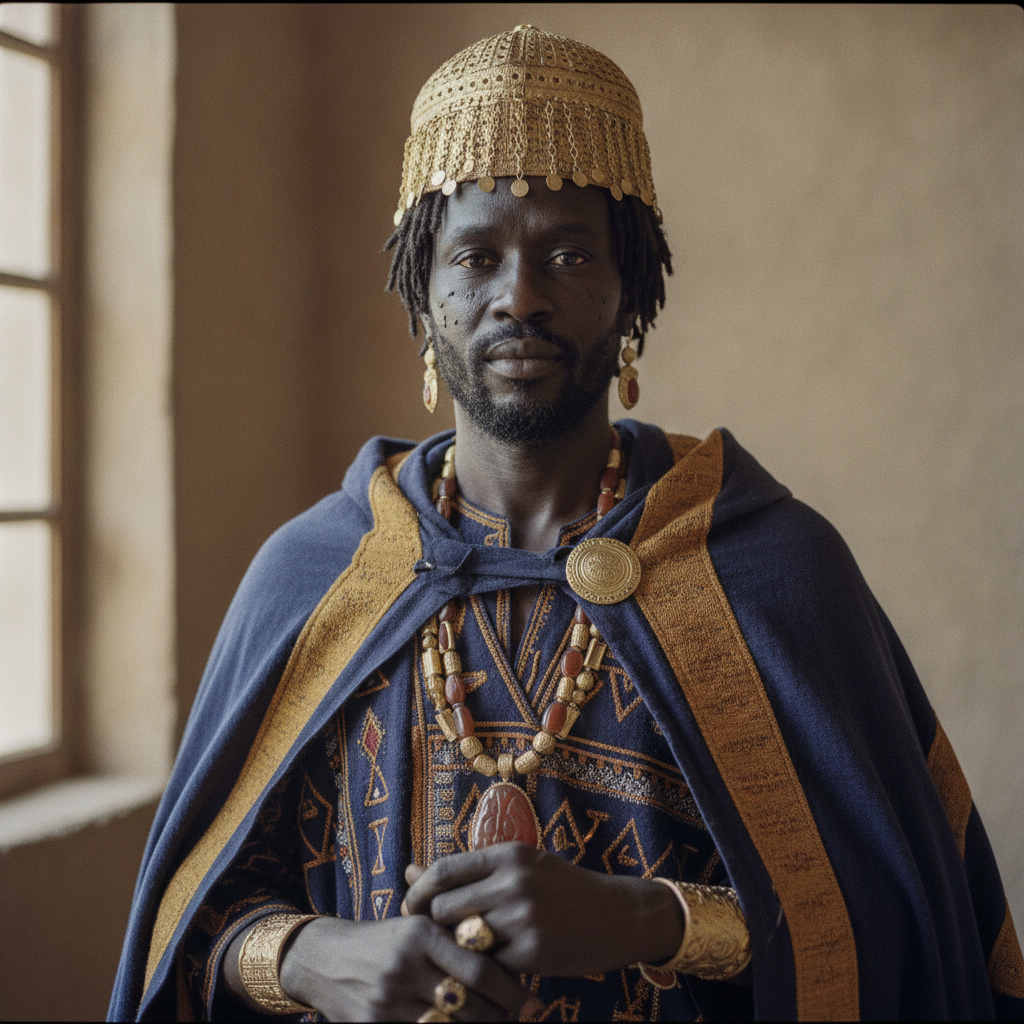
Sundiata would have presented as physically impressive: broad-shouldered and sturdy from a warrior life, with a commanding, upright posture. The epic casts him as a heroic leader, so imagine a mature, robust man whose presence matched his role as founder and commander. His skin was almost certainly dark brown and his hair tightly curled or coiled—most often worn short or closely cropped by Mande men of the era. Facial features likely reflected West African Sahelian traits: a broad nose, full lips, and strong cheekbones; facial hair was probably sparse or kept short rather than a long flowing beard. He would have shown battle marks or scars consistent with a life of conflict and leadership, and his face may have carried the calm intensity of a seasoned ruler. In public, Sundiata’s look emphasized strength and dignity rather than delicate ornamentation of the face.
Height / build
Likely tall for his time · Likely robust/athletic
Hair
Likely very dark (black) · Likely tightly coiled (kinky) · Likely full; hair worn braided, tied, or styled for status
Eyes
Likely dark
Complexion
Likely dark
Face
Likely broad to oval face · Likely broad, rounded nose
Notable features
Tall stature, commanding bearing, royal jewelry (gold/ornament), possible ceremonial marks or scarification
Grooming
Probably had a beard and mustache (well‑groomed) · Likely kept hair and beard styled to show rank—braids, ties, or trimmed facial hair—accompanied by jewelry and regalia.
Dress / presentation
Luxurious Mande royal robes and tunics, embroidered cloaks, leather goods and gold/metal ornaments
height build
Height
Likely tall for his time
Epic tradition emphasizes a commanding, heroic physical presence; leaders with cavalry/elite status often taller than the rural average.
height build
Build
Likely robust/athletic
Portrayed as a warrior and hunter in the epic—roles that imply muscular, capable physique.
skin
Complexion
Likely dark
Belonged to Mande populations of the Sahel region, who characteristically have dark brown skin tones.
hair
Hair color
Likely very dark (black)
Consistent with West African ancestry and regional populations.
hair
Hair texture & style
Likely tightly coiled; worn braided or tied for status
Typical hair texture for the region; elite grooming often used braids/ornaments to show rank.
other
Facial hair
Probably had a beard and mustache
Adult Sahelian men commonly sported facial hair; leaders often kept groomed beards as a sign of maturity.
In Mande culture of the medieval Sahel, rulership combined martial prowess with visible wealth. Physical strength, courage in battle, control of cavalry, and the display of gold, textiles and ornate horse trappings signaled legitimate authority—so a king like Sundiata would be presented as both warrior and lavish patron.
Sundiata came from the Mande (Mandinka) elite of the western Sahel. Physically this population typically shows dark brown skin, broad facial features and tightly coiled hair—features that would have been common among nobles and commoners alike, differentiated chiefly by dress and ornament.
Modern images vary wildly—some dress him in European medieval garb or generic ‘African king’ tropes; historically he would have worn Mande regalia and local styles of dress and ornament.
Modern portrayals often anachronistically dress Sundiata in European‑style crowns, chain‑mail, or generic 'tribal' costumes; historically his regalia would be Mande: robes, textiles, leather, horse gear and gold ornaments, not medieval European armor.
Likely tall for his time—portrayals present him as a commanding, heroic figure.
Likely dark.
Likely very dark (black) and tightly coiled; probably braided or tied to show status.
Probably—adult Sahelian men and leaders commonly had groomed beards and mustaches.
Luxurious Mande robes and tunics, embroidered cloaks, leather, horse trappings and gold or metal jewelry signifying wealth and authority.
Our image comes from the Mande oral epic, later Arabic chronicles, and regional cultural context rather than contemporary portraits.
Epic of Sundiata (oral tradition)
Mande oral epic; recorded in modern versions (e.g., Djibril Tamsir Niane) · oral tradition (13th century origins); recorded 20th century
Primary cultural source portraying Sundiata as a heroic, strong leader; provides narrative cues about stature, warrior role, and elite presentation though not precise physical metrics.
Tarikh al-Sudan and Tarikh al-Fattash
West African Arabic chronicles · 17th century (compilations of earlier traditions)
Later Arabic chronicles record the history and rulers of the Mali realm, noting wealth, horses and rulership rituals that inform expectations about royal dress and public image.
Modern historiography and synthesis
Nehemia Levtzion, Djibril Tamsir Niane and other historians · 20th century
Scholars synthesize oral and Arabic sources to reconstruct Sundiata’s reign, arguing for the likely appearance of elite Mande regalia and the heroic physical depiction in the epic.
Statues and modern portraits of Sundiata
Various 20th–21st century Malian public art · 20th–21st century
Public sculptures and paintings visualize Sundiata for modern audiences—useful for understanding contemporary perceptions but not direct historical evidence of his features.
Regional ethnography and archaeology
Studies of Mande dress, material culture, and Sahelian populations · 20th–21st century studies
Archaeological and ethnographic evidence about textiles, metalwork and population appearance provides context for likely clothing, jewelry and phenotype.
Arabic geographers and West African accounts (context)
Ibn Khaldun and other medieval/early modern Arabic authors (secondary references to Mali) · 14th century onward (various)
face
Facial features
Likely broad face with rounded nose and strong jaw
Regional phenotype and heroic descriptions suggest broad features and strong jawline suited to leadership imagery.
grooming
Grooming & ornamentation
Likely well‑groomed with gold ornaments and ceremonial insignia
Mali’s early rulers displayed wealth via gold, jewelry and fine clothes; epic leadership often paired with visible regalia.
clothing
Clothing style
Luxurious Mande royal robes and embroidered tunics
Royal Mande dress used tunics, cloaks and imported or locally woven textiles, often richly decorated and paired with metalwork.
cultural
Public bearing
Commanding and regal, presented as heroic leader
The epic frames Sundiata as the model king/hero; his public image would underline authority and courage.
other
Possible ceremonial marks
Possibly had scarification or symbolic marks
Some Mande groups used scarification or insignia to mark lineage/identity, which may have served as visible markers of status.
While not contemporary to Sundiata, these writers describe Mali’s wealth and courtly display, reinforcing expectations about royal ornamentation and public appearance.