face
Facial attractiveness
Strikingly beautiful
The Tale of the Heike describes her as a woman of exceptional beauty combined with martial prowess.
Portrait reconstruction
0–0 · Japan (Heian-era, served Minamoto forces) · Late Heian period (12th century, Genpei War)
Tomoe Gozen most likely looked like a striking, athletic woman with long dark hair, a powdered face and painted brows, her hair tied for battle, dressed in early samurai armor over layered robes and armed with a bow and sword.
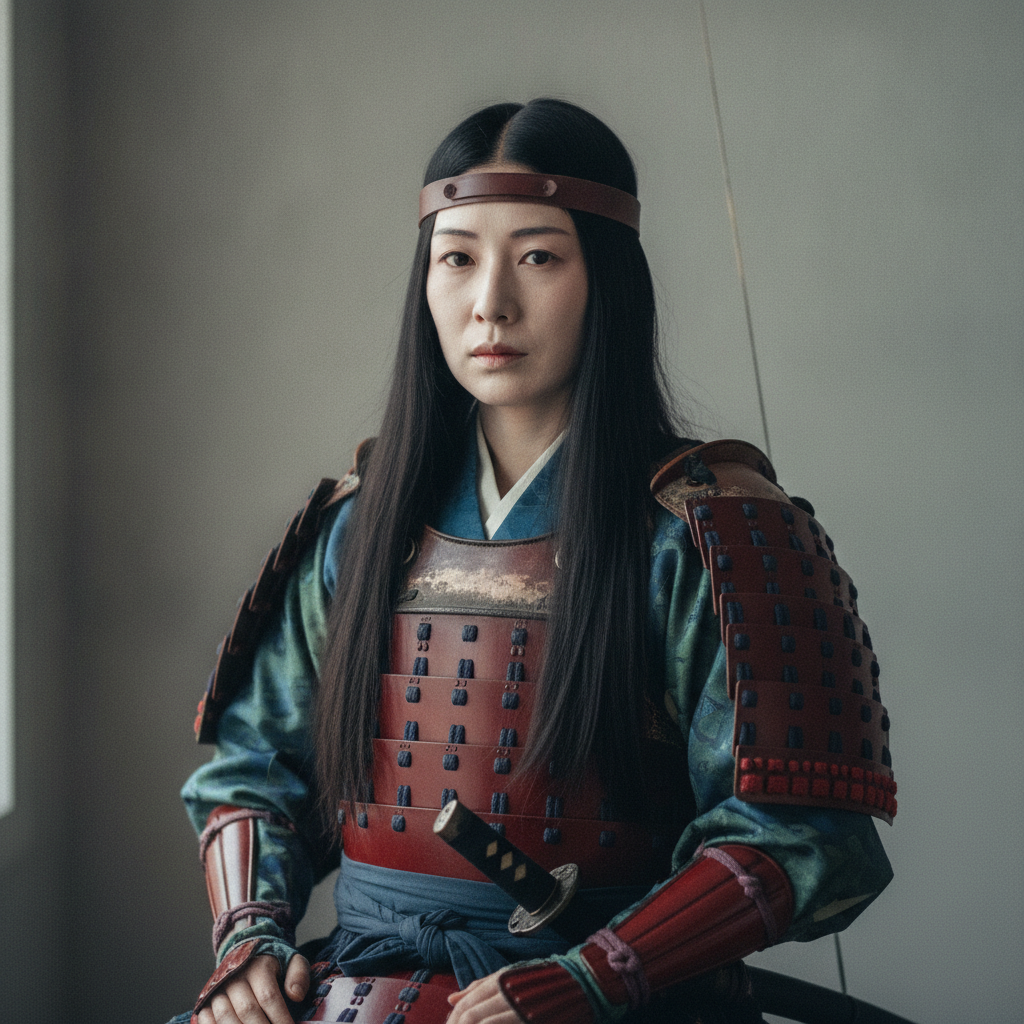
Overall impression: a blend of Heian court beauty and battlefield practicality — she would have read as both elegant and fearsome. Muscular shoulders and an athletic carriage from riding and combat would give her a compact, powerful presence rather than a fragile one. Contemporary descriptions emphasize her beauty, but that beauty sat on a trained, battle-ready frame. Face and hair: likely long, glossy dark hair worn long in peacetime but tied back or bound for fighting; a pale, powdered face (oshiroi) with painted eyebrows (hikimayu) and a touch of red on the lips. Her eyes would have been dark brown, her skin weathered by sun and wind from campaigning, and she probably bore small scars or marks earned in combat, visible alongside the court cosmetics. Clothing and equipment: she probably wore layered Heian-style garments beneath practical lamellar or banded armour tailored for mobility—shorter sleeves or bound robes for riding, a cuirass and shoulder guards, and protective greaves as needed. Her primary weapons would have been the yumi (longbow) and a tachi-style sword; she may also have carried a short blade for close work. Helmets and horse gear completed the fighting ensemble, blending aesthetic court elements with hard-wearing materials for war.
Height / build
Likely average height · Likely athletic/slender-muscled
Hair
Likely black · Likely straight · Likely a normal hairline; long tresses when ceremonial, tied back for battle
Eyes
Likely dark (brown to black)
Complexion
Likely very pale/fair (court makeup), possibly weathered in campaign
Face
Likely oval to slightly heart-shaped · Likely small to medium, straight
Notable features
Long glossy black hair, pale face, refined small features combined with a purposeful warrior posture and visible armor/weaponry.
Grooming
None · Heian-era long straight hair polished for court, but usually tied back or bound when fighting; likely used white face powder and other court cosmetics when in noncombat contexts.
Dress / presentation
Ceremonial Heian kimono for court; practical samurai armor (mounted warrior's cuirass, hakama) and weapons (yumi, naginata or sword) in battle.
face
Facial attractiveness
Strikingly beautiful
The Tale of the Heike describes her as a woman of exceptional beauty combined with martial prowess.
hair
Hair length and color
Very long, black
Heian female beauty ideal and later pictorial depictions show noble women with long black straight hair; Tomoe is commonly depicted that way when described in texts and art.
eyes
Eye color
Likely dark (brown to black)
Native Heian Japanese populations typically have dark brown/black irises; textual sources imply dark eyes by omission and later portrayals show dark eyes.
skin
Complexion
Likely very pale (court makeup)
Heian-era aristocratic women used white face powder (oshiroi) as a beauty standard; Tomoe, described as beautiful, would likely present that way in noncombat settings.
height build
Build
Athletic, slender-muscled
Accounts emphasize Tomoe's prowess as a mounted archer and swordswoman, indicating a trained, strong, and agile body rather than a frail one.
clothing
Heian court beauty prized long black hair, a small face, and very pale skin. Tomoe fused those courtly ideals with the practical attributes of a mounted warrior—her cosmetics and long tresses signaled nobility, while her armor, tied hair, and weapons signaled competence and raw physical skill.
As a member of the samurai milieu in late‑Heian Japan, Tomoe would have shared the common East Asian features of the Yamato population—straight black hair and dark eyes—while social class determined cosmetics, dress, and grooming more than genetic variation.
Modern images often either infantilize or overly sexualize her, give stylized short hair, or neglect Heian cosmetics and real armor—oversimplifying her dual identity as courtly noblewoman and hardened warrior.
Contemporary images often present Tomoe as either an androgynous short-haired fighter or an exoticized fantasy heroine; both ignore Heian cosmetics, long hair traditions, and the likelihood she alternated between ceremonial beauty and tightly bound combat hair.
Likely average height for a late‑Heian Japanese woman—not notably tall or short for her peers.
Likely dark (brown to black).
Very likely long, straight, and black—worn loose or ceremonially long in court and tied back for combat.
Yes—sources describe her as strikingly beautiful while also being a fierce fighter.
Practical samurai armor for mounted combat with a bow and sword (and possibly a naginata), her hair secured for fighting.
Descriptions in the Tale of the Heike and later illustrated scrolls plus Heian beauty and martial customs form the basis for her likely appearance.
The Tale of the Heike (Heike Monogatari)
Heike Monogatari — medieval war tale · c. 13th century (compiled)
Primary literary source that describes Tomoe Gozen as a beautiful and formidable warrior—key textual basis for her appearance and reputation.
Heike emaki and medieval illustrations
Heike emaki (illustrated scrolls, various medieval copies) · 13th–16th centuries (various copies)
Illustrated scrolls and emakimono that depict scenes from the Tale of the Heike; show Tomoe in armor with long hair and weapons—visual tradition shaping later images.
Ukiyo-e and woodblock depictions
Edo-period and later prints (ukiyo-e) · 17th–19th centuries
Later popular art portrays Tomoe as armored, often idealized; these images reflect Edo and later aesthetics more than Heian reality but show persistent motifs (long hair, armor, weapons).
Modern scholarship on onna-bugeisha
Stephen Turnbull, 'Samurai Women' and related works · late 20th century – present
Modern historians synthesize textual and visual sources to describe female samurai appearance and equipment, lending support to the armored, athletic image of Tomoe.
Medieval war chronicles and later tales
Various chronicles and later medieval narratives referencing Genpei War figures · 13th–15th centuries
Additional narrative sources repeat and embellish the Heike portrait—reinforcing her combined beauty and martial role across centuries.
Heian court costume and cosmetic manuals (contextual evidence)
Heian-period court practice records and archaeology · Heian period (794–1185) context
Archaeological and documentary records on Heian cosmetics, hairstyles, and garments provide context for likely appearance (long hair, oshiroi makeup, multilayered robes).
Battle dress
Samurai armor with bow and sword
Tale of the Heike places her on the battlefield equipped for mounted archery and sword combat; later art consistently shows her in armor with weapons.
grooming
Hairstyle in battle
Tied back for fighting
Practical combat requires hair bound away from face; warrior depictions and behavioral sense point to tied/secured hair for action.
cultural
Cosmetics
Likely used white face powder (oshiroi) and formal cosmetics in court
Heian court beauty practices included oshiroi, and the Tale of the Heike highlights her beauty in the terms of that culture.
comparison
Presence among soldiers
Commanding and unusual
A woman of refined appearance who could fight would have stood out visually—both for her courtly cosmetics and for wearing armor and weapons.
other
Age appearance
Likely youthful adult (20s–30s)
Narratives present her as an active battlefield commander during the Genpei War, a role typically performed by young to middle‑aged adults.