height build
Height
Likely ~1.67 m (about 5'6")
CT scans and measurements of the mummy produce an estimated adult height consistent with this value.
Portrait reconstruction
1341 BCE–1323 BCE · Ancient Egypt (Thebes / Valley of the Kings) · Late Bronze Age — New Kingdom (18th Dynasty)
Tutankhamun probably looked like a slender, dark-haired teenage Egyptian with almond-shaped eyes, warm-toned skin, and a smooth, youthful face.
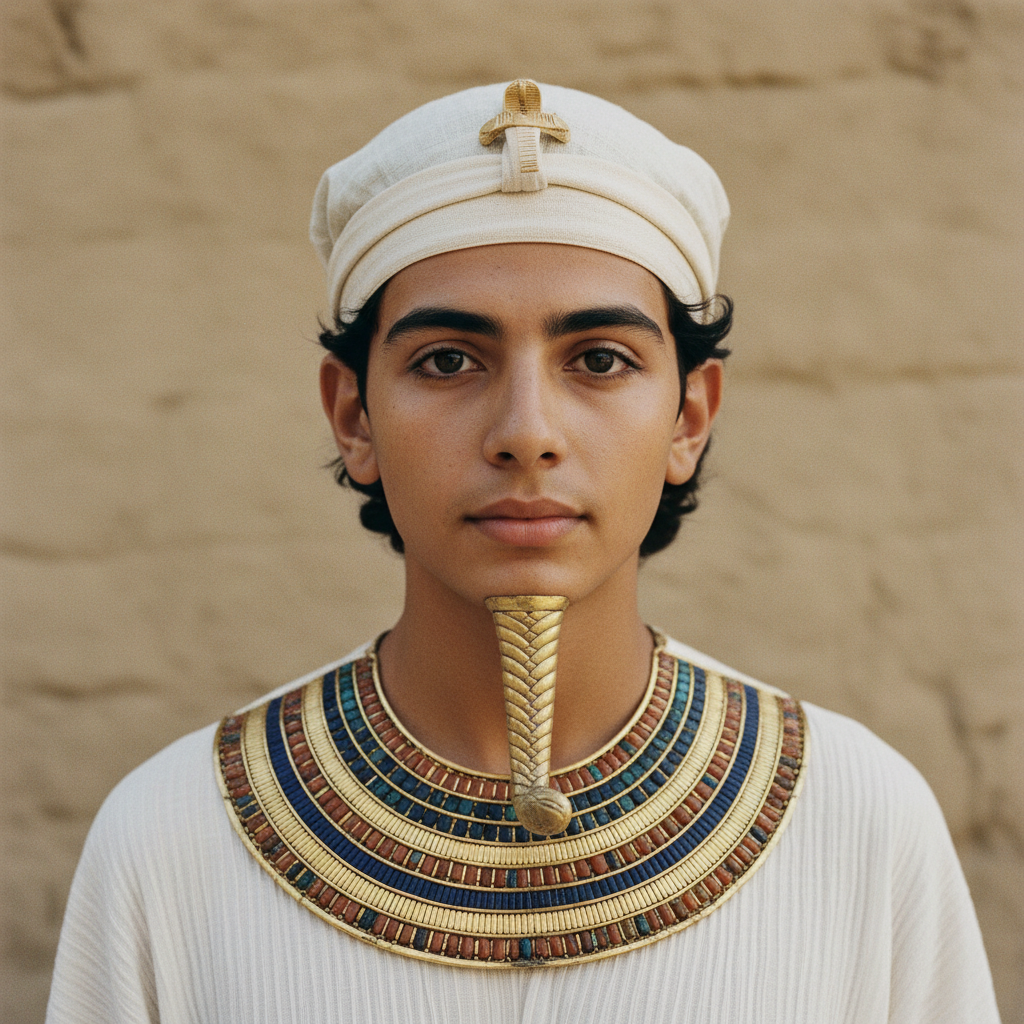
He would have appeared young and slight — a teenager with a narrow, gently rounded face, proportionate features, and a smooth complexion. Contemporary reconstructions place his height at about 1.67 m and his age in the late teens, giving him the lithe, almost boyish presence seen in many tomb portraits. His facial features were likely Mediterranean-Nile Valley in character: almond-shaped eyes often emphasized with dark cosmetic lines, a straight to gently rounded nose, and medium-width lips. Hair was probably dark brown to black; in life he most often would have worn a wig or coiffure in public and ritual contexts, so his natural hair was usually hidden. He was probably clean-shaven in daily life, with the false ceremonial beard reserved for royal iconography. Clothing and accessories completed the look: finely pleated linen kilts, broad collars of gold and faience, and the striped nemes wig or khepresh crown in formal depictions. In informal or domestic scenes he would appear in simple, well-made linen garments that emphasized his slender build while royal regalia added richness and color in official imagery.
Height / build
Likely ~1.67 m (about 5'6") · Likely slender / lithe
Hair
Likely dark (black to very dark brown) · Likely straight to lightly wavy · Likely typical/normal hairline for a young man
Eyes
Likely dark (brown)
Complexion
Likely Mediterranean / olive to dusky
Face
Likely oval to narrow, youthful · Likely straight to medium‑prominent
Notable features
Youthful, symmetrical face; large almond eyes as emphasized in art; often shown wearing nemes headcloth and the royal false beard.
Grooming
Probably clean‑shaven (ceremonially depicted with a false gold beard) · Likely used wigs, shaved or closely cropped hair, kohl eyeliner, and ornate jewelry — the royal aesthetic emphasized neat grooming.
Dress / presentation
Royal linen garments (shendyt kilt, wide collars), wigs or nemes, gold jewelry and regalia; funerary mask shows idealized royal make-up and ornament.
height build
Height
Likely ~1.67 m (about 5'6")
CT scans and measurements of the mummy produce an estimated adult height consistent with this value.
height build
Build
Likely slender / lithe
Royal statuary and the mummy indicate a slim, non‑heavily muscled body typical of an adolescent courtier.
face
Face shape
Likely oval to narrow, youthful
Reliefs and funerary portraits emphasize a narrow, smooth, youthful face; reconstructions from CT scans show similar proportions.
other
Nose shape
Likely straight to medium‑prominent
Statues and facial reconstructions indicate a straight nasal profile rather than a markedly hooked or flattened nose.
eyes
Eye color / appearance
Likely dark (brown); eyes emphasized with kohl
Typical Nile‑Valley pigmentation plus pervasive use of kohl in royal imagery gives the impression of large, dark almond eyes.
hair
Hair color
Likely dark (black to very dark brown)
Pharaohs were portrayed as eternally youthful and divinely perfect. Sculptors and mask‑makers smoothed features, emphasized symmetry, and used cosmetics to project vigor and sacred authority. Tutankhamun’s mask and statuary fit that visual program more than they act as literal portraiture.
Tutankhamun belonged to an Egyptian royal line of the Nile Valley with connections across the Eastern Mediterranean. His likely dark hair, brown eyes, and medium/dusky skin reflect the typical appearance of elite New Kingdom Egyptians rather than later Europeanized portraits.
Modern images often treat the gold funerary mask as a literal likeness or over‑Europeanize his features; the mask is an idealized, symbolic portrait and later portrayals sometimes exaggerate features not supported by the mummy or statues.
The famous gold funerary mask is a stylized, idealized object full of symbolic cues (deities, inlayed materials, and cosmetic exaggeration). It announces royalty and divinity as much as it shows a face—modern readers should treat it like a state portrait rather than a snapshot.
No—he was probably average for his time, around 1.67 m (about 5'6").
Likely dark brown; ancient depictions highlight large almond eyes with kohl.
Likely dark (black to very dark brown), straight to lightly wavy, often worn as a wig or under a nemes headcloth.
He was probably clean‑shaven in life, but is depicted wearing a ceremonial false beard as pharaoh.
Probably yes—he would have matched Egyptian royal ideals of youthful, symmetrical beauty and neat grooming.
Not exactly—the mask is an idealized, symbolic portrait; CT‑based reconstructions from the mummy give a more naturalistic face that shares broad features but is less stylized.
Tutankhamun’s gold funerary mask
Tutankhamun tomb treasure (Golden Mask) · c. 1323 BCE (funerary object)
A gilded, inlaid, idealized portrait used as a funerary and symbolic image; shows stylized youthful face, almond eyes, inlaid cosmetic detail, and ceremonial beard.
CT scans and forensic analysis of Tutankhamun’s mummy
Egyptian Mummy Project / CT studies (Hawass and colleagues) · 2005–2010 (radiological and forensic publications)
CT imaging provided age-at-death estimates (~17–19), measurements used to estimate height (~1.67 m), skull shape, and allowed craniofacial reconstructions used to produce realistic facial approximations.
Facial reconstructions based on CT data
Egyptian Mummy Project facial reconstructions (Z. Hawass et al.) · 2005–2006
Reconstructed faces translate skeletal data into likely soft‑tissue features, showing a young man with Mediterranean features and dark hair—closer to a naturalistic face than the gold mask.
Tomb statues and wooden/stone portraits from Tutankhamun’s tomb
Tutankhamun tomb assemblage (KV62) · c. 1323 BCE (objects found 1922)
A range of small-scale statues and reliefs depict the king in formal poses—these show proportions, styling, and the royal ideal (youth, slenderness, specific garments and wigs).
Painted reliefs and Amarna‑influenced portraits
Contemporary 18th‑Dynasty art (Amarna and post‑Amarna styles) · c. 1350–1320 BCE
Contemporary art shows stylized features of royal family members (elongated eyes, cosmetic emphasis), providing cultural context for how Tutankhamun would be depicted.
Archaeological records and Howard Carter’s documentation
Howard Carter archive and excavation records · 1922–1930s
Ancient Egyptian populations and surviving hair samples generally indicate dark hair; tomb art and wigs show black hair.
hair
Hair style / texture
Likely straight to lightly wavy; often worn as a wig or under a nemes
Royal depictions commonly show straight wigs or the striped nemes; natural hair in the region is typically straight to wavy.
grooming
Facial hair
Probably clean‑shaven (with ceremonial false beard when shown as pharaoh)
Egyptian royal males commonly shaved; the false beard was a ceremonial device attached to the chin in images and masks.
skin
Complexion / skin tone
Likely Mediterranean / olive to dusky
Region, population context, and painted portraits of contemporaries indicate a medium/dusky skin tone typical of the Nile Valley elite.
clothing
Typical dress
Royal linen garments, wide collars, wigs/nemes, and gold jewelry
Tomb finds and reliefs show pharaohs in linen kilts (shendyt), broad collars, nemes headdress, and regalia; Tutankhamun’s tomb yielded many such objects.
cultural
Presentation
Neatly groomed, heavily made‑up eyes, and idealized youthfulness
Royal protocol and surviving art emphasize cosmetics (kohl), wigs, and an idealized youthful appearance for kings.
Photographs and records of the tomb contents and the exposed mummy established the primary visual and material evidence that drives later reconstructions and interpretations.
Genetic and kinship studies of 18th‑Dynasty mummies
Hawass et al. genetic study (2010) and subsequent analyses · 2010
Population and familial DNA work provides regional ancestry context and familial relationships among royal mummies, supporting a Nile‑Valley/Eastern Mediterranean population background.