height build
Height
Likely shorter than modern averages (≈150–155 cm)
Stature estimates for first‑century Levantine women are around 150–155 cm; rural diet and life conditions support a shorter female average.
Portrait reconstruction
0–0 · Galilee, Roman Judea (modern Israel/Palestine) · 1st century CE
Likely a young Galilean Jewish woman with olive‑toned skin, dark hair and brown eyes, dressed modestly with a head covering.
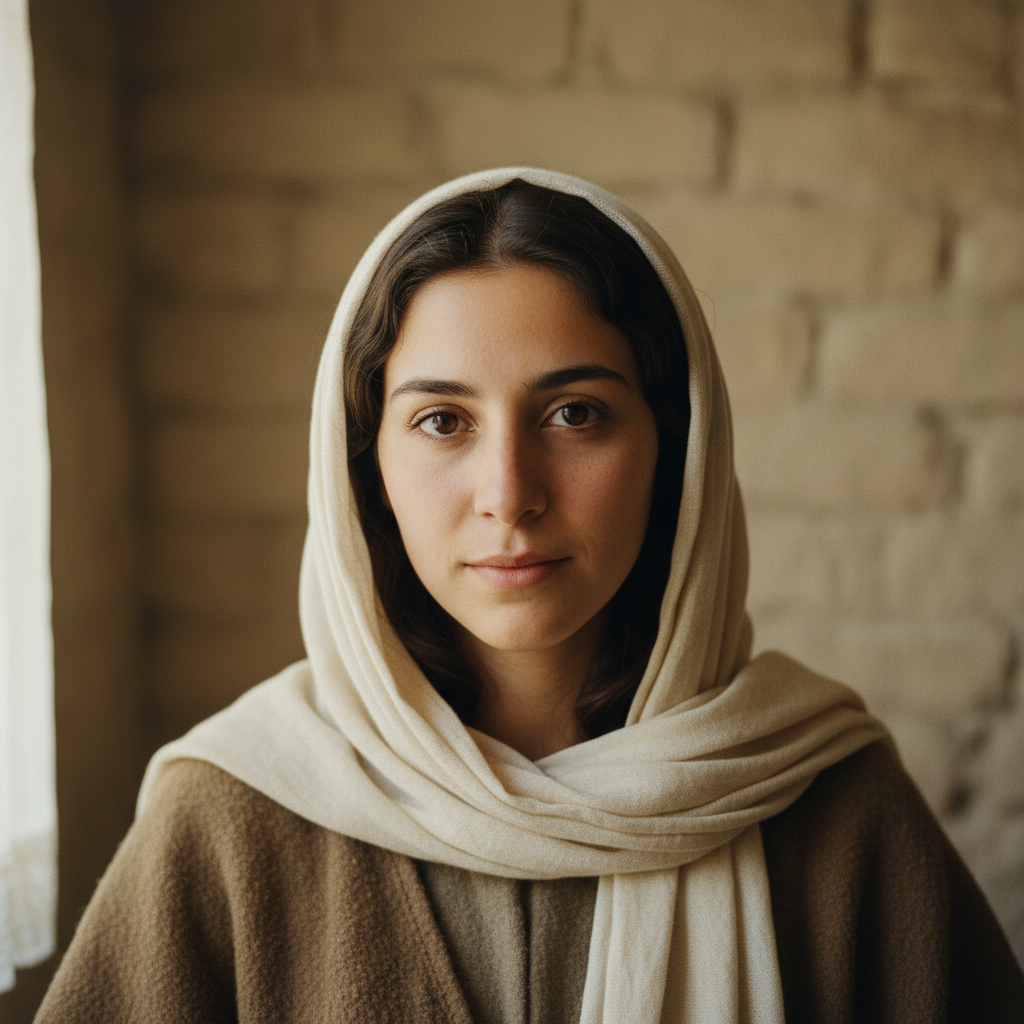
She would have appeared youthful — probably in her teens or early twenties — with an olive to light‑brown complexion typical of the Levant. Her face would have been Mediterranean in character: dark brown eyes, straight to gently aquiline nose, and full brows framing a calm, unadorned expression. Her hair was most likely dark brown or black, worn long but arranged simply — braided or coiled and kept under a veil when in public. Clothing would be plain and functional: a linen or wool tunic (kethoneth) under a modest outer mantle or shawl (himatión‑style), usually in muted natural dyes, and simple leather sandals. Her build would reflect daily household and field work: compact and sturdy rather than fragile — shorter than many modern expectations (roughly within short adult female ranges for the region), hands callused from chores, posture practical and upright. Jewelry, if any, would be modest — small earrings or a simple ring — not the ornate crowns seen in later art.
Height / build
Likely shorter than modern averages (≈150–155 cm / 4'11"–5'1") · Likely lean to slender
Hair
Likely dark brown to black · Likely wavy to curly · Likely typical female hairline (no strong recession)
Eyes
Likely dark brown
Complexion
Likely olive / Mediterranean complexion
Face
Likely oval to slightly rounded · Likely straight to gently aquiline (typical regional variation)
Notable features
Dark eyes and hair, youthful face, modest head covering, plain garments; an unadorned, pious presence.
Grooming
None · Wore hair neatly arranged and covered in public in keeping with Jewish modesty norms; likely simple braids or pinned styles under a headscarf.
Dress / presentation
First‑century Galilean Jewish woman's tunic and mantle with a head covering; practical wool or linen garments (later iconographic blue cloak is symbolic, not literal).
height build
Height
Likely shorter than modern averages (≈150–155 cm)
Stature estimates for first‑century Levantine women are around 150–155 cm; rural diet and life conditions support a shorter female average.
height build
Build
Likely lean to slender
Daily household and agricultural tasks, combined with frequent childbearing, produced a lithe, physically capable body rather than heavy musculature.
hair
Hair color
Likely dark brown to black
Population genetics and regional pigmentation patterns in the Levant favor dark hair among first‑century Jewish women.
hair
Hair texture and style
Likely wavy to curly; worn braided or pinned and covered
Mediterranean hair textures are often wavy/curly; Jewish modesty norms and art tradition show women’s hair arranged and covered in public.
eyes
Eye color
Likely dark brown
Dark brown eyes are predominant in Near Eastern populations; no textual evidence indicates otherwise.
skin
Complexion / skin tone
In first‑century Jewish Galilee, visible modesty, covered hair, and restrained adornment signaled a woman's virtue and marital status. Youthfulness and a healthy, working body mattered more than jewelry or fashion; piety and reputation were the primary 'attractive' qualities.
Mary would have resembled other Aramaic‑speaking Galilean women: dark eyes, dark hair, olive skin, and a lithe working body. Genetic and archaeological evidence show a mix of Mediterranean and ancient Levantine ancestry across the region, producing features distinct from northern Europeans.
Modern art often depicts Mary as pale, blue‑cloaked, and European; historically she was a dark‑haired, olive‑skinned Near Eastern woman who dressed plainly and covered her hair.
Art and film often portray Mary as pale‑skinned and blue‑cloaked, with delicate northern European features. Historically she was likely darker in complexion, wore utilitarian clothing, and used a simple head covering; the symbolic blue cloak and fair skin are later cultural additions.
No — likely shorter than modern averages (around 150–155 cm / 4'11"–5'1").
Likely dark brown.
Likely dark brown to black, probably wavy to curly.
Texts emphasize her youth, purity, and piety; she was likely seen as modestly attractive within her community rather than flamboyantly beautiful.
Simple layered tunics of linen or wool with a mantle and a head covering in public; later blue cloaks are symbolic additions.
By combining textual context (age, social role) with archaeological, osteological, and cultural data about first‑century Galilee rather than direct portraits.
Gospel of Luke (Annunciation narrative)
Luke 1:26–56 (New Testament) · Late 1st century CE (text tradition)
Provides chronological and social context (young woman of Nazareth, betrothed to Joseph) but gives no direct physical description; supports youthful age and marital status assumptions.
Protoevangelium of James
Protoevangelium of James (apocryphal gospel) · 2nd century CE (text)
Early non‑canonical tradition that amplifies Mary's life and sanctity; influenced later iconography and popular ideas about her youth and purity though not a contemporary eyewitness account.
Byzantine icons and mosaics
Byzantine Christian art (4th–14th centuries) · 4th–14th c. CE
Earliest visual traditions present Mary with a veil and stylized facial features; these images are theological and symbolic rather than documentary but show long‑standing conventions (head covering, modest posture).
Archaeological and osteological data for Roman‑period Palestine
Osteoarchaeology surveys and regional anthropological studies · 20th–21st century research
Skeletal analyses provide average stature ranges and general health indicators for first‑century Levantine women, supporting short stature and a working lifestyle.
Jewish customs and dress descriptions
Second Temple period sources and later rabbinic summaries · 1st century BCE–2nd century CE (contextual sources)
Describe norms for female dress, hair covering, and public modesty that explain why Mary would usually appear with her hair covered and wearing simple layered garments.
Renaissance portrayals
European Renaissance art (15th–16th centuries) · 15th–16th c. CE
Popularized the pale, blue‑cloaked, northern European Mary image that dominates modern imagination but reflects local aesthetics more than first‑century reality.
Likely olive / Mediterranean complexion
Levantine ancestry and regular outdoor activity imply a warm olive tone common among Galilean inhabitants.
grooming
Facial hair & grooming
No facial hair; neat, modest grooming
Cultural norms and biology indicate women did not have facial hair; modesty norms emphasized restrained grooming and hair covering.
clothing
Everyday dress
Tunic (chemise) and mantle with head covering; plain wool/linen
First‑century Jewish women commonly wore layered tunics and mantles; head covering signalled modesty and married/engaged status.
face
Face shape & profile
Likely oval to gently rounded face with a straight or gently aquiline nose
Regional skeletal and portrait patterns point to these common facial proportions in the Levant.
cultural
Perceived attractiveness
Likely considered modestly attractive and pious
Christian texts emphasize her purity and youth rather than ornamental beauty; local standards prized modesty and piety.
comparison
Compared with later art
Dissimilar to Europeanized images—more Near Eastern in complexion and features
Medieval and Renaissance iconography adapted Mary to European ideals; first‑century reality would align with Levantine features.