height build
Height
Likely tall for his time
Contemporary and near‑contemporary reports stress an imposing physical presence and later iconography depicts him as taller than peers.
Portrait reconstruction
1431–1476 · Wallachia (modern Romania) · 15th century
Vlad the Impaler most likely looked like a dark‑haired, broad‑shouldered Wallachian prince with a prominent nose, piercing brown eyes, and the furs and brocaded robes of fifteenth‑century nobility.
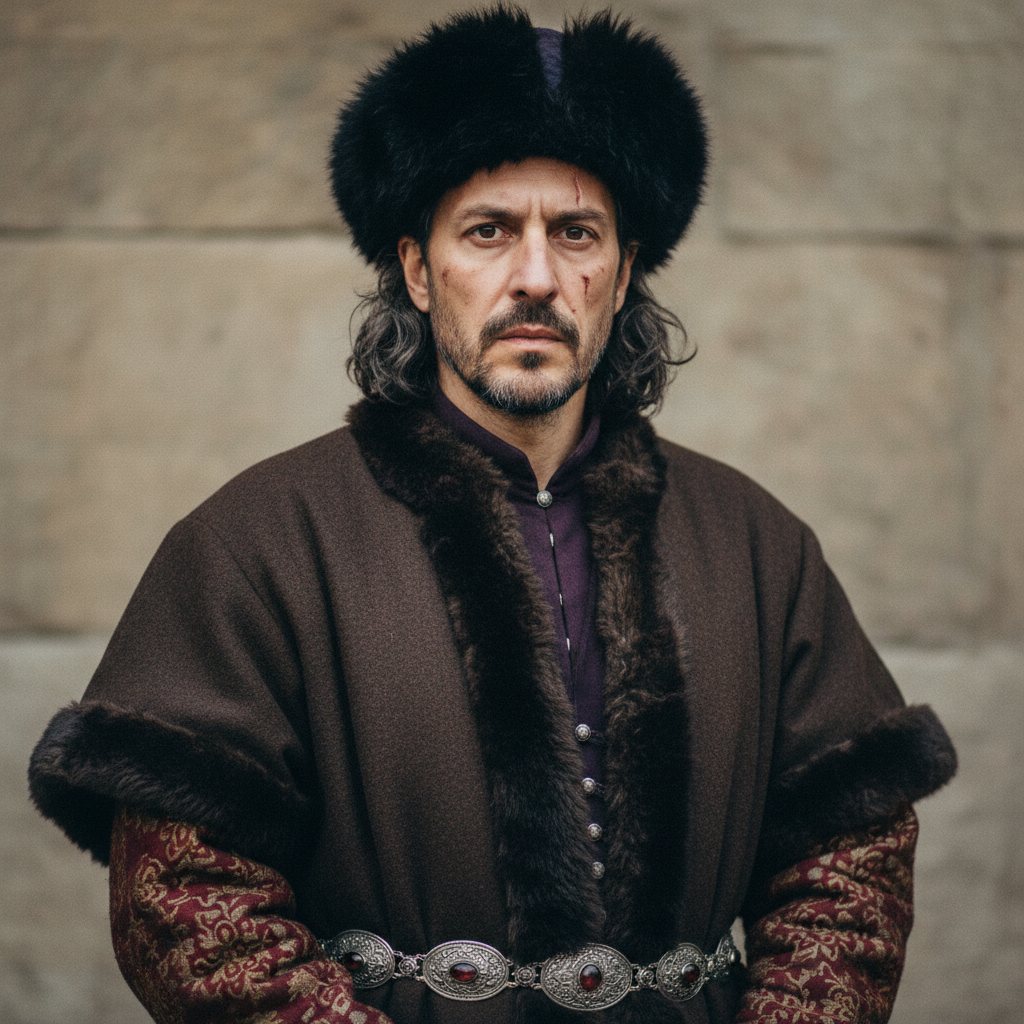
Face and hair: He most likely had dark hair—short or cropped for campaigning—and brown eyes set under a heavy brow, giving a sharp, penetrating gaze. Later portrait traditions show a conspicuous nose and a moustache with a short pointed beard; these features fit popular images and are consistent with Balkan noble grooming, so he was probably pictured with facial hair in later depictions. Build and dress: Imagine a solid, muscular frame—broad shoulders, a sturdy torso built for riding and fighting rather than courtly slenderness. His everyday princely dress would have included richly embroidered kaftans or coats, heavy fur linings, a tall fur or felt hat, a decorated belt and a sabre at his side; in battle he would appear in mail or early plate elements combined with leather and lamellar pieces typical of the region. Scars and bearing: Contemporary accounts stress an imposing, battle‑scarred presence—weathered skin, likely a few facial or hand scars from warfare, and a severe, controlled expression. Overall he projected ruthless discipline and authority: upright posture, steady stare, and an austere dignity that made him look both aristocratic and dangerously practiced in violence.
Height / build
Likely tall for his time · Likely lean and muscular
Hair
Likely dark to graying · Likely wavy to straight · Likely moderately receding (high forehead)
Eyes
Likely dark
Complexion
Likely olive to fair (Mediterranean/Balkan complexion)
Face
Likely angular/long · Likely prominent, slightly hooked or aquiline
Notable features
Prominent nose, high forehead, stern expression, possible battle scars or weathered skin
Grooming
Probably a moustache with a short, trimmed beard · Groomed but stern: trimmed facial hair, practical military haircut for a noble of his rank.
Dress / presentation
Balkan/Byzantine‑influenced princely dress — fur‑trimmed caftans, embroidered robes, jeweled belts; armor when campaigning
height build
Height
Likely tall for his time
Contemporary and near‑contemporary reports stress an imposing physical presence and later iconography depicts him as taller than peers.
height build
Build
Likely lean and muscular
A military and riding lifestyle plus accounts of battlefield activity point to a wiry, athletic frame.
eyes
Eye color
Likely dark
Dark eyes were typical in Wallachia; later painted portraits render him with dark eyes.
hair
Hair color
Likely dark to graying
Portrait tradition and regional norms point to dark hair; surviving images of older Vlad portray gray at temples or overall graying.
hair
Hair texture
Likely wavy to straight
Common hair texture among Southeastern Europeans and reflected in period portraits.
hair
Hairline
Likely moderately receding/high forehead
Multiple later portraits show a high forehead and thinning hairline typical of a man in middle age.
In 15th‑century Wallachia, masculine authority meant martial readiness and visible status. Princes displayed power with fur‑trimmed robes, heavy belts and arms, and maintained a stern, no‑nonsense bearing rather than delicate beauty. Toughness, endurance and the signs of command (armor, horse, retinue) mattered more than youthfully handsome features.
Vlad belonged to the Drăculești dynasty in the Danubian Principalities, a population mix of Vlach (Romanian), Slavic and broader Balkan influences. This context makes dark hair and eyes, olive‑to‑fair skin, and an often angular Mediterranean/Slavic facial type the most plausible baseline for his appearance.
Modern vampire and Hollywood images exaggerate pallor, gauntness and fanged features; historical Vlad was a typically robust, dark‑featured Balkan noble, not a supernatural gaunt figure.
Modern vampire imagery turns Vlad into a corpse‑pale, fanged monster or anachronistic aristocratic dandy. Historically he was a living, breathing Balkan warrior‑prince: weathered, dark‑featured, and physically robust. The theatrical gauntness and supernatural pallor are 19th–20th century literary inventions, not historical reality.
Probably taller than the average 15th‑century man—accounts emphasize an imposing, commanding stature.
Likely dark; dark brown eyes fit regional patterns and later portraits.
Likely dark, often pictured with greying in later life.
Probably a moustache with a short, trimmed beard—common for Balkan nobles and shown in later portraits.
A severe, authoritative bearing, rich fur‑trimmed princely dress or armor, and a stern, angular face with a prominent nose.
They combine near‑contemporary textual descriptions, later portrait tradition, and regional demographic and costume evidence to form the most likely image.
Hungarian diplomatic correspondence and reports
Kingdom of Hungary chancery (15th century reports) · 15th century (c. 1460s)
Diplomatic letters and reports to and from Hungarian authorities describe Vlad's actions and project an image of a physically imposing military ruler; they help justify descriptions of his stature and public bearing.
Ottoman and Balkan chronicles
Ottoman and regional chronicles (15th century) · 15th century
These texts emphasize Vlad's cruelty and political role; while not focused on precise physical detail, they support the image of a hardened, battle‑scarred leader.
16th–17th century portraits and engravings labelled ‘Vlad Ţepeş’
Various Central European portrait traditions · 16th–17th century
Post‑contemporary portraits consistently show a dark‑haired man with a moustache, short beard and a prominent nose, wearing Balkan/Oriental‑influenced princely garments—these inform popular imagery though they are produced after Vlad's life.
Early book illustration used in Romanian and Central European histories
Printed portraits in 16th–18th century histories · 16th–18th century
Widely reproduced images establish the familiar visual trope (moustache, pointed beard, fur hat) that later generations accept as Vlad's face.
Material culture of Wallachian elites
Archaeological and textile studies of 15th‑century Balkan dress · Modern scholarship
Studies of clothing and regalia provide a secure basis for describing the fabrics, furs and jewelry of princely dress Vlad would have worn.
Regional population studies (Southeastern Europe)
Modern demographic and anthropological syntheses · Modern
Provide context for likely hair, eye and skin tones typical of 15th‑century Wallachians and neighboring populations.
grooming
Facial hair
Probably moustache with trimmed beard
Eastern European princely fashion and surviving iconography commonly show masculine moustaches and short beards.
skin
Complexion
Likely olive to fair (Mediterranean/Balkan)
Demographic synthesis of Wallachian population plus outdoor military life suggests an olive to weathered fair skin tone.
face
Notable facial features
Prominent nose and stern, angular features
Later depictions and literary descriptions emphasize a sharp, severe face and commanding expression.
clothing
Clothing style
Balkan/Byzantine‑influenced princely dress (fur‑trimmed caftans, embroidered robes, jeweled belts) or armor in battle
Wallachian elites blended local, Byzantine and Ottoman fashions; princely regalia included furs, embroidery and jewelry.
other
Public bearing
Severe and commanding, not ornate vanity
Accounts stress ruthlessness and authority; his public image emphasized control and force over refined softness.
Modern statues and commemorative portraits
20th‑21st century Romanian monuments · 20th–21st century
Recent sculptural portraits reflect modern national memory and borrow from the later portrait tradition rather than direct contemporary likenesses.