height build
Height
Likely average height
No direct measurement survives; social and population data place him near the contemporary English male mean (mid-5' to 5'8").
Portrait reconstruction
1564–1616 · Stratford-upon-Avon and London, England · Elizabethan / Jacobean England
William Shakespeare most likely looked like a dark‑haired, high‑foreheaded English gentleman with a receding hairline, a moustache and a small pointed beard.
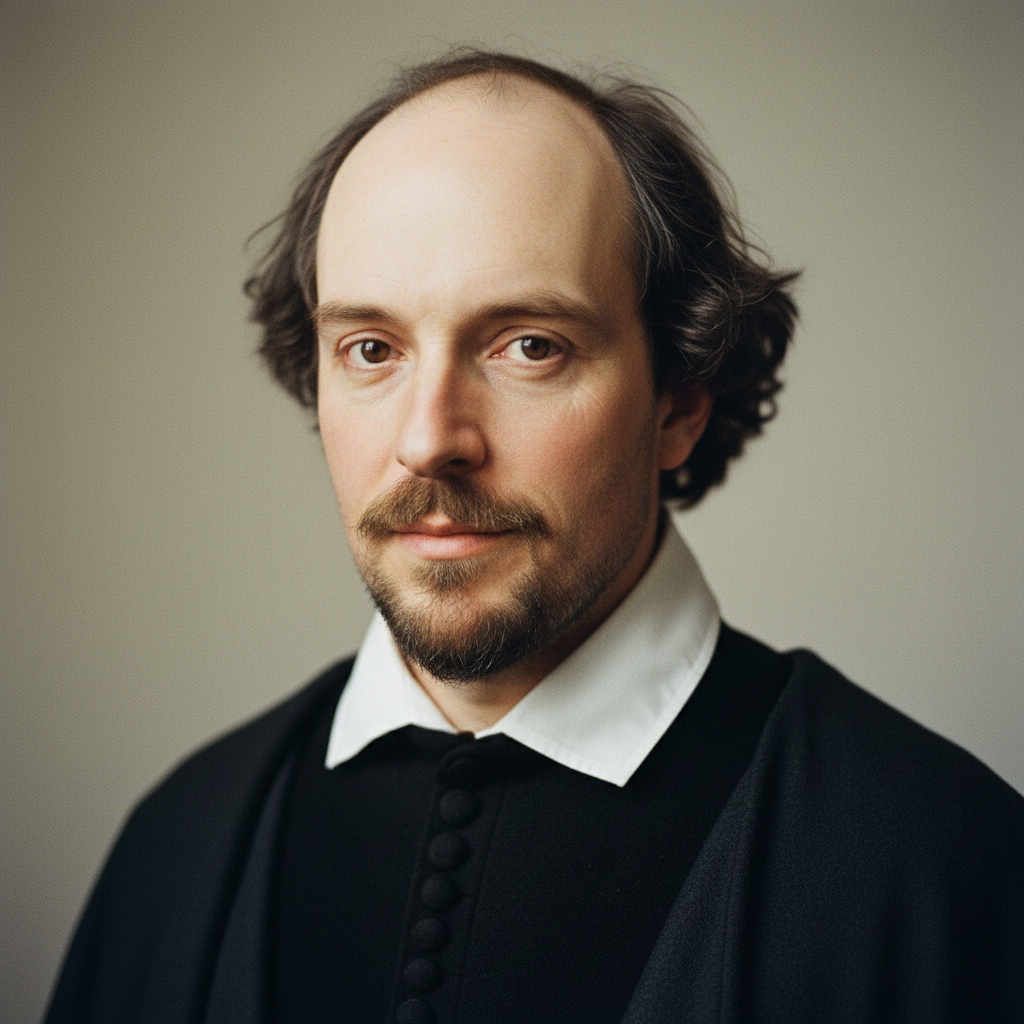
Face and hair: He is best imagined with a long, narrow face and a high forehead—signs of a receding hairline at the temples—paired with dark hair, probably brown to dark brown. Portraits and memorial images give the impression of a mature, measured countenance rather than a florid or cherubic look. Facial hair and features: A modest moustache and a neatly pointed beard define his lower face, framing a prominent, slightly aquiline nose. His expression in surviving likenesses reads composed and intellectual—someone used to public presence and conversation rather than rough outdoor labor. Dress and bearing: He would have worn the clothes of a gentleman and working professional of his time—doublet, perhaps a modest ruff, and a cloak or coat—presenting a respectable, urbane appearance suited to both Stratford and London circles.
Height / build
Likely average height · Likely slender to medium build
Hair
Likely dark to graying · Likely wavy to straight · Likely receding / high forehead
Eyes
Likely dark (brown)
Complexion
Likely fair to ruddy
Face
Likely long/oval face · Likely prominent / slightly aquiline
Notable features
High forehead, receding hairline, prominent nose, long face, composed intelligent expression
Grooming
Probably moustache with small pointed beard (goatee) · Neatly trimmed facial hair and short styled hair, consistent with Elizabethan gentlemanly fashion.
Dress / presentation
Elizabethan gentleman: doublet, starched ruff or falling collar, cloak/gown—sober, well‑made, status-appropriate
height build
Height
Likely average height
No direct measurement survives; social and population data place him near the contemporary English male mean (mid-5' to 5'8").
height build
Build
Likely slender to medium build
Actors and theatre managers typically led active lives; portraits show a long, not heavy, face and no signs of corpulence.
hair
Hair color
Likely dark to graying
Chandos and other portraits show dark hair in younger depictions and gray in later images; signatures and contemporaries imply he lived to older middle age.
hair
Hairline
Likely receding / high forehead
Multiple contemporary and near-contemporary likenesses (Droeshout, Chandos, Stratford bust) show a high forehead and thinning hair at the temples.
hair
Hair texture
Likely wavy to straight
Portraits render hair as short, slightly waved or straight rather than tightly curled.
eyes
Eye color
Likely dark (brown)
In Shakespeare’s England, appearance signaled education and status: a well-cut doublet, a neatly starched ruff or falling collar, and tidy facial hair were markers of respectability. Learned men favored sober colors and controlled grooming over ostentatious display—the look of an intellectual who was also a gentleman.
Shakespeare came from a provincial Midlands family and spent his career in London; his features—fairer skin, dark hair, brown eyes—fit the typical late Tudor English phenotype. His middle-class status and theatrical career would place him among well-dressed professionals rather than aristocratic extravagance.
Modern images often romanticize or standardize Shakespeare’s look (flowing hair, theatrical flamboyance); surviving images show a more restrained, gentlemanly appearance with receding hair and modest dress.
Popular depictions often show Shakespeare with flowing long hair and an almost romantic, Bardic look. Surviving portraits and the funerary monument present a far more restrained image: shorter hair, a receding hairline, and conservative gentleman’s clothing—less romantic than iconic.
Likely of average height for his time (roughly mid-5' to 5'8").
Likely dark (brown).
Likely dark hair that grayed with age, worn short and slightly waved with a receding hairline.
Yes — probably a moustache and a small pointed beard (goatee), the standard gentlemanly style of the day.
He was likely seen as respectable and intellectually striking rather than conventionally beautiful—commanding presence over flashy handsomeness.
By comparing contemporary portraits (like Droeshout and the Chandos), the Stratford monument, and period clothing and population context.
Droeshout engraving (First Folio plate)
Martin Droeshout / First Folio · 1623
Line engraving published in the First Folio; contemporaries stated it was an approved likeness and it shows a long face, receding hairline, moustache and pointed beard, prominent nose, and gentlemanly attire.
Chandos portrait
National Portrait Gallery (Chandos) · early 17th century (c.1600–1610)
Oil portrait traditionally connected to Shakespeare showing dark hair, moustache, pointed beard, long face and high forehead; considered one of the most familiar likenesses though provenance is debated.
Stratford-upon-Avon funerary monument (Holy Trinity Church)
Stratford monument · erected shortly after death (early 17th century)
Stone monument and bust in Shakespeare’s parish church showing a bearded, high‑foreheaded man; long accepted as a memorial likeness placed by family/community.
Cobbe portrait (attributed claim)
Cobbe Collection / National Trust (debated) · claimed early 17th century (contested)
A portrait once proposed as a likeness of Shakespeare; some features align with other images but attribution remains highly debated.
Flower portrait (disputed)
Flower portrait (later attribution claims) · later 17th/19th-century overpainting; attribution disputed
Painted portrait once claimed to be Shakespeare; later analysis suggests overpainting and doubtful provenance, making it unreliable as evidence.
Ben Jonson’s First Folio eulogy
Ben Jonson, 'To the Memory of my Beloved the Author, Mr. William Shakespeare' (First Folio) · 1623
Poetic tribute praising Shakespeare’s genius and presence; while not a physical description, it contextualizes his public image as a commanding, unique figure.
Contemporary English men of his region more commonly had brown/dark eyes; portraits do not show light eyes and textual hints favor dark tones.
grooming
Facial hair
Probably moustache with small pointed beard (goatee)
Both the Droeshout plate and the Chandos portrait display a moustache and pointed beard typical of Elizabethan gentlemen.
face
Face shape & nose
Likely long/oval face with a prominent nose
Droeshout and Chandos portray a long face and pronounced nose; the funerary monument likewise emphasizes these proportions.
skin
Complexion
Likely fair to ruddy
As an Englishman of provincial origin who worked in London, he likely had a fairly pale Northern European complexion with some rosiness seen in painted likenesses.
clothing
Clothing style
Elizabethan gentleman dress (doublet, ruff/collar, cloak)
Portraits and the Droeshout engraving depict him wearing the sober professional attire of a successful playwright/actor-manager.