height build
Height
Likely tall for his time
Near-contemporary praise stresses his imposing presence and leadership; visual compositions in the Bayeux Tapestry place him as prominent among nobles.
Portrait reconstruction
1028–1087 · Duchy of Normandy; Kingdom of England · 11th century
William the Conqueror probably looked like a broad-shouldered Norman warrior with mid-length dark hair, a prominent moustache, and the practical chainmail and ducal dress of a battlefield leader.
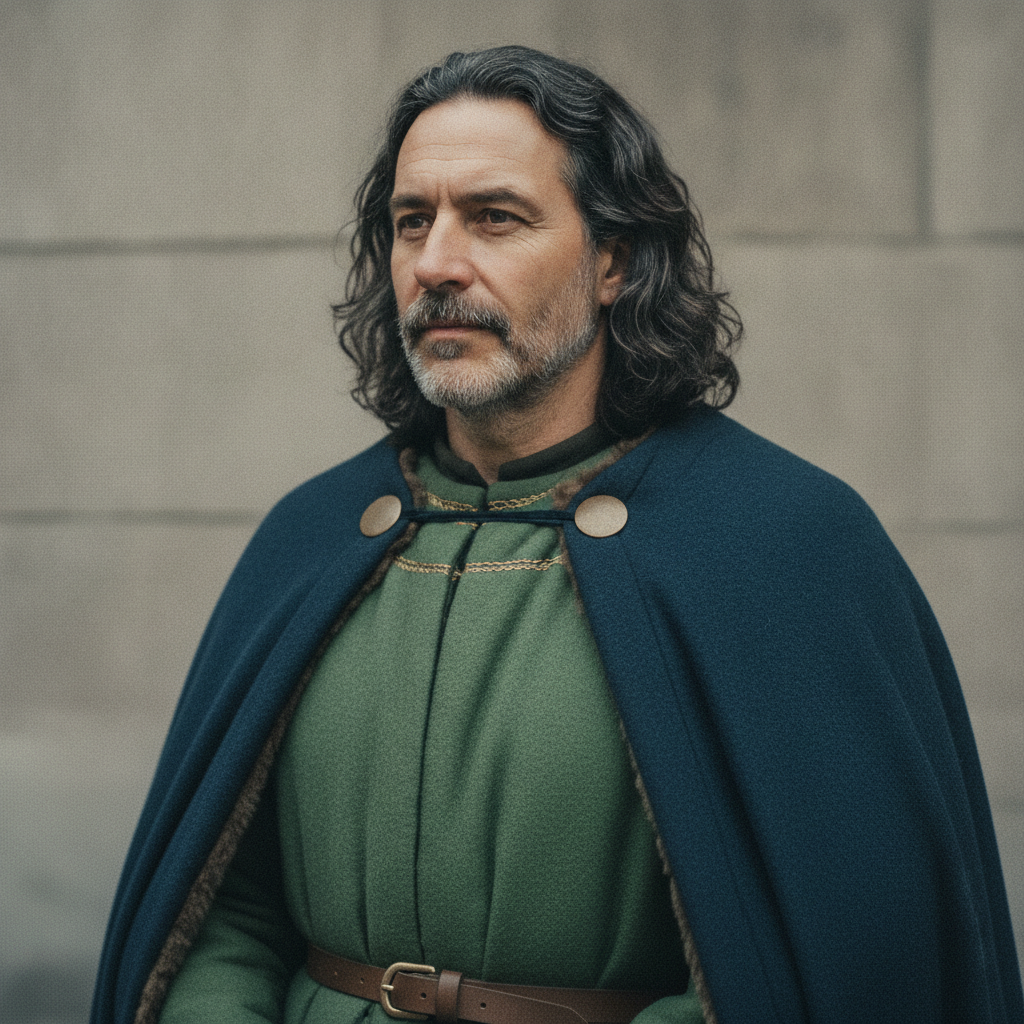
Hair and face: Contemporary images show William with mid-length hair—falling to around the ears and nape—and a clear moustache; he was likely dark-haired rather than fair-blond, with a compact, strong face marked by a firm jaw and a prominent nose. The moustache was a deliberate, visible mark of a warrior-leader; he does not appear in contemporaries as heavily bearded. Build and bearing: He likely had a solid, broad-shouldered frame—stocky and powerful from constant riding and campaigning rather than tall and lanky. Contemporary accounts emphasize his forceful presence and stamina, so imagine a compact man built for combat: broad chest, dense muscles, and the upright, purposeful posture of an experienced commander. Dress and equipment: In action he is best pictured in mail: a hauberk over a padded gambeson, a conical helmet with a nasal guard or simple head covering, a belt-mounted sword, and a kite-style shield—functional, not ostentatious. Off the field he would wear cloaks and modest ducal finery: practical garments that signal rank without the heavy ornamentation of later medieval kingship. Facial tone and grooming: Complexion was probably a Northern European hue—pale to ruddy from outdoor life—and grooming neat: hair kept to a controlled length and facial hair limited to the moustache, presenting both martial readiness and aristocratic dignity.
Height / build
Likely tall for his time · Likely broad/stocky, muscular
Hair
Likely dark to graying · Likely wavy · Likely receding/thinning with age
Eyes
Likely dark
Complexion
Likely fair to Mediterranean-olive for a northwestern European of Norman descent
Face
Likely broad/oval face · Likely prominent / aquiline nose
Notable features
Commanding bearing, prominent nose/jaw, moustache, likely stocky neck and shoulders
Grooming
Probably moustache, possibly short beard or trimmed facial hair · Military grooming: short to mid-length hair and a trimmed moustache; in court he would wear hair and beard neater and clothes richly ornamented.
Dress / presentation
On campaign: hauberk, conical helmet, surcoat; at court: embroidered tunics, fur-lined cloaks, jeweled belts
height build
Height
Likely tall for his time
Near-contemporary praise stresses his imposing presence and leadership; visual compositions in the Bayeux Tapestry place him as prominent among nobles.
height build
Build
Likely broad/stocky and muscular
Active military life and horseback command imply a robust, well-muscled frame common among fighting nobility.
hair
Hair color
Likely dark to graying
Norman elite typically depicted with dark hair; late-life graying is consistent with portraits and chronicler references to an older ruler.
hair
Hair texture and style
Likely wavy; short to mid-length
Tapestry figures and Norman grooming show mid-length wavy hair kept practical for battle and neater at court.
grooming
Facial hair
Probably moustache, possibly trimmed beard
Norman men of rank are typically shown with moustaches on contemporary art; chroniclers and later images echo this.
face
Facial features
Norman aristocratic culture prized military prowess and visible signs of rank. A duke projected authority through a strong, battle-ready body, trimmed hair and moustache, and richly decorated court garments when not in armour. Authority was expressed in posture, ornaments (belts, brooches), and layered clothing rather than delicate beauty.
William belonged to a Norman ruling class formed by Scandinavian settlers, intermarriage with local Frankish elites, and regional populations; imagine northwest European features — generally dark hair and eyes but with some Scandinavian influence visible in stature and robust bone structure.
Fiction often makes him either a hulking brute or a suave modern aristocrat; the historical image is more of a compact, battle-hardened noble with refined court taste.
Film and popular art flip between caricatures: a roaring hair‑tousled giant or a slick modern gentleman. In reality, William was neither Hollywood-hulking nor fashion-model handsome; he likely combined a roughly muscular, practical soldier's body with the ornate trappings of medieval court — austere in battle, ceremonially luxurious in peace.
Likely tall for his time — chroniclers and visual hierarchies portray him as an imposing, prominent figure.
Likely dark — common for northwest European populations of Norman elites.
Likely dark, probably wavy and short to mid-length; it likely grayed with age.
Probably a moustache and possibly trimmed beard; moustaches are common on Norman elite depictions.
On campaign: chain mail (hauberk), conical helmet and surcoat; at court: embroidered tunics, fur-lined cloaks and jeweled belts.
By combining the Bayeux Tapestry’s visual cues, near-contemporary chronicles describing his presence, and knowledge of Norman dress and grooming to produce a likely, visually coherent image.
Bayeux Tapestry scenes of William
Bayeux Tapestry · c. 1070s
A near‑contemporary embroidered narrative showing William in mail, with mid-length hair and a moustache, depicted as the central, commanding figure in several scenes.
Gesta Guillelmi (William of Poitiers)
William of Poitiers, Gesta Guillelmi · c. 1071–1086
A near‑contemporary Latin biography praising William's leadership, vigor and authority; provides descriptions emphasizing dignity and martial capability rather than physical minutiae.
Orderic Vitalis, Historia Ecclesiastica
Orderic Vitalis · early 12th century
A near‑contemporary chronicler whose accounts echo traditions about William's character and public bearing and occasionally comment on appearance and presence.
Tomb effigy and later representations (Caen, Abbey of Saint-Étienne)
St-Étienne Abbey effigy and later medieval imagery · 12th–13th centuries (later works and restorations)
Later funerary sculpture and effigies present an idealized royal image used in medieval memory — helpful for dress and regalia but less reliable for facial detail.
Wace, Roman de Rou
Wace · mid-12th century
A poetic account that repeats and embellishes physical and moral traits of Norman rulers and shaped later popular images of William.
Likely prominent nose and strong jaw
Stylized contemporary portrayals and verbal descriptions stress a commanding visage with a strong profile.
eyes
Eye color
Likely dark
Dark eyes were common in northwest European populations of Norman elites; no direct contemporary color record survives but chroniclers give no indication of unusual light eyes.
skin
Complexion
Likely fair to Mediterranean-olive
Normans were northwest Europeans with mixed Norse and Frankish ancestry; an olive-fair tone fits period population profiles.
clothing
Battle dress
Hauberk (mail), conical helmet, surcoat
Bayeux Tapestry and military equipment finds show Norman nobles wearing mail and helmets in mid-11th century.
clothing
Court dress
Embroidered tunics, cloaks, furs, jeweled belts
Chroniclers and later effigies indicate high-status textile use and ornament for rulers at court.
other
Public bearing
Commanding and martial
Contemporary texts emphasize leadership, dignity, and an authoritative presence as part of his persona.