height build
Height
Likely tall for his time
Epic tradition and later display objects (the oversized 'Wallace sword') and literary descriptions emphasize an imposing, above‑average stature.
Portrait reconstruction
1270–1305 · Scotland (Lowlands / Borders) · High Middle Ages / Wars of Scottish Independence
William Wallace likely looked like a dark‑haired, broad‑shouldered Lowland warrior in mail and wool, with a short beard or heavy stubble and a weathered, commanding face.
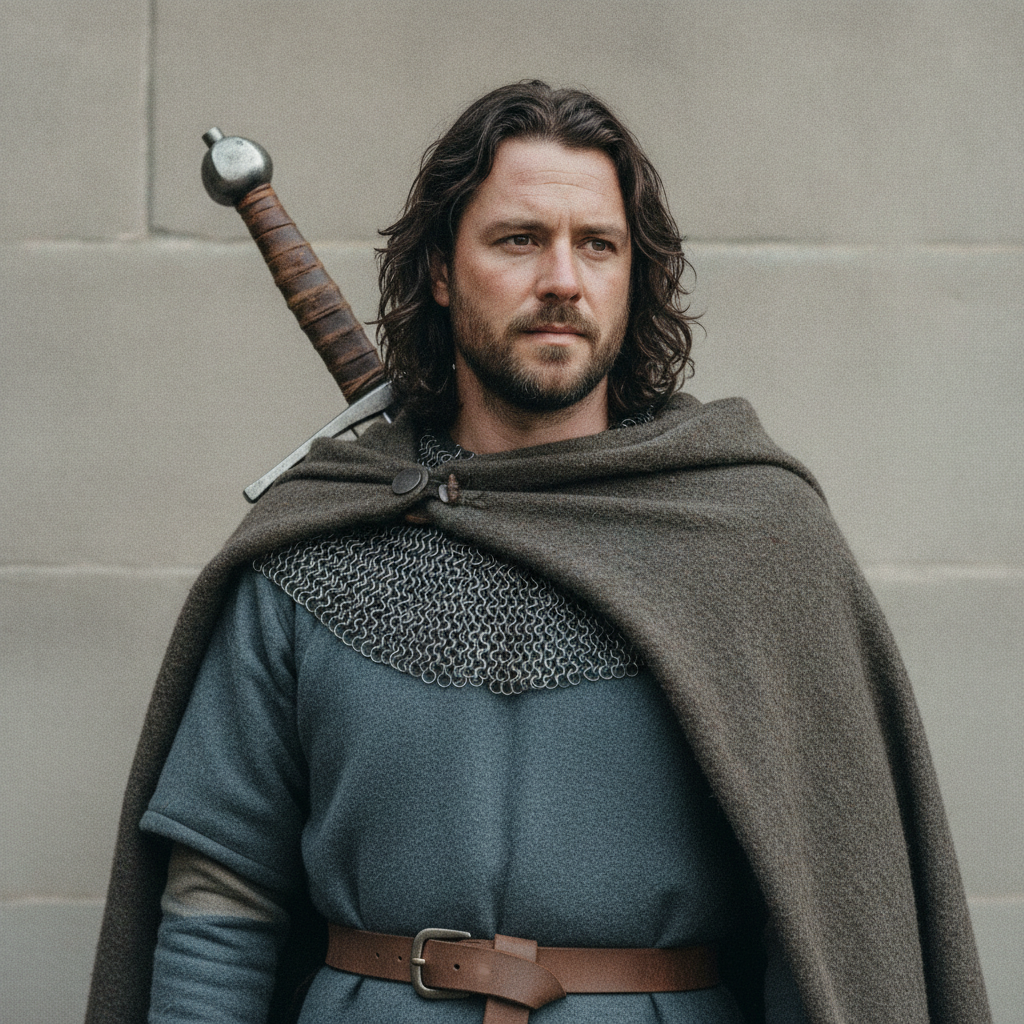
Build and bearing: He was probably taller and more heavily built than the average man of his time—broad shouldered, sturdy from riding, marching and fighting. His presence would have been imposing rather than lithe, with a working, muscular frame and weathered posture from campaigning. Hair, eyes and complexion: Likely dark hair worn to around shoulder length for practicality, often tied back or tucked under a hood; dark brown eyes; fair to ruddy skin browned by sun and wind. A strong, angular face with a wide jaw and steady gaze would have suited a frontier leader. Facial hair and marks: He probably wore a short beard or heavy stubble rather than extreme grooming — facial hair practical for the field but not ornamental. Battle scars, a few broken teeth or a nicked ear would be consistent with sustained combat and raids. Clothing and arms: Wallace would have worn a padded garment and hauberk (mail) over wool clothing, a simple surcoat or cloak, and sturdy leather boots; his everyday look was practical and functional. He likely carried an arming sword, spear or polearm and a shield—later images of an enormous two‑handed sword and romantic Highland dress reflect later symbolism more than his everyday kit.
Height / build
Likely tall for his time · Likely lean, muscular
Hair
Likely dark brown · Likely wavy · Likely full hairline (mid‑length, not receding)
Eyes
Likely dark (brown)
Complexion
Likely fair to ruddy
Face
Strong, square jaw with pronounced cheekbones · Straight to slightly aquiline
Notable features
Tall stature; large, imposing sword (tradition); weathered, battle‑toughened face
Grooming
Probably a short or trimmed beard · Practical and functional grooming—trimmed beard, mid‑length hair kept for campaigning rather than fashionably long or shaved.
Dress / presentation
Chainmail hauberk or brigandine with a surcoat, wool cloak, sturdy leather boots and belt—practical military leader’s dress rather than romantic Highland dress
height build
Height
Likely tall for his time
Epic tradition and later display objects (the oversized 'Wallace sword') and literary descriptions emphasize an imposing, above‑average stature.
height build
Build
Likely lean, muscular
Campaigning, ambush warfare and long marches would favor a wiry, athletic form common to medieval soldiers.
hair
Hair color
Likely dark brown
Dark hair was typical in the Scottish/Border population and later poetic descriptions simply imply dark hair rather than blond.
hair
Hair texture & style
Likely wavy, mid‑length and practical
Campaign practicality and northern European hair types suggest wavy, mid‑length hair kept out of the way when fighting.
eyes
Eye color
Likely dark (brown)
Brown/dark eyes were the most common trait in the medieval Scottish population.
skin
Complexion
Likely fair to ruddy
Late 13th‑century Scottish martial culture rewarded visible evidence of prowess: vigor, the bearing of arms, practical clothing for raids and pitched battles, and a weathered appearance that signaled battlefield experience. Nobility and leaders were expected to look capable rather than courtly—clean but rugged, with armor and cloaks that displayed status through quality, not ornamentation.
Wallace would have looked like a northern British man of mixed Gaelic and Border Anglo‑Norman ancestry: predominantly dark hair and eyes, fair skin prone to reddening from outdoor life, and physical traits in keeping with a population adapted to a cool, windy climate. He would not have looked Mediterranean or exotic—think rugged northern European.
Popular images (e.g., Braveheart) overplay long free hair, painted faces, tartan kilts and heroic exaggerations; historically he was more practical, wearing mail and plain wool.
Modern pop culture often supplies kilts, long flowing hair, blue woad face paint and extravagant romantic costume. These are largely 19th–20th‑century inventions. In Wallace’s time, tartan as modernly understood was not used as a national costume, woad face paint was not a battlefield norm in 13th‑century Scotland, and practical armor was standard for knights.
Likely tall for his time — tradition and the oversized sword associated with him emphasize an imposing stature.
Likely dark (brown).
Likely dark brown, wavy and mid‑length—practical for campaigning.
Probably a short or trimmed beard or stubble, consistent with knightly norms and campaign practicality.
Mail (hauberk), surcoat, sturdy wool cloak and leather boots—practical armor and clothing rather than tartan kilts or face paint.
No — Braveheart popularized kilts, woad and long flowing hair; historically Wallace would be more practically dressed and less theatrical.
The Wallace (poem)
Blind Harry (Blind Hary), The Wallace · c. 1477 (15th century)
A long heroic poem that transformed Wallace into a towering, legendary figure; provides literary descriptions that influenced later visual portrayals.
Chronicles mentioning Wallace
Andrew of Wyntoun & John of Fordun (Scottish chronicles) · 14th–15th centuries (compilations)
Later medieval Scottish chroniclers record Wallace’s deeds and occasionally note his stature and heroic presence, helping form a consistent image across centuries.
The 'Wallace Sword' (object associated with Wallace)
National Wallace Monument (display sword) · 15th century (sword dated later than Wallace)
A very large two‑handed sword long associated in tradition with Wallace; its size contributed to the image of Wallace as a tall, powerful warrior though the sword itself dates later.
Wallace Monument statue
Wallace Monument (Stirling) statue · 19th century (erected 1869 for the monument)
A Victorian era monumental sculpture that codified a specific heroic image—broad shouldered, bearded, with heavy sword—which has strongly influenced modern visualization.
Medieval military dress and arms (comparative studies)
Scholarly studies on 13th-century armour and clothing · various modern studies
Research on period armour and clothing indicates a knight of Wallace’s standing would wear mail, surcoat and wool garments rather than later romantic Highland costume.
Population context for medieval Scotland
Historical and anthropological overviews of medieval Scottish populations · modern syntheses
Provides background on common northern British traits—dark hair and eyes, fair skin—useful for estimating Wallace’s likely complexion and coloring.
Northern British complexion combined with outdoor campaigning would give a fair base tone with sun‑exposure reddening.
grooming
Facial hair
Probably short beard or stubble
Knightly and warrior norms of the late 13th century often favored facial hair; campaign realities favor short/functional grooming.
clothing
Usual clothing in campaign
Chainmail hauberk or plate elements, surcoat, wool cloak
As a knight and leader he would wear mail or protective armor with practical woolen clothing and a travel cloak during campaigns.
other
Iconic accessory
Associated with a very large two-handed sword in tradition
Later tradition and the sword displayed as 'Wallace's' emphasize a large weapon as part of his image.
face
Facial appearance
Weathered, strong‑featured (square jaw, pronounced cheekbones)
Leader and soldier image in chronicles and later portrayals emphasize a strong, commanding face; outdoor campaigning would add weathering.