height build
Height
Likely tall for his time
Achaemenid royal reliefs portray kings as taller and visually dominant compared with attendants; kingship imagery emphasizes above-average stature.
Portrait reconstruction
519 BCE–465 BCE · Persian Empire (Iran, Mesopotamia, Anatolia) · Achaemenid Persia, 5th century BCE
Xerxes I likely had dark wavy hair, a full curled beard, wore a narrow diadem, and dressed in richly patterned royal robes.
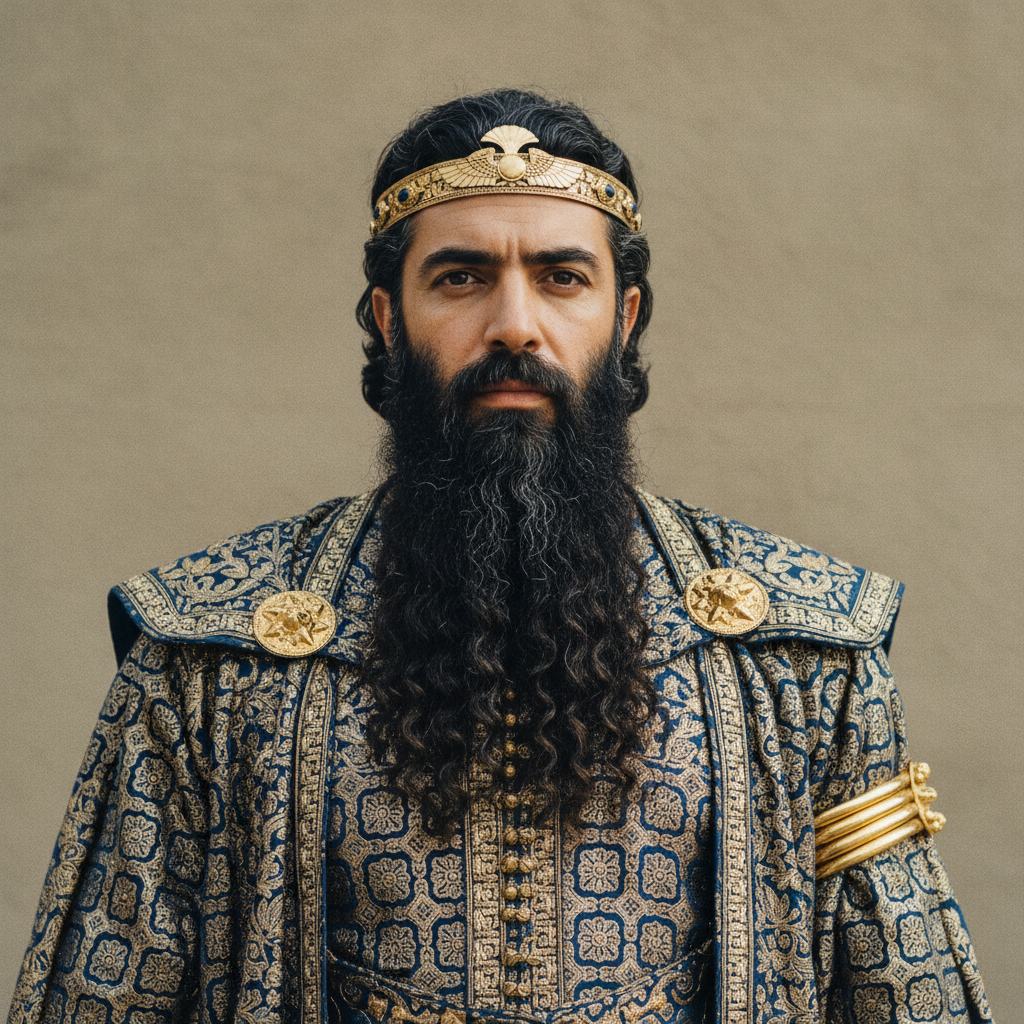
Face and hair: Xerxes would be seen with dark, wavy hair falling in stylized waves around the head and shoulders and a full, carefully shaped beard made of tight curls or ringlets—an Achaemenid royal look that frames the face and signals authority. His features are presented as strong and dignified rather than soft or boyish. Headgear and dress: He wore a narrow diadem or royal band across the forehead and frequently appears in long, ankle-length robes densely patterned with borders and geometric motifs. Cloaks, belts, and visible jewelry such as bracelets or armlets complete the ensemble, giving him a layered, richly textile appearance rather than plated armor. Overall bearing: The visual language around Xerxes emphasizes formality and command—a straight, upright pose, a composed expression, and garments that mark rank. The effect is of an imposing ceremonial figure: elegant, richly dressed, and unmistakably royal in public representation.
Height / build
Likely tall for his time · Likely solid / broad-shouldered
Hair
Likely dark to graying · Likely wavy to curly · Likely receding modestly with age
Eyes
Likely dark
Complexion
Likely medium olive / West Asian (Mediterranean) complexion
Face
Oval to rectangular with a strong jawline · Straight to slightly aquiline, prominent
Notable features
Regal diadem/crown, curled beard, embroidered royal robe, commanding posture
Grooming
Likely a full, elaborately styled and curled beard · Hair and beard were carefully arranged and often curled or patterned to signal royalty and status.
Dress / presentation
Imperial Achaemenid dress—embroidered long robe, mantle, patterned trousers, and a diadem or crown
height build
Height
Likely tall for his time
Achaemenid royal reliefs portray kings as taller and visually dominant compared with attendants; kingship imagery emphasizes above-average stature.
height build
Build
Likely solid / broad-shouldered
Royal iconography shows a robust, authoritative frame consistent with a ruler depicted in full regalia and sometimes in military contexts.
hair
Hair color
Likely dark to graying
Achaemenid images show dark hair in male portraits; as a mature king he would likely have had some graying.
hair
Hair texture
Likely wavy to curly
Sculptural and glyptic art commonly renders royal hair and beards as wavy or curled, a consistent Achaemenid stylistic trait.
grooming
Facial hair
Likely full, elaborately curled beard
Persepolis reliefs and seals repeatedly depict Achaemenid kings with full, stylized beards arranged in distinct curled rows.
face
Face shape
Achaemenid Persian kings signaled their power through elaborately arranged hair and beards, patterned robes, and a diadem or crown. The visual program prioritized a composed, ritualized masculinity—orderly hair, a carefully curled beard, and richly decorated clothing—over the simpler, athletic ideals celebrated by contemporary Greeks.
Xerxes belonged to the Achaemenid ruling elite, formed from Persian, Median, and local West‑Asian lineages. Physically he would reflect that Near Eastern elite blend—medium olive skin, dark eyes, and dark hair—distinct from northern or sub-Saharan phenotypes but part of the diverse imperial population.
Modern films and cartoons often exoticize or caricature him (e.g., wildly long hair, fantastical crowns) or reduce him to a Greek stereotype; actual Achaemenid portrayals show a stylized but consistent royal image centered on beard, diadem, and richly patterned robes.
Films and cartoons often exaggerate Persian costume (towering, fantastical crowns) or recast Xerxes as a monstrous caricature. In reality Achaemenid royal dress was elaborate but stylized and codified: patterned robes, a diadem, and a restrained crown rather than Hollywood excess.
Likely tall for his time—royal images emphasize an above-average stature to project authority.
Likely dark—brown or dark brown is most probable given regional population traits.
Likely dark, probably showing some graying by middle age.
Yes—probably a full, elaborately curled beard typical of Achaemenid kings.
Imperial Achaemenid robes—embroidered long robe, cloak, patterned trousers and a diadem or crown.
By combining contemporary reliefs and seals that show Achaemenid royal imagery with near‑contemporary textual descriptions and regional population context.
Persepolis reliefs (Apadana palace staircases)
Persepolis reliefs (Apadana, Persepolis) · c. 5th century BCE
Stone reliefs show Achaemenid kings and dignitaries in patterned robes, wearing diadems and with stylized wavy hair and curled beards—central visual evidence for royal appearance.
Tomb of Xerxes I, Naqsh-e Rustam (royal tomb reliefs)
Tomb of Xerxes I, Naqsh-e Rustam · c. 5th century BCE
The royal tomb iconography identifies the king with royal insignia and a stylized visage consistent with Persepolis representations.
Herodotus, The Histories (descriptions of Persian kings and dress)
Herodotus (Histories) · mid-5th century BCE
Herodotus discusses Persian royal dress, ceremonies, and behavior—supporting how Xerxes would have presented himself publicly (diadem, robes, formal ceremony).
Achaemenid cylinder seals and glyptic art
Achaemenid glyptic/seals · 6th–5th century BCE
Seals depict men with wavy hair and patterned beards and provide consistent motifs for elite male appearance across the empire.
Ctesias (Persica) and later Greek accounts
Ctesias (Persica) · 5th–4th century BCE (later fragments)
Later Greek writers provide anecdotes and descriptions that, while less reliable, echo the Persian royal image (beard, robes, diadem) used in Greek narratives.
Modern museum summaries and reconstructions
Museum/academic reconstructions (British Museum, Encyclopaedia Iranica summaries) · 20th–21st century
Modern archaeological syntheses and reconstructions use reliefs and texts to produce humanized portraits consistent with Achaemenid visual language.
Oval to rectangular, strong jawline
Royal portraits combine an elongated face and pronounced chin in reliefs and seals, signaling strength and authority.
face
Nose
Straight to slightly aquiline
Near Eastern royal imagery and later Greek descriptions favor a prominent straight or slightly hooked nose for Persian rulers.
eyes
Eye color
Likely dark
Population context for elite West‑Asians and the way eyes are shaded/represented in surviving imagery indicate dark eyes are most probable.
skin
Complexion
Likely medium olive / West Asian complexion
Achaemenid elites were West‑Asian in ancestry; artistic portrayal and geographic origins support a Mediterranean/olive skin tone.
clothing
Typical dress
Imperial Achaemenid robes with diadem/crown
Reliefs and textual accounts indicate kings wore long embroidered robes, mantles, and a diadem or crown as visible marks of royal authority.
grooming
Grooming style
Carefully arranged hair and beard, ornamented clothing
Achaemenid royal imagery intentionally shows elaborately groomed hair and patterned beards to display status and ritual purity.
other
Presence
Commanding, ceremonial posture
Reliefs emphasize a stoic, frontal or slightly turned stance with clear markers of rank, projecting authority in public ceremonies.